

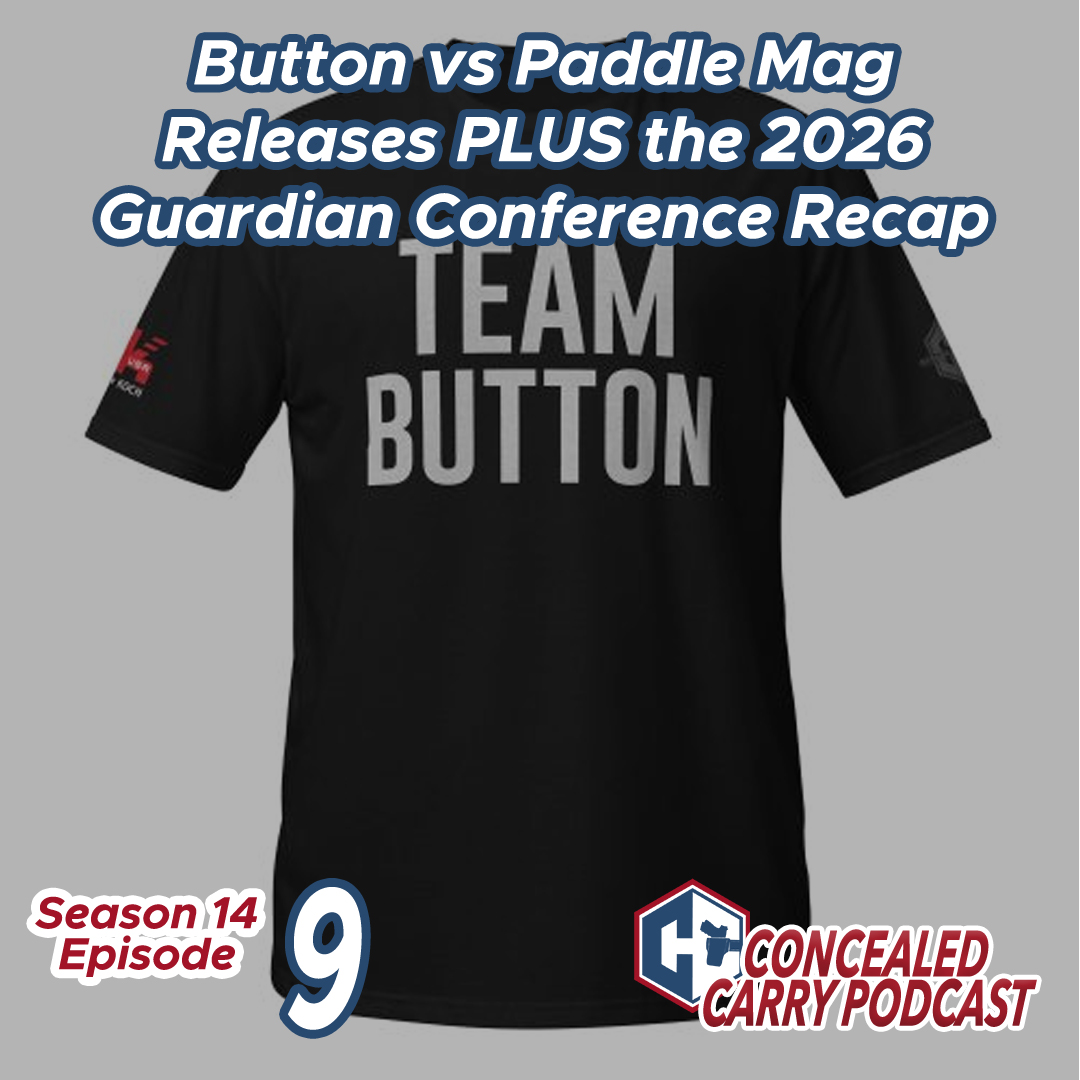
S14E9: Button vs Paddle Mag Releases PLUS the 2026 Guardian Conference Recap
About This Episode:
In this episode, Riley Bowman and Jacob Paulsen do a debriefing of the 2026 Guardian Conference. We share our top takeaways and lessons about the event, how we plan to further improve it for future years, and why we think you should attend in 2027! Also, we talk about button versus paddle mag releases in light of the release of the new HK VP9A1-B models with button mag releases. Tune in so you don't miss!
Watch this episode
Read the transcript
And welcome to the Concealed Carry Podcast, part of the ConcealedCarry.com network, brought to you by HK. Today is Thursday, October 8th, 2026. As of the live recording of this episode, I'm your host, Riley Bowman, and I'm joined today by co-host... Jacob Paulson. That guy over there. And we're glad to be with you for another podcast.
It's been a few weeks, and our apologies for that. We're actually going to talk about some of that today. We're going to talk about, the Guardian Conference, the 2026 Guardian Conference. Kind of do a debriefing of that. Talk about some major takeaways and lessons learned from this year's event. And also why we think maybe you ought to consider joining us in 2027.
And we're also going to talk about something that's been controversial the last week, which has to do with mag releases. How you release the magazine of your gun. Button or paddle? It's a big debate, apparently. Yeah, I saw a post on Facebook that says this is all the interwebs are talking about right now. Yeah, apparently. We're going to talk about where that kind of originated from, and get into that. We'll also share our opinions about mag releases.
Something that maybe you ought to think about in your choice of gun. We're talking about carrying guns for self-defense, and you want to make sure you're carrying the right choice for you, whatever that is. So, without further ado, let's talk about some quick sponsors. Today's episode is sponsored, brought to you by HK.
All right, Heckler & Koch, they have been a fantastic partner. They've supported the podcast for quite a while now and also have been sponsors of the Guardian Conference that we're going to talk about here today, as well as the title sponsor of the Guardian Conference, which is CCW Safe, our other episode sponsor today.
But a couple of things there. We'll actually talk some more about HKs and their pistols here in a moment, but you can find more about them at hk-usa.com. And then let's take just a moment and talk about our other sponsor, CCW Safe. They've been another incredible partner of the Concealed Carry podcast and everything we do in our mission at concealedcarry.com. We're thankful for that and for, everything that they've done for us.
And we hope that we're returning that favor as well. One thing that would be a big help is if you would at least just consider, Just look at their website. Go to ccwsafe.com, ccwsafe.com, and just take a look at some of their programs, their plans, their different coverages, the different resources they have on their site.
And that would be a huge help to us if you just take a few minutes and do that. Because what I think will happen is you'll find that they are the best provider of self-defense coverage in the industry. And probably lead you to thinking, you know, about getting a plan through them. And I would highly encourage you to do that.
So head on over to ccwsafe.com to learn more. Make it happen. We had a number of their folks and staff at the Guardian Conference this year as well. And it's always good to see them. They're good people. They care about our mission, which is to help educate and train and prepare like-minded citizens, concealed carry-minded folks like you, to be the best that we can be, to not make mistakes, to be prudent and moral and sane in our judgment, and to try to stay out of trouble where we can, right?
But if it does come down to it, we've got a great team of people there. CCW is safe to back us up. But they're great people, and it's really great to associate with them. Yes. Well, let's get into the first thing here, which is you want to talk about paddles and buttons? Sure, let's do it. Or do you want to talk about the conference first?
Let's talk about paddles and buttons. All right, let's talk about paddles and buttons. The thing everybody wanted to hear, I'm sure. Yeah, of course. I mean, above anything else, yeah. Right, right. Well, okay, so here's the thing. The big news is about a week ago, actually it was a week ago today, HK announced a new extension to an already existing product line.
That is the VP9A1 series of pistols. I think it was right around the start of the year. They announced the A1 series, the VP9F, the VP9K. Shortly after that, the VP9X was announced. And these all have an enhanced mag well. It's actually got a funnel on the magazine well. You're comparing the original VP9s to the A1 series.
Right, right. The original VP9s, right, did not, like, so the A1s have a larger magwell opening, right? Which is huge. Makes reload so much easier. Way, way more consistent for me as I'm doing reloads and things. And I know that reloads aren't maybe not the biggest thing ever, the most important thing ever. Like, there's tons of other things that are important as it relates to, like, even a self-defense shooting.
Because civilians having to reload in a situation not super common, but but hey we still practice we still train, and anything we can do to make that easier I think is good so a lot of really great enhancements to the a1 series of VP9 pistols from the original series that some people are referring to that now as the a zeros and so, What took them about nine or ten months now to come out with, in addition to the A1 series, is B models of those same guns.
And what the B models are, are ones that have a magazine button release. Yeah. So, I'm just going to add some clarity in case you're lost. Yeah, because I do that all the time. We've got lots of different people listening to this podcast, That's all. I'm just teasing. So the original VP9s were available, at least in recent history, in both paddle and button mag release. This is true. And then when the new VP9A1s came out, they were only available in paddle.
And now the new thing is that we now also have the button options in the new VP9A1 series. So when we talk about button versus paddle, to just kind of attempt to describe these, most semi-automatic handguns sold in America today have a button mag release. It probably comes from the factory on the left side of the gun such that your right thumb is probably positioned not too far from it.
And that's how most people would release their mag is with their right thumb, hitting that button mag release, which is kind of on the grip behind the trigger guard, between the trigger guard and the back strap of the gun, closer to the trigger guard. And the paddle, when we're referring to the paddle, it's this thing that these Germans do.
Imagine taking the paddle but base of your trigger guard, and at the point where it connects to the grip, basically the paddle mag release is making that part of the trigger guard kind of this springed tension thing that you can push down on to release the mag. It's really a lever. A lever, thank you. That's better, thank you.
Like we say, it's a paddle mag release. It's a lever. But a lever might almost be a more accurate description. I mean, it'd be like if you were pushing down on the back of your trigger guard. Yeah. And have that make your mag come out. So the paddle, to be clear, too, it's one or the other. It's not both. There's not a gun that has both the button and the paddle. Guns either have the paddle or the button.
And I think that there's – most Americans are used to the button because that's what most of the guns here have. But if you maybe have had a Walther or an HK before that has the good old paddle mag release. Yep. Yeah, and it's – you said the funny thing is these Germans came up with this thing. It actually is, I think, pretty true.
But you know what? There's some irony there is that it was actually a German that originally invented the button mag release. Do you know that? Back in like the early 1890s. I learned that like two days ago. And then –, Well, the gentleman that the 9mm Luger is named after. He also kind of adopted that. Okay, he was actually Austrian, but then he ended up working in Germany and working for German firearms manufacturers.
And then it was John Moses Browning that was like, hey, this is a good idea. And he puts it on the 1911. Before that, a lot of semi-automatics had a heel release for the magazine, which is not very convenient for anybody. No, no work to be very good. You have to reach underneath and grab that, and the magazines rarely fell very freely, like pop the heel release and then pull the magazine out.
And reloads just weren't that important to people, I guess, back then. Or maybe they just couldn't figure it out. But the button mag release has been a thing for over 100 years, well over 100 years. Paddles, I think, came to be more in like the 60s, 70s thereabouts. HK has been well known for them for a long time. The P7 that HK made was a paddle mag release gun.
And the USPs and the HK-45s and the P-30s and all those have been paddle mag releases. Walther's made guns with paddle mag releases as well. Again, another German fire manufacturer. So that's where we definitely kind of make that tie with the Germans. And we love our Germans, you know, as HK brand ambassadors. But we also like our buttons too, I think.
Yeah. I mean, what I appreciate about the paddle mag release is that it's ambidextrous. Yeah. I mean, that's the thing that I like. Like, if I could have buttons on both sides of my gun, like, that would be cool. Yep. But I really like that the paddle is ambi. Yeah. And for me, I'm sort of like, it's not a big deal. Like, I would not die on this hill. Mm-hmm.
Whatever. Like, my VP9's got a paddle mag release, and it doesn't bother me. I never complain or feel like, oh, darn it, I wish I had the button one. I'm like, yeah, whatever. Like, this is the one I got. It's fine. Yep. But there's no question that I have to break my grip more to the paddle than I do the button. Yeah. Okay. Yeah.
Yeah, so let's talk about this. This is where the debate comes into play, right? Is there definitely some people that have some strong feelings about this? And how strong, I don't know. John Correa and I have been having fun this last week actually debating online about this very topic. And to be clear, most of that, maybe not all of it, but most of that has just been completely for fun.
We've just been having fun having this little debate. And uh you know he makes some really strong points and i think he holds those points very strongly himself which is great which is fine i actually recognize and applaud those those benefits, uh of the paddle mag release uh, which you mentioned one which is that by nature they are inherently um, ambidextrous okay that makes sense you know there's a paddle on either side of the trigger guard.
So whether you're a right-handed or left-handed shooter, you've got an option. So no problem there. The other one that I think is actually a stronger case made on behalf of the paddle mag release has to do with the virtual impossibility, of having a magazine inadvertently released from your gun wads in the holster. Yeah, and this is definitely a go-to justification for this thing.
And I think it was a bigger issue when holsters were softer materials like leather. And now today with hard plastic Kydex style thermo whatever-ness holsters, I don't think it's as common of an issue. I can't say that I've ever had my mag bumped out of my gun before. While in a holster ever so so yeah i've acknowledged that it could be an issue and that maybe it has been an issue but not that it's a major one and perhaps that it's lesser of one now with hard plastic holsters Hey we got michael bell and tony watching online and he says love the banter love the banter between you and john c lmao i appreciate that michael thanks for tuning in today yeah um i'm with you i think that, today is less of an issue to have you know with, the primary holster people are using to carry the guns or is usually a hard-sided, whether it's injection molded or a polymer thermoplastic you know a holster of some kind, uh tend to have less issues there but we i've still seen issues and i usually see issues from holes from like hydex holsters that are not, designed as well as they probably should be sure and also ones that are using thinner kydex material than what we think should be used so like we make everything at ksg armory holsters out of 80 000 thickness material uh there are still some holster manufacturers out there using 60 000 thickness which is, 20 less thick very thin very do you say 20 it's actually.
I said 20%. 25% actually less. Oh, jeez, math. Yeah, yeah. Right, right, right. Yeah, you're right. I got you. 25% less thick. But yeah, less thick and a lot more flexible. And so more likely to have pressure from the body exerting against that holster material and managing to work that mag release open so that the magazine pops out.
Here's another thing. It is also more of a concern for those who are left-handed, and still have a right-handed button release on their gun. Uh, so, uh, where if you, you know, follow me here on this. So like, if you take a traditional 1911, Jacob, where really have one option, which is a mag release on a 1911 is on the left side of the gun.
Right. Designed for a right-handed shooter. Yeah. They're not, not, they're not swappable. And so as right-handed, you're carrying that it's inside a holster. It's up against your body. The flesh of your body is relatively soft. As long as that holster is designed correctly, you're probably not going to have an issue with that magazine getting the mag button being pushed.
But if you flip that around and you're a lefty and you're carrying it now as a left-hander and that magazine button's on the outside now, so it's not up against your body, it is, conceivable that something from your environment could push up against that, the edge of a counter or desk or something, and bump that button.
And that might knock that loose. So that's a possibility. So some of you are probably hearing all this talk about mag buttons and holsters and not having the magazine released prematurely from the gun. And you're thinking, well, what's the big deal? Shouldn't I just have a holster that covers the magazine button? And you would think that that would make sense. Actually, on the surface, it makes a lot of sense.
And so then you might look, okay, well, where's a holster company that makes quality holsters that covers the magazine release? And I actually can't point you to one that I know of. Right, because a quality holster manufacturer actually wants the magazine button to be at least partially exposed. Yeah, and that's what we find. I mean, whether it's KSG Armory or Philster or Darkstar Gear or Henry or any of these guys that I know well and that I know makes quality products, they all leave that magazine button exposed, either wholly or at least in part.
And I think that's for a couple of reasons. Now, the first one that most people would point to is, and I think probably where your mind goes to, Jacob, is, well, as a serious practitioner of the gun, I don't just carry my gun for defense, but I'm training and practicing with it. And part of that might mean that I am on the range practicing training, and I may want to at times make administrative exchanges of magazines while gun remains in holster.
And there is definitely a benefit to that, particularly when you are in classes. You go to a training course of any kind, you're there with multiple people, and you've got an instructor running the line and there's times you just want to make a quick change but you're not free to just pull your gun out of your holster. So it's nice to be able to do it right there in the holster and make that mag change. And you can't really do that with a paddle mag release.
Because you just can't reach it, right? Because of where it situates against the holster. And so having that button and having it exposed is advantageous in that case. But the other case that I make as a holster maker, as you know, in which we make holsters, is that I have seen more issues with holsters that cover magazine buttons than don't.
And so a good holster maker understands that, hey, if I trim the holster material to where it's really close to the magazine button, but not actually covering it, it does provide a little bit of a shield. It provides a little bit of protection. Yeah, because the holster material stands out from the body of the gun, from the magazine button.
It's just recessing the button, basically. Yeah, so like the button kind of sits in a recess. When that's up against your body, there's virtually no chance of it getting pushed while it's in the holster. Now, if you've got the left-handed situation like I talked about a moment ago, there is a modicum of a possibility that it could get bumped by something.
But as long as that holster material is trimmed close to it, we're talking about a very small target that something has to hit just right to get that button, right? And so I think that where I am at and where most of the holster manufacturers are at is that it makes sense to trim it close, but not actually cover. And if it's done right, it really negates most of the concern about having that magazine inadvertently released while it's in the holster.
Yeah, fair. And I think there's other little preference things. I mean, probably the biggest argument here is, like, just carry what you're used to. If you've been used a button your whole life, probably then this new VP9A1B series is a good option for you to consider because you're used to the button. I think that is the case. Like, you wonder why, like, okay, we're HK brand ambassadors. All right?
We think that you ought to at least consider looking at your next pistol being an AHK. Yeah. If you already have some, get another one. And probably, I think, because I've heard it. I've literally heard people. This is the correct use. People tell me, Jacob, and I'm referring to the correct use of the word literally. We'll find out in a second when he finishes. I have literally heard people say to me, I would consider one of those guns if it weren't a paddle mag release.
Yeah, I think that was an unnecessary use of the word literally. Unnecessary, but it's correct. But your point is super valid that it has definitely held back some customers. And, you know, certainly on the flip side, I've heard plenty of people who are like, oh, I used a button for 100 years of my life, and then I got the paddle, and now I love it, and I'll never go back.
Yep. Okay, that's cool, too. Yep. Yeah, that's fine. Totally. That absolutely is a thing. I think that, so John Correa pointed out in one of his fun response videos to me about, well, Riley, I mean, are you still just using iron sights or have you adopted the red dot? And it's like, okay, yeah, I've adopted red dots. I'm a big believer in pistol optics.
But there's a it's not quite a perfect argument that is being made there because in the case of sights versus an optic well my gun still has both and, I want to have both on my gun and I'm capable of using both it's just I'm going to use the one that is, more advantageous which is the pistol optic and then of course if there's a problem with the optic I'm going to fall back onto the irons right, In the case of a magazine release, it's one or the other.
I don't get to have them both and then make the choice. And also, it comes down to the fact that it is kind of hard, I think, to overwrite 115 plus years of history. You look at guns in the U.S. market and how many of them have a button mag release. It's like 99%. And even some of the other German makers, like look at the PDP and guns from Walther.
They're not even bothering putting paddles on those guns anymore. They're all buttons. And so it's sort of like Walther's like throwing in the towel, like, well, we tried the paddles, but we're finding worse. I guarantee you they've sold a trainload of PDPs over the years, and it probably was a smart choice that they went with a button.
It probably feels silly like we're talking so much about something so simple. Because it really is simple and it is definitely personal preference. You might just find one's easier for you. I think, you might be like, man, for me, I just can't do this or I can't do this. That's harder for me to feel like I get the leverage.
Some people are upper body weight or upper body strength and or just functionally challenged in terms of arthritis or any number of other things. And so, yeah, Yeah, in some ways it's a silly little distinction, but it is a fun way for us to tell you that the button is available. That's really what this is all about. Yeah. As we want you to know.
If you've been holding out because you didn't want the paddle, now is your time. Yep. I appreciate the opportunity to talk about this just so people can have, I think, I would hope, a more educated place to come from. Sure, sure, sure. You know, if you've been thinking about a particular gun and you're not choosing that gun because it features a certain mag release or not, you know, maybe some of what we've said helps you in that evaluation.
But the real thing here is that having options are nice, and I think it's a really smart move for HK to have what I think is an excellent firearm. In the case of the VP9A1 series, the VP9F, VP9X, VP9K, I like them all. They're awesome guns. I'm a little partial to the F. I think it's a perfect size for a guy like me. It's probably a little big for other people that are looking for something concealed carry-wise.
Like normal humans. Yeah, but I love the gun. And I appreciate being able to just use a button that I have used tens of thousands of times before. It's just easier on my brain. I don't have to, you know, I mean, I spent 10 months getting used to the paddle since the A1 series was released. And, you know, I actually have no problem carrying a paddle gun.
I'm not worried about having to make a reload in a self-defense incident, really. So it's just not that huge of a priority for me. But it's just nice to have an option and something that I'm very familiar with. Yeah, hopefully that fits where a lot of you guys are at. And you can go pick up a sweet HK and not have to worry about relearning how you do mag reloads.
If you're looking for one right now, just a heads up that they're kind of shipping right now to dealers. So if you call or go to your local gun shop and they don't have the A1B series yet, ask them to order it. Yep. Yeah, exactly. They're available for order right now. So... All right, let's now shift gears and talk about the 2026 Guardian Conference.
Yes, and if you didn't attend or you think you may not have any desire to attend in the future, I'd encourage you to still stick around. I mean, some of this stuff is going to be kind of event-specific, but we're going to highlight some of the training that was offered there, some of the instructors that you might want to be familiar with or be looking up to see if they're in your area or coming through your local area as well.
Yeah. So this year is the sixth year of the event. Yes. Keep in mind, this is something that we started talking about doing in a training event, probably 2017, 18-ish. Yeah. You know, kind of like, wouldn't this be cool if we, you know, could put on some like big training event? And so that kind of was, the seed was planted around that timeframe.
I don't remember exactly, but, and then it was really around 2020, which is ironic because, you know, COVID happens, but we really start thinking like, yeah, maybe is it, Is now the time, you know, how do we do this? Later that year, we went and scoped out the venue where we were going to host it. And, man, we started getting after it with planning the first ever Guardian Conference, which went really well. And I think each year has gotten better and better and better. And I thought it would be kind of fun to do a recap of this year's event.
I mean, again, some of you weren't there, and you may not think this applies to you. But we're going to try to share some lessons learned and some observations, I think, that I think could be applied to just about anybody or anywhere or any other training event. Probably some training specific things that would be helpful for you to consider the next time you go, you know, take a class or something.
We've done this for a while now. We've got a little bit of experience under our belt and we know a thing or two. That's right. Well said. Let me get some quick numbers out of the way. Yeah, let's do it. So we had 84 attendees at this year's Guardian Conference, which is on the lower end of the range over the past six years. Yep.
But we're still very thrilled that 84 people signed up for this event and showed up. Realistically, it's been difficult for just about any training event to sell. Actually, just about any training period. I got a class right now. I'm about to go teach this weekend in Idaho that has been hard to get people to sign up for.
Yeah, it's a tough season. I think it's a... Generally, I think... Kind of an economy thing and... Economy's not awesome. Yeah. But the firearm industry generally is performing less awesomer than the economy on average. Yeah. So... 84 people. Yeah, 84 people. High temperatures this year. It was... Like 99, 98, 94, something like that. Yeah. We don't... We don't... Just have a hot year.
Yep. We... Man, I had some good numbers. I was trying to keep this all in my head, but I'm going to have to look up my notes now. But there's some good stuff here. So 40% first-timers, never been to the conference before, 60% returning. 17% women versus men this year. And that's actually on the low end. Like on average, women usually, let's see.
I have that somewhere here. Yeah, so on average, we're doing closer to 18% women. So it's just a little bit under indexed there. It's pretty close though. Yeah, not too crazy. Water. Man, we went through a lot of water. This is fun. So about 2,100 bottles of water, which is roughly 280 gallons. And that doesn't count water that people brought themselves, you know, that they filled up with their own little water bottle like I have sitting here next to me. This is like just plastic disposable water bottles, 2,100 of those.
So that's, yeah, that's a lot of water. The good news, like, with that is, you know, on the ground we had a little more than 100 people. So 84 attendees, but, you know, there's staff and sponsors that were there, too. There's more than 100 people, I think. I don't know. I think there's 115-ish. Yeah, somewhere in that range.
But 280 gallons of water. That means that most everybody did a pretty good job to average close to a gallon of water per day. Which, I mean, if you didn't, you were going to pass out for sure. Yeah, yeah. So people had to be on that. Yeah. There was one other. Oh, the HK Challenge I thought was worth discussing. So this is something we started doing last year.
This is the second year of the HK Challenge. It's just a competitive style stage that is set up and attendees and I suppose staff and everybody else is invited to come and run the challenge to see. It's a way to kind of test your skills to get a sense for what that feels like to kind of put pistol mechanics and pistol performance all on the line in a semi-potentially stressful environment.
So we had 67 people shoot the HK challenges here. And wanted to give a shout out to the top attendee who was John Plyler. So I did very well. And the top woman attendee was Susan Young-Mock. So she rocked it. She did very well. So those are all just some rough overall ammo. We can talk about that. It's kind of fun. We estimate about 78,000 rounds of ammo were fired.
In three days. So that's a lot of ammo. And understand that not every class at the conference is a shooting class. Right. Right. There are some that are non-fire. We got legal classes, medical classes, hand-to-hand combatives, jiu-jitsu classes. So not every class is shooting rounds. We still went through 78,000 rounds.
That's mucho ammo. Let's talk about the classes because I think that's kind of where most of this conversation needs to be. So a lot of really interesting classes this year. This is our second year with Adam Winch, and I want to start with Adam. And Adam's great. We were very happy with him last year. Feedback from students was very good. And so we asked him to come back.
And this year he taught a class. Okay, well, all the instructors taught a two-hour class just on Friday morning, and then they kind of had whatever else they were teaching. So on Friday morning, Adam taught a class called Structural Concepts, which was pretty cool. And it was really about this idea of managing recoil through physiology.
And I didn't get any visibility on that class. I just didn't have a chance. He only taught it once or twice, and I just didn't get to it. But the rest of the weekend, he taught a class called That Others May Live. And this was a very high-demand class. It was pretty full almost all weekend long. Also, the highest round count class. Students were burning through ammo in this class.
And I did get a chance to observe some of this one. It was pretty cool. The general premise of this classroom, Adam, was that you have a threat that you need to deal with is such that you need to use your gun to deal with it, but there are innocent people in the environment. Maybe those people are between you and your threat, so you need to, in any number of potential ways, manage that.
Maybe they're next to you. Maybe it's a baby you're holding. Maybe it's a small child. Maybe it's an adult. Maybe it's your buddy. And so how do we manage that environment? How do we work through that and still solve the threat in a safe and prudent manner? I thought that was a pretty cool class. Yeah, I heard a lot of great things about that others may live class.
Super, super cool. I think it's important skills and not just skills. It is that, but it's also, it gives you a lot to think about, you know, when you're thinking about, like, it's one thing when I'm just concerned about Numero Uno, right? Like, I just got to take care of me. You know, I can come up with any number of scenarios that I'm just the one, I'm the only one that's involved in my personal defense story, right?
But as soon as there's other people in the mix, wow, it changes so many variables, and so many other priorities and things that you got to keep in mind. Yeah, and as we go through this, I'll just add that most of these instructors, they make their living by teaching classes. So one of the objectives here, I mean, we gain nothing if you go sign up for an Adam Winch class.
But I want you to know about these different offerings and what these guys are doing because you can go check their websites. You can see where they're going to be. A lot of these guys travel around the country. Or you could host them. You could say, hey, I'm going to grab me and some friends, maybe some people from church, whatever the thing is.
And we'd like that instructor to come to us and we can work something out with the local gun range and have him teach a class to us. So that's what you might be considering as you're thinking through this or listening to us talk about it. But Adam's a very diverse instructor. Last year he taught something that I think was kind of a ground fighting or I can't even remember what it was.
But he'll do anything. If you want him to come do vehicle tactics or in fact when we called him the other day he was on his way to Montana. What was he doing? He called it something like... Defenders University. Yeah, and it was like 10 or... Nine days. Nine days and all the things. I mean, all the things, you know, in and out of cars and home defense and use of cover. I mean, just all the things.
Rifles and pistols and all the things. Yes. Yeah. So anyway, fabulous instructor. And I thought he did a fabulous job at the Guardian Conference. Yeah, absolutely. So we were glad to have him back for his second year. I think also for a second, or is it his third time now? Dan Brady. Dan Brady. So this is Dan Brady's third year, but only the second year on purpose.
Yeah, yeah. So back in 2024, he filled in last minute for somebody who was unable to make it. So it's his second year that we advertised him as an instructor, third year teaching. One of his most popular classes that he taught this year, well, two, I think, really. But the last two years, he's done a low light class. And this year, I think particularly because we just launched the Defense After Dark course, which is a video-based course on concealedcarry.com that we filmed with him as the subject matter expert, I think people were particularly excited to get into his low light class.
And it filled up. It was super full. And so that went really well. And he does a good job. But I want to focus on his vehicle defense, whatever he calls it. I can't remember what he called it. Vehicle something, something, defense something, gun thing. Yeah, I don't remember what it was called. I don't know. Exactly, but.
Yeah, it's funny because I stared at all these names like 100,000 times. But he taught this last year and this year. And last year, people were into it. They were excited. This year, it was very popular. I think the word got out kind of thing. People were really excited about it. And it's hard because at that particular range, as of up till now, we just don't have the permission to drag some beater wrecked car out there and shoot it up.
But Dan does a good job of attempting to create the environment so you can understand what it's like to draw with and around a steering wheel. He does it dry in an actual car, but then he does it, you know, live on the range in his kind of mimicked environment. And I think that's critical skill. I mean, I feel very strongly about vehicle defense skills because not only do the average American spend a massive load of time in your car, like – The average American is spending more than two weeks of their year just sitting in a car.
But you're also highly vulnerable during that time, right? So I spend more time at work or in my house than I do my car, but I'm way more vulnerable in my car than I am when I'm in my house or at work. So I think we just see too many news stories. Let's not forget there are people that the car is their job. Right. And those people probably do spend more time in their car than anywhere else.
Yeah, I mean, Mickey Shook is texting me right now, and he probably spends, you know, he's doing like 40,000 miles a year. Yeah, yeah. So, yeah, I think that it's just a highly important skill. And that class, you know, fabulous feedback. People really had a good time. And Dan doesn't travel as much, but he does put on that class at Apache Solutions in North Carolina.
So if you're willing to travel to North Carolina, you could train with him in that class or his low light or the other things they offer there. Yeah, he did another great class called Reach Out and Touch Someone. Ah, this was his two-hour block. Yeah, it was his two-hour one. And basically, it was... Hey, we're going to shoot targets at far distance, which in that class they were shooting at 50 yards.
Yeah, with a handgun. Which is, I mean, how many of you have shot a handgun at 50 yards? I guarantee a bunch of you haven't. And some of you might be like, well, what's the point? What's the purpose? Oh, jeez. I could come up with actually a lot of answers for you. I could give you three high-profile mass shootings that were stopped at 40 to 50 yards with a handgun.
What's his bucket? Elijah Dickens in the mall in Indiana. right? Andy Brown. Andy Brown, yeah. Way back in the 90s. How far was Jack Wilson shot? That was, I think, about 15-ish yards. Okay. Still good distance. Intermediate distance. And it was a headshot, mind you. So here's the thing. If you wanted to be able to make a reliable headshot at 15 yards, you probably better make a reliable body shot at 25 or beyond.
Yeah, I was going to say 30, 40. Yeah, exactly. And so here's the thing. Shooting is shooting. And being able to shoot a well-placed shot, okay, an accurate shot has its place and has its time. And if you can hit a target at 50 yards, then there's pretty much no shot you can't make with a pistol in your hand. And so it's worth exploring.
And there's definitely times where it can come in handy. So anyway, that was a really great classroom I heard. People loved it. Yeah, it was chock full. He taught it twice. In fact, the biggest complaint we got about most of these two-hour classes is just that people want them to be longer. But, yeah, that was fantastic, and he did a good job. So Dan Brady killed it again. Good job, Dan.
Well, are we just going to go through everybody? Because we can't leave anybody out. No, I think we should keep talking. Okay. I mean, well, let's talk about another one. We had this year for the first time a fantastic combatives instructor by the name of Cecil Birch. Yeah, I'm really honored that Cecil agreed to come to the Guardian Conference and teach.
Him and I have just been getting to know each other a little bit better over the last year, and so we made that invitation. He taught three different classes. One is kind of a basic just enough jits, is what he called it. It's just enough jiu-jitsu. It was a two-hour block, and people enjoyed that. He did a four-hour block called Winning the Clinch, which I think is – this is one of those highly underrated things at the Guardian Conference because people don't – either they think that it's cooler to just shoot the pew-pews in the dirt and or it's like – for some, including myself, it just feels uncomfortable to touch other sweaty dudes.
But it's – no, you're not going to roll around on the mats at these classes at the Guardian Conference. They're not that level of training in combatives. They're a lot more like let's get some basic skills established that you can have in your arsenal. I mean, we're talking, here's what you need to know and understand.
I mean, you can go way deep into hand-to-hand and combatives work, but the, purpose of classes like what Cecil is teaching is to teach you kind of some of the core principles of dealing with human problems where, perhaps a gun is not justifiable yet, right? And a lot of problems do start where it's just a human problem.
And, I mean, maybe you got some OC spray and can handle it with that. Maybe you don't. Or maybe for whatever reason you don't feel like OC spray is the answer. And next thing you know, you got a dude right in your face. Yeah, maybe someone jumps out from behind a bush and punches you in the nose. Yeah, so... Being able to basically gain control and maintain control over another person that, I mean, look, I got little kids.
I got kids that I try to wrestle with that are 8 and 11 and around those years. And even just getting one of them to submit and not move, pin them down can be challenging, right? And now imagine trying to pin somebody down or maintain control over somebody's arm because you're not sure what's going on. Maybe they're reaching for something.
Either way. Or you just want to stay on your feet. That's something that's super important with respect to winning the clinch. Your goal when you're in a situation like this, you don't want to end up on the ground if you can help it. I think the other element – I'm sorry to interrupt you. I agree. Carry on. I think another element that is overlooked, and I know that maybe we're spending too much time on this one, but it's overlooked.
Is that if you're listening to my voice, you are a gunfighter. And so you need to learn jiu-jitsu or hand-to-hand or combatives, whatever term you want to use, I don't really care. And it's not all jiu-jitsu, so maybe that's unfair. But you need to use it in the context of having a gun on you and or potentially facing somebody else that has a weapon.
And I think that's something that Cecil Birch brings to the table, as have others that have taught at our conference in the past. But this idea of, yes, we need some basic hand-to-hand skills, but in the context that I might have a gun on me? And how does that come into play? Well, that's why you got to be able to understand principles associated with...
Basically controlling another person's limbs. Yes. Right? Because hands is what, does harm and what does damage. Whether it's with blows or knives or guns, you got a gun and you're involved in an altercation and if that other person discovers you're armed, well, guess what? Your gun now maybe becomes their gun unless you can prevent them from taking it.
That's undesirable. Yeah. Suboptimal for sure. Yeah, you then might feel like you're forced to have to shoot someone. That would be bad. Yep. So, Also, last minute, unadvertised, people didn't know it was going to be available, we asked Cecil to teach another class, which is something like counter, contact, gun, something, fight.
Yeah, it was close quarters, gun fighting stuff. Yeah, yeah. Tell you what, I'll just pull things up. And Chuck Haggard, who we'll talk about next perhaps, he had a close quarters handgun class, and it was full slot. We just could not get more people into it, and it was higher demand than we were able to accommodate. And I thought, you know, Cecil's got some empty blocks where he's not teaching.
And I think Cecil has – people have this perception that he's the combatives guy, but he's really a pretty jack-of-all-trades guy. So, you know, had him kind of teach the other element that's part of that winning the clinch, which is the gun part, you know, deploying and utilizing the gun in close quarters. And a lot of people opted to jump into that class and I thought that went really well.
Yeah. Yeah. Counter contact gunfighting. There you go. Counter contact gunfighting. So anyway, Cecil's great. He's primarily based out of Arizona, but he will travel for ammo and food as well. So you could contact him. His business is Immediate Action Combatives. He's really worth taking a look at, not only because of his knowledge about fighting and fighting with hands and bodies, but also he's quite skilled with gun as well and teaching that aspect.
How it all plays together. Yeah, so definitely worth taking a look at. I sat through a class of his once that was all about ankle draw. So he's quite diverse. Yeah. All right, so I mentioned Chuck, so I think we go to Chuck first. Sure. Chuck next, and I love Chuck. And Chuck is a staple of the Guardian Conference. The only instructor to have taught every year, all six years, is Chuck Haggard.
I don't know what Guardian Conference will be like the day that it happens about Chuck, but it'll be sad for sure. So Chuck's great, and the problem, same thing. Chuck could teach all the things, and so it's hard because he's very high demand. He has a lot of potential things he could offer. But this year he did a class called Street Encounter Skills, which is not too dissimilar from things he's done in the past with managing unknown contacts or pepper spray-related things, but he taught it this year in a different format.
It was a four-hour format altogether, and I think that really went well. I had a big group of people who were in that class. He taught his low-light class he's done the last several years, as well as what we just got done mentioning, which was this close-quarter handgun something. Close-quarter handgun. Close-quarter handgun. That was very high demand, as I mentioned, to the point we just could not get everybody who wanted it into it.
But the reviews were fantastic. And again, a thing that I think is an under-considered skill in the concealed carry defensive space is this idea that a lot of gunfights happen in very close proximity, maybe even entangled. But if not entangled, still potentially very close. And so having some basic training and skills around how to apply the gun stuff in that environment I think is highly valuable.
Yeah, and it's not just about shooting at a very close distance, you know, because pretty much anybody can probably do that relatively well. If you can point your hand at a target with a gun, you can probably hit it at one, two, and three yards. But it's about the other things you need to know about what it means to shoot and fight with a gun in close quarters.
Some things to watch for, ways to make sure you don't get parts of your body, in the wrong places at the wrong times and end up putting yourself at risk. Like you don't want to shoot your support hand because it's not where it should be. Things like that. Yep. Chuck is always a great, he's a big hit. He actually taught four different classes, grip, sights, and trigger, which he's done before. It's always a hit.
It's very fundamental, Lee, but those fundamentals are super important. We all need work on things like grip, sights, trigger. Low light fundamentals. We talked about him teaching low light and the close quarter handgun. And then the street encounter skills are all the things he taught. And so here's the thing. If you read some of the feedback he got from students, let me just share one little quote here from somebody, Jacob.
And this is a simple short quote. It's amazing to go to a conference where the classes positively impact your life. I love that. Yeah. That is spot on. We'd like to think that every class at the conference positively impacts the lives of those in attendance, and I think that they are. It's cool to see that on paper as an actual feedback item from somebody that attended one of Chuck's classes in this case, saying, you know, this positively impacted my life. So that's very cool.
Yeah, it's a big deal. Okay, who's next? Let's talk about Wayne Dobbs. Wayne Dobbs, fifth-generation Texan. So Wayne, oh my goodness. Thank you. This is Wayne's fifth year at the Guardian Conference. Another one of those people. It's kind of become a staple of the event at this point. Yep. And he puts so much heart and soul and energy into his classes.
And it just shows people love training with Wayne. But he taught three different classes this year. So he taught a class that he's taught before called Trigger Modes. And I like Trigger Modes. It's kind of a fun way to think about having a problem and what's going to be necessary to solve that problem. This year he taught it in a two-year format. and I thought it was really, really good.
And then he taught a class called Get in the Fight, Stay in the Fight. And this is one of those that I was really excited about for like a year. This is the first time Wayne's ever taught it. And so I was really excited to see kind of how it would unfold. And it has kind of, it's really effective at teaching you some like what I would call core firearm manipulations, but understanding the context that those play in a defensive encounter. And so what I mean by core or manipulations, draw, reholstering, but then things like reloads and malfunction clearing.
So those are sometimes just administrative things that you just need to learn how to do well, but all of them have application in the gunfight. Absolutely. Yeah. And it's something that we, again, this is one of those things that, Especially with like the manipulations, like malfunction clearing, especially, those are things that probably don't get practiced as much as they should.
And so having a structured environment with an experienced instructor that can, really teach that well and then give you the opportunity to drill those repeatedly, I think is really cool to have that as a feature of this year's conference for sure. And then he taught a third class, which is one he's taught before. I think he calls it Cracking the PMO Code.
By PMO, of course, pistol-mounted optics. So Wayne works full-time for Aimpoint. So he's, you know, intimately familiar with that platform and how it's evolved over time and what it does for people. And anyway, I think that was also a fantastic class. He always does a good job with that one. Yep, absolutely. Actually, I saw a little video clip of Wayne this week, where he's talking about that and he says something along the lines of you know we got to build the solution first for how to shoot the the pistol optic well and he's referring to you know the things that, like some people maybe start with uh, things that are focused around the optic itself like you know here's we want to teach you how to shoot the optic well he he really, i think his vision of this aligns with mine very well as far as if we can build the foundation of good shooting, that leads us to a place where the dot's going to be where we want it to be it's going to be there consistently you know because we're basically trying to get where we can present and grip and shoot the gun consistently well.
Right it's it's a perspective that is that is less hey red dots are different so you have to learn how to use them and more like hey if you use a gun effectively like if we teach you like really strong and solid fundamentals then the dot is going to be natural I appreciate that, too. Super grateful for Wayne and his contribution to the Guardian Conference. And, yeah, another great year.
And I don't know if we mentioned it with Chuck. Chuck's company is Agile Training Consulting, I think. You can Google him. Very easy to find where he's going to be teaching, what he's going to be doing. And then Wayne doesn't do as many public enrollment classes, but he is available here and there. I know he does some stuff with Palisades Training Group and, of course, events like ours. and he'll be at Revolver Fest this weekend.
Revolver wound up in November. Yeah, he's super knowledgeable on revolvers. In fact, I did, I think it was one of his blocks at TACCon one year, and it was exceptional. Yeah. So it was good. Smart dude. Let's talk about Brian Hill. Let's go to Brian next here. Brian. Yeah, he's taught a couple years now in a row. This might have been his third year.
I think it was his third year, yeah. And he's such an excellent coach. I mean, just a good trainer. Or people really look forward to training with Brian. It's funny because some people pick the classes they take at the Guardian Conference by the name of the class, the description class. Other people are like, I really don't care what Brian Hill is teaching.
I just want to take a class with Brian Hill. They more pick the instructors than they do the classes. But Brian Hill is fabulous. And he taught two different classes. The first one, his two-hour block is called Shot Calling. And it's what it sounds like. It's all about vision, a concept that you do a lot of work with, Riley, in your classes as well.
And it seemed very popular. People had a good time. I was not able to kind of observe much of Brian's class, so regrettable for me. And then he taught a second class over the weekend, which he taught several times, though he had some help on Sunday. Some people stepped in because he had to leave the conference early, and so some other people stepped in and taught his curriculum for him. Yeah.
Yeah. His classes are always a hit. In fact, here's a comment from somebody. It was in one of his classes. Brian is a psychologist disguised as a firearms instructor. And I know exactly what they mean just from reading that because I've observed and or been like an AI in a class that Brian taught at another conference. And the whole time I was there as a, I say AI because I don't know how much assisting I was actually doing as an assistant instructor.
I was really just there observing and I was taking notes the entire time because he would just come out with these one-liners that were just so good. Just so just, he phrases things in ways that I've not heard anybody, any other instructor phrase things like and things that get you to think in different ways and the psychologist part, it's like, yeah, it jives.
You kind of think he's just too smart to be a gun instructor. Yeah, I agree with that. Yeah, but I mean, that second class was pistol optics and vision, and I think it was very popular. And Brian, you know, he's also a guy who travels a lot, trains a lot. You can find all his classes on his website, which is the complete combatant.
And we're just very grateful that he's been at the Guardian Conference now three years in a row. Yep. Yep. We have three Bryans. Yeah, we do. So let's go through all the Bryans. Let's talk now about Brian McLaughlin. So Doc Brian McLaughlin was back. This was his fifth year teaching. We just missed him last year. And he taught two different classes. One was hostile medicine, which has kind of become one of his kind of core things that he does now.
And it's a fabulous class. It starts kind of basic, stop the bleed-ish, but then it merges into some live fire and some prioritization around dealing with medical problems when you still have active threats. Yeah. Yeah. You know, I haven't been able to participate in that class, but having observed it, both from some video content we've captured of it in the past and hearing people talk about it, I appreciate what it brings to an event like ours.
Having the opportunity to you know because the five essentials of emergency management is more of your kind of basic emergency trauma class like here's the tools here's tourniquets and pressure bandages and so on and here's how they work and here's how you apply them, but then put you in an environment where you're expected to, apply those things under pressure, under stress, and perhaps as you're also manipulating a firearm, shooting a firearm, dealing with other problems.
There's just not many environments where you get the opportunity to do a class like that, so I think it's great. A quick apology to some of his attendees because one of the sessions that class he taught, they ran out of time and there was another issue, range issue, that prevented them from doing the live fire block. So I'm sorry that didn't happen in that one. But I think people who train with Brian always have a good time.
Oh, for sure. Brian has such a fun personality and a passion for everything that he does. It's hard not to have fun when you're hanging out with Brian in a class. Let's talk about our third Brian, Brian Eastridge. Brian with a Y. So Brian taught two classes, one called Revolvers for Revolver Curious Folks. The other one was Why the Revolver. And both of these are what they sound like.
Kind of a little bit of an introduction to the platform itself and then kind of how do we then develop some skills and understanding of how this platform is unique or special or better in some certain circumstances or how do we leverage its best attributes and uh you know i think people had a good time that was one where you didn't have to bring your own gun brian brought a bunch of loner revolvers and people were able to train and practice with those as well and um Yeah. I mean, if you're paying attention to consultgary.com, you'll notice that we've been a little, you know, the attitude has shifted a little bit, you know, and certainly speaking for myself, that's all I can speak for.
But 10, 15 years ago, there was a very, very significant attitude on my part of like, we've moved past the wheel gun. Like, you know, like we've moved on now. And the last several years, kind of this, you know, we've seen this revolver resurgence. And certainly that's been true in my personal view. Not that I'm carrying around a revolver now as my primary gun, but that I recognize that it has applications and benefits that maybe the semi-automatic does not.
I've owned a revolver for basically two decades now, but didn't ever really consider carrying one until a few years ago. And some of that was because of Brian Easteridge's influence on me personally, and having conversations with him and, you know, kind of bouncing ideas off of him. And, you know, I'm known to carry a J-frame, you know, 38 special from time to time.
Usually it's in the context of I'm wearing nontraditional clothes for me, you know, like some running shorts or gym shorts, that kind of thing. And I'm just running about and, you know, I'll throw on an Enigma. That's hard to get out. Yeah. With a J-frame in it because it's easy, it's lightweight, doesn't require me to have any other belt, you know, because the Enigma is the belt at that point. Sure, sure.
And the J-frame works so well in that context and is invisible on my body, the way the organic shape of a revolver just blends in with the body. So, and I mean, it's, is it the highest, you know, capacity, highest powered gun? No, but it's a get yourself out of trouble and get out of Dodge kind of, you know, gun. And I'm perfectly comfortable with it in that kind of context for sure.
I think it's just a relevant tool with relevant application for a practitioner of concealed carry. So I'm not saying that it needs to be your new go-to or that it's better or worse. I am saying that part of being well-educated and well-rounded is understanding the wheel gun. There's definitely, I think, value to that, and it's good to learn more about it from one of the experts in this country, which is Brian Eastridge.
And there's actually a funny thing. We just talked about Wayne Dobbs. I would consider him an expert. Chuck Haggard's an expert as well in wheel guns as well. So, all right. Let's talk about our folks from CCW Safe. Don West, Sean Vincent and their team there. Yeah, so Don and Sean came out. this is maybe their fourth year teaching at the Guardian Conference another one of those that's I think underappreciated for sure because again people are sort of like I'm going to the Guardian Conference I want to shoot the pew pews not listen to the lawyers Yeah, more to come from me because I'm actually right now like actively engaged in a project in which Don West is involved.
And so you'll hear more about that in a couple of weeks, I suspect. But these are true experts. And every year they teach a different class. It's never even the same. And so I think, man, for one, getting out of the sun for two hours and sitting in air conditioning to get an expert education from true experts in the field.
And they present it so well. I just think that they're so good at explaining it. They did great things. Brandishing, road rage, and front door encounters. I mean, their topic this year covered some of the most often asked questions that we see. Yes. And so it was remarkable to me that more people didn't sign up for those course blocks than they did. because these are some of the trickiest situations a lot of people find themselves in.
And I should clarify, when you hear us talk about this, it's something you need to understand if you've never been to the Guardian Conference. We don't force people to take any class. So we're not saying, hey, if you've never taken Don West class before, you have to take Don. That's just not how this event works. You take the classes you want. But...
Man, I wish that more people wanted to or understood what they're missing out on. And I kind of feel that way about every class at this event, of course. But they certainly had several class blocks, and those classes were very full. So not to suggest that they were sitting around doing nothing. They were great, and they did a good job, and they're such experts in their field.
I mean, I don't know this to be true, but it's possible that Don West has more real-life good guy self-defense experience, legal experience, than any other lawyer in the country. Yeah. And Sean's no, baby in that space either. In fact, the day after the conference ended, I think Sean had to be at a pretty important trial starting the next week.
Yeah, exactly. So, I mean, these guys are constantly working on stuff that's relevant to what we care about. They are also practitioners of their craft. Yeah. I mean, Don's one of those guys for sure. He is like the number one point of contact if you have to call CCW safe. Yeah. He might be the guy who answers the phone.
Exactly. Yeah. Which is one of the reasons I feel confident in kind of that little statement I made is because you have his whole career as an actual trial attorney going in front of judges and courts and juries on self-defense related matters. Not all of his cases were self-defense, but certainly had plenty of experience and some high profile ones at that.
But now working with CCW Safe, he's dealing with members of that organization who are being involved in incidents almost daily. Mm-hmm. We've got to talk about Zach Cox. Zach. Oh, my goodness. Zach. So Zach has, this year being his second year at the Guardian Conference, he's basically taught two types of classes. He's kind of become the shotgun guy the last two years at our event.
He's taught shotgun classes. This year, I can't remember what his shotgun class was called. Shotgun Guardian. Shotgun Guardian. No, I did it. Shotgun Guardian. And people love that class. They look forward to it. We bring a bunch of loaner shotguns so people don't have to bring their own. Though we've noticed over the last couple of years, we're loaning out shotguns less.
More and more people are like, I think, you know, after last year, I went and bought one and that kind of thing. So that's cool. And I think shotguns are also becoming a little bit more cool again, kind of like revolvers are. But anyway, he did a great job and nothing to take away from a shotgun class. But he teaches this other class that's just absolutely bizarre.
And last year, he taught it twice. And people were sort of like, I don't know what to do with this. But the people who took it were raving fans. I mean, they couldn't stop talking about it. So this year he offered it again. This time it was just full. I mean, it was a very high demand class. Combat jukebox. Yeah, yeah, yeah, yeah. Combat jukebox. So I don't know how to explain this in a way that doesn't sound weird.
But basically he has you shoot in cadence with the rhythm of music. And various different types of songs or music so you get a sense for different cadences. And certainly there's an entertaining factor to that. But he explains the application and why learning that and understanding that has value as well. It's actually something I'd like to talk to him some more about.
Since I haven't had the opportunity to participate in that directly, I've got a lot of questions, and I just need to get him on the phone and ask. It's the only class I was able to jump into at the 2025 Guardian Conference. So I got some ammo out in that one. Did you have fun? Yeah, it was a good time. I mean, sometimes some of these things are entertainment, and that's fine.
But I think you learn some valuable lessons in that class, and you have a good time doing it. Zach is a very diverse instructor. He can offer a lot. I think he's developed a little bit of a reputation as the shotgun guy. But he's another one of those guys that travels, and you can find him at various events, and he also is putting on classes, and you can host him.
You can bring him out to your place and put some people in front of him. Yeah. Tyler Tharp. Tyler. I think Tyler's third or fourth year at our conference. I'd have to think about that. I think third at least. At least three, maybe fourth. And Tyler has kind of established himself at the Guardian Conference the last several years anyway as the long gun guy. So he's teaching all the AR classes.
And he taught a couple different classes this year. He actually did do a handgun class this year, I think for the first time, called Taming the Recoil Monster. And this was a two-hour block, probably very similar to Adam Winch's two-hour structural concepts thing. How do we manage recoil in a way that's efficient and effective?
And good feedback from that class. But then he taught two rifle classes. One was operator two-gun. The other one was precision carbine. So precision carbine is what it sounds like, right? Like how are we relatively long-distance shooting with a carbine and then operator two-gun. It's all about the transition and the back and forth between the rifle and the handgun. Very popular classes.
And rave reviews. People seem to really like it. He does a great job. He's so unassuming. Just so kind of down. Like anyone from Mississippi should be. Oh, yeah. That is for sure true with Tyler. He's down to earth and I think does a great job of speaking to people where they're at, which is normal people. He's a normal dude that can teach normal dudes how to shoot well.
And he brings a lot of energy, and he's very patient. Yeah, I think everyone likes training with Tyler, and he does such a great job. There's a comment that somebody left in one of his classes, the Taming the Recoil Monster. Tyler could teach a dead fish how to do things right. That's high praise. I've been wondering if that person's like, man, I feel like a dead fish sometimes.
Yeah, right. Yeah, but I think that he's another guy you could contact, you could host him, or you could see where he's going to be. If you live in the southeast, then almost certainly he has a class coming up you could jump into out there in Mississippi. Yeah, he will travel to wherever. But yeah, definitely if you're… Synergy training group. Yeah, yeah.
There you go. I think we've gotten through everybody. Cool. Yep. Except me. Riley taught at the event. He was the busiest. Actually taught more hours of training than any other instructor there. And you taught, I think, three classes. Yep. Your two-hour block was? Yeah, we did. It was strategies for. Oh, tools for. Tools for. For skill drills or something. I don't remember.
I'll be honest. I didn't even know what to call the thing. I just had to come up with a name. Tools to perform better on drills. Basically, it's to help you shoot better when it counts. Those classes were very full. People had a good time. But in your four-hour blocks, you taught one that was defensive. It was competitive in nature.
And then you also did the movement one. So the movement and shooting was really good. And it's not anything in nature. It's just about understanding movement, which could apply in whatever context. And that keeps people awake. They were moving in the range. I'll tell you, and this was a challenging conference to do that class because of how hot it was.
Because the heat doesn't have to be out there. And I had people moving and running. And it's like, yeah, trying to make sure I didn't cause people to pass out or have heart attacks or whatnot. But it's a critical skill. Highly valuable. And those classes were very high demand, which is why you were teaching every single available block.
And it went really well. And then your competitive class, which is drag racing with a gun. And that's obviously for people who have an interest in or curiosity about or are passionately involved in competitive shooting. And so that class was full as well. Oh, I always have a great time. I know that it's not ideal probably in your mind, especially as we're trying to schedule things to have like all these different options. But I love teaching something that's a little bit more…, traditional you know like movement and shooting i mean okay you know it could be applied to all sorts of things but i i get such a kick out of teaching those competition oriented classes.
Uh we just have a great time and it's fun to introduce people that have never done it before because i'd say probably 80, or more of those that participate in those classes have never actually shot a uspsa or idpa match before and so they're getting their first taste and man like they they just they they love it and they can't get enough of it.
Uh and frankly wish those classes could they're already like a four hour long class but you can you just there's only so much time when you gotta put each student through a stage one at a time we you know we can only, get so many through at a time but it's a great time and, students you know from years past have messaged me after the fact sometimes months down the road, riley thank you so much for that class i went and shot my first match where i've been shooting matches for three or four months now and like you know it's just warm as my heart uh not that competition shooting is everything, but i do think it has a great deal of value for people if at the very least just to have fun doing something fun with a gun in your hand which certainly drag racing with a gun, is fun i mean it's all about what can i do because that's how i kind of think of it you know you look at the drag drag racing as a sport as a motor sport, You put all this work in to probably haul your $80,000 car or whatever it is to some track in Missouri, let's say, and race for all of just like a few seconds, right?
And it's kind of what it is when you go to a lot of these shooting matches is you put in a lot of practice, a lot of time beforehand to then go to a range and really only shoot for a few seconds at a time. But it's all about putting 100% of you into it and having fun. That gives you some context for this year's Guardian Conference.
I know we're probably a little over time compared, yeah, a little bit past where we normally would go but we went through this because we want you to have some ideas. Here's the takeaways I would hope that you'd have. One, am I well-rounded? Am I really studying and learning and taking the types of classes that give me more skill?
Two, where might I go in order to seek out instructors who can train me on these skills. And we've given you a large number of people that are highly capable that we trust and who have a track record of doing an amazing job. And of course, three, in a very self-interested way, we hope that you might consider looking at attending the conference next year.
The dates are already set, September, I think, 17, 18, 19 of 2027. Just go to guardianconference.com and it's right there on the homepage. And we are in early bird mode, So you can save some bucks if you buy your ticket in the next little while. So something to consider. Yeah. Definitely would love to see any or all of you there next year.
I think it's one of the finest –, Large-scale training events that a person can attend. I mean, obviously, I'm biased. I'm way more biased than that. It is the absolute number one best defensive concealed carry focused training event in the nation every year. I'm speaking humbly, of course, but I've attended and or taught at a number of other conferences over the years.
And they all have something cool and special to bring to the table. But this is a remarkable event with amazing people and you're going to come away having learned a lot over three days and having made some really cool new friends. And that's, I think, one of the reasons why people keep coming back is because, it starts becoming almost like a family reunion of sorts in the good way.
I know some of you don't care for family reunions. This is an awesome family reunion, you know, because not only are we training you for three days we're feeding you for three days we have some some excellent food over the course because our event is, definitely unique in this regard to where you come to the training event and you worry about almost nothing as long as you've gotten yourself there and you have a place to sleep at night, you don't really need to do anything else other than get to the range each day with ammo and guns, because we take care of you the rest of that time you show up there's some food you can grab in the morning before the event starts each day, you go train for four hours, then there's lunch provided for you, then you go train for four more hours, and then there's dinner provided for you pretty much all three days.
Unless you're not a Guardian Nation member, there'll be one night that you don't, you might have to go find dinner on your own, but it's worth it being a Guardian Nation member. And then you're going to get fed every dinner for all three days. And then you might even have one of those nights be a low light class or something.
And, and you know, then you're back to training for several more hours. And so there's just so much training and fun and food and friends and family, and it's for a very reasonable price. So, guardianconference.com. Yeah, do that, guardianconference.com. Is there anything that you'd do differently for next year? Yes, a ton of forgets stuff.
Just give us one. I'm putting him on the spot. I like my secrets. Oh, you like your secrets? I like my secrets. But here's one. We are fiddling around with some ideas of having several classes is correlated around specific themes that people might be interested in. Yeah, we don't know what that's going to look like. We don't even know for sure that's going to be a thing.
We can pull it off. But we're having some interesting discussions that I think could make for an even awesomer experience at the conference. So stay tuned for that. My thing for next year would be less hot, Jacob, less hot. Odds of that are really good, actually. statistically speaking, the odds of next year not being colder are very low.
I think this year was an outlier and so I'd like to think our chances next year are much improved. I'll tell you, one of the reasons why we do it when we do it is because of the recommendation of Brian Eastridge who's lived in that area for pretty much all of his life and he's like, you know, one of the best times of the year weather-wise is the third, fourth week of September, and that's when you want to do this conference and most years it's worked out.
Yeah it's never cold i mean it's right it's it airs on the side of a little bit warm But usually not like you're dying warm you know like it's usually just, warm and yet still comfortable right like like as long as you're taking care of your body you're hydrating like you're good and you'll survive the weekend no problem uh this year was an exception for sure, but uh the other reason is uh, Like weather, it's supposed to not necessarily be a major, you know, time of the year for, you know, a lot of rain or that kind of stuff. And so.
Well, it works at that location. Yeah. That venue is huge, huge, huge, huge, huge. You mentioned a lot of other events like this that we're familiar with or that we've been to. I don't think any of them have the venue as wonderful as we have. I agreed. So the Oklahoma City Gun Club is utterly amazing. And they obviously have a lot of demands on that venue. So there's only so many times a year we would have access to it.
But, so anyway, it's central in the country. It's near a major airport. Easy to travel to. Yeah, that's the place. Fairly low cost to travel to. I mean, flying in and out of OKC, not hard, not expensive. Lots of options to anywhere in the country and relatively easy to drive to from probably 60, 70% of the country as well. Yes, yeah.
It's an awesome place, an awesome time, and we hope you'll join us there. Guys, you should be making time for training and putting aside resources for that. If you truly are passionate about the concealed carry lifestyle and being the most prepared that you could be, get out there and get some training. Whether it's at our event or somebody else's, we just hope you're doing it, and we hope we can bring something to the table that makes you go, oh, maybe I'll go check that out.
And just a reminder that the Guardian Conference is sponsored by our sponsors of this podcast episode today, which is HK and CCW Safe. CCW Safe is the title sponsor of the Guardian Conference and have been since its inauguration. And we are so thankful for that because without their support, it would not happen, period.
And so they're, again, a wonderful partner. And we hope that you'll consider supporting them because they support us and make, not only the conference possible, but also this podcast possible and a whole bunch of other things possible besides the fact they provide an amazing service and amazing product. CCWsafe.com. The other HK, title sponsor of the podcast and a major sponsor of the Guardian Conference. And again, without their help, it would be really difficult to pull all this off.
We thank them for being a wonderful, marvelous partner. Check out the new HK VP9A1B pistols, or just any of their pistols for that matter. But particularly if you're interested in a push-button mag release option, because you've not really considered them before, because they didn't have that, or you didn't know they had that, guess what? They have a push-button mag release option for Americans that like American buttons.
So check it out, VP9A1B. And yeah hk-usa.com is the link. And I'll just say thank you to other Guardian Conference sponsors since we were on that topic there you can learn about all the conference sponsors on the conference website guardianconference.com Yeah, a bunch of them. Amazing sponsors. Guys, thanks for being here, being a part of this episode. We will be back with you again next week.
I like to think we'll get back more on our normal schedule. Probably actually do a Justified Save episode next week. Yeah, we'll probably do. And so that'll be a good one. You know, we always have plenty of stories to, bring to the podcast for you there. So look forward to that next time. Until next time, a reminder to train right, train often, and train safe.
So you can fight hard, fight fast, and fight true. Take care, everyone. A reminder that laws vary from place to place, and we encourage listeners to seek local legal advice to understand applicable laws. Concealed Carry, Inc., its brands and properties, and the Concealed Carry podcast is not a legal service, nor are we attorneys at law.
We make our best-fade effort to share Concealed Carry-related insights and information about firearm-related incidents and the laws pertaining, based on our own understanding and experience. But things can be different where you live, or laws may have changed by the time you listen to this. We cannot be held liable for your actions based on the information shared in this podcast.
Please exercise care with all things pertaining to firearm use, Concealed Carry, and always practice following basic firearm safety rules. More information about safety can be found at concealedcarry.com forward slash safety. Thank you.
More episodes
-
 S14E7
S14E7
-
 S14E6
S14E6
-
 S14E5
S14E5
-
 S14E4
S14E4
