
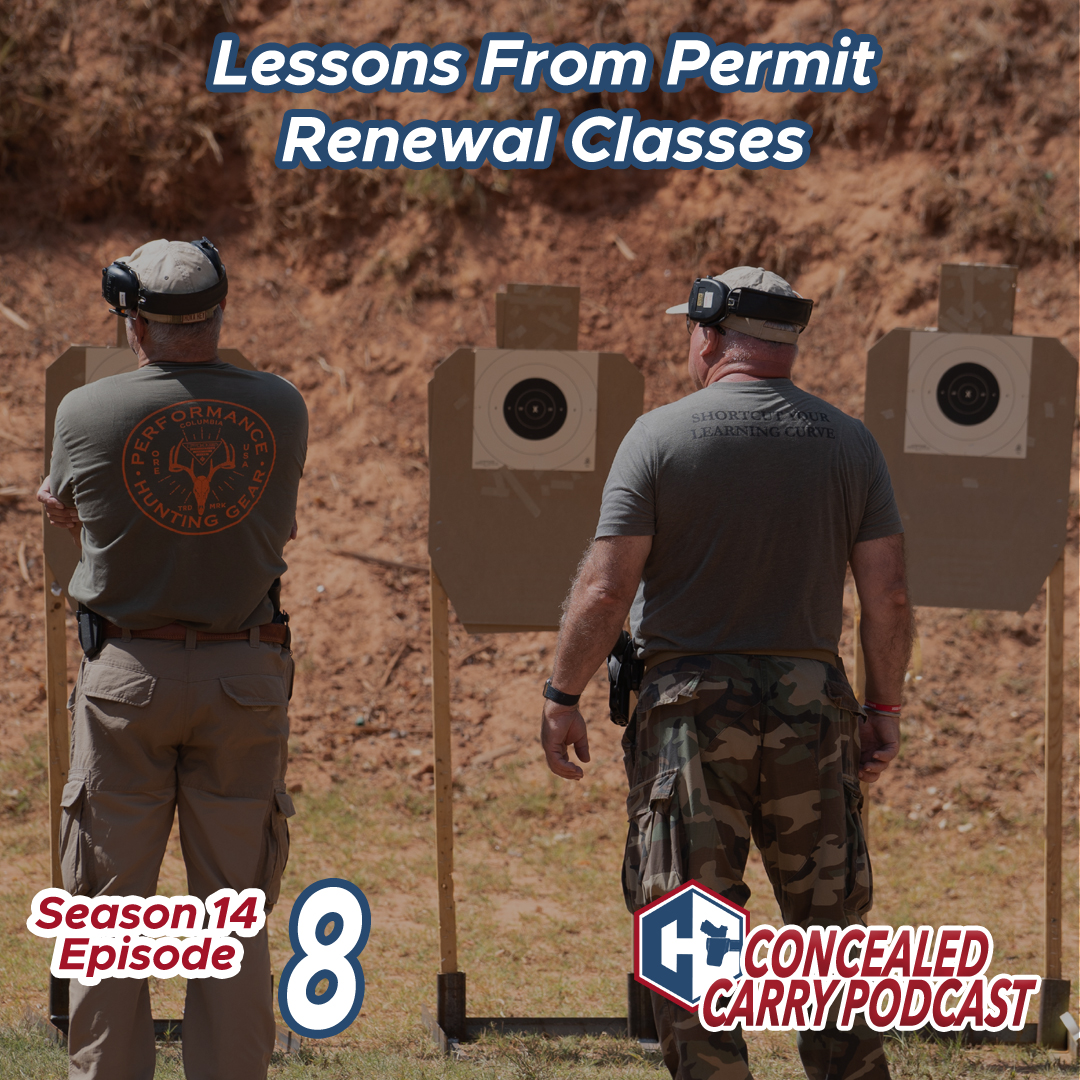
About This Episode:
In this episode, Riley Bowman and Jacob Paulsen share top lessons learned from concealed carry permit renewal lessons. Some are obvious, some are not. If you're new to carrying a gun, do you fall within these categories? Or if you've been carrying for a while, are some of these things still mistakes you're making?? Tune in so you don't miss!
Watch this episode
Read the transcript
And welcome to the Concealed Carry Podcast, part of the ConcealedCarry.com network, brought to you by HK. Today is Friday, September 11th, 2026, as of the live recording of this episode. I am your host, Riley Bowman, joined today by co-host, Jacob Paulson. Yep, that's me. Yeah, he, yeah. I say your name. Sorry, my bad. Just kidding.
Dude, it's been an interesting day. I've been kind of in this like solemn state of mind with it being the 25th anniversary of September 9-11. Yeah, I would take today as a holiday over Labor Day. Totally. Yeah, like it just kind of feels like in our current season of America that this would be a more appropriate holiday than some of the other holidays we have.
But it's a work day, you know. And like in our business, our rule is if the post office is open, we're open basically. So we're working. Yeah. I had that very thought, in fact, as I was thinking about the fact that it's not a holiday today. I was like, why is it not a holiday? I really feel like it should be. And then I was thinking about, well, probably somebody thought about it.
And then like, well, we have Labor Day just a few days before. And, you know, we don't have two federal holidays, like, within three or four days of each other or something, you know, to that effect. Yeah, I get it. And then I'm thinking, we should make the whole week a holiday. Well, a holiday is weird, too, because, I mean, I guess, you know, you have, like, Memorial Day and Veterans Day.
But, I mean, it's, you know, you don't want to, it's not like we want to celebrate what happened. Right. But we do want to, like, have ample time to remember what happened. I agree so i've been uh but as i said i've just been kind of in this, sort of funk today just i mean i don't know if i'm the right word but just you know just kind of like reflective definitely reflective there yeah that's a good word i like that reflective for sure um, Yeah. And it's not just because of 9-11. It's because of what's happened since 9-11.
It's because I think back, I think, to 25 years ago, and we had our nation's problems then too, for sure. Yeah, yeah. But then I look at what we're, worried about, where we're focusing our effort and our time as a nation, as a government, as a people, as a society, as Americans, and it's sometimes a little bit depressing.
Like we just spent all this time the last couple of weeks focused on this Lindsay Clancy trial thing, you know. Yeah, I heard about that. And people, you know, we're not here to get into that, okay? But like it's just there's some, what I would say are really bad takes about that case and people's thoughts on it. And it's just like, why is this what we are worried about today instead of like the things that made America great and still could make us great?
And we saw some terrible things on 9-11, 2001. And we saw some amazing, you know, things that came out of that as a country. And some bad things that came out of that. Really bad things. Yeah, no doubt about that. So anyway, today I was also thinking about how you and I visited the Flight 93 National Memorial in 2019. Yeah.
And saw that firsthand where that took place. That was really humbling. You know, say what you want about the United States of America, but we make a pretty dang good memorial. Oh, yeah. I mean, whoever's on the memorial committee, you guys nail it every time. I mean, you're just really good. Yep. Yep. I've got a question for you here in a minute that I'm going to follow up on a little bit.
But first, let's just mention some episode sponsors. And by the way, we're here today to talk about lessons from permanent renewal classes, concealed carry permanent renewal classes. Yes. Which is something that you've taught. I have not taught a single renewal class. I don't know if I will here in the great state of Colorado.
Maybe. I don't know. But you've definitely taught a few. And we've talked about this, and some of the things that you've shared with me are not surprising to me at all. There's a few things that maybe are a little surprising. We're going to share some of those lessons learned from those renewal classes because we think they're helpful for fellow concealed carriers.
You guys and folks watching and listening to the Concealed Carry podcast, we'll share those with you here in a little bit. But first, today's episode is sponsored and brought to you by HK. We're proud to be brand ambassadors for HK, Heckler, and Koch, and to carry their guns and rely upon their equipment to be life-saving equipment.
So, you know, I mentioned, I think, in the last episode, I'm sort of back to, carrying the CC9 again a little bit and sort of getting re-familiarized with it after a good stint with the VP9K. I think you're still carrying the CC9 pretty much every day and still loving it. Yeah, I like the CC9. I think it... In that category, in that class of guns, I think it is the best.
Yeah. It's just that simple for me. It's a great gun. Yeah. So, like I said, I got it on me, and I've done a little bit of work on mine. I've got a custom texture that I stippled on it myself because I wanted more grip, but I do that to almost every gun I have. Yes, you do. But the trigger on it, I think, is great. It's optics ready. I've got an optic on it. I think you've got an optic on yours.
Gots to have it. And they're great guns. They're super reliable. They run like a champ. That's true. And they're made in the U.S. Yeah, the HK CC9 is made in the U.S. Yeah. That's correct, which is super cool. Yeah, I love it. Yeah. Designed and engineered and made by Americans that understand Americans and understand concealed carry. Right. Yeah.
Nothing against your German counterparts in HK Germany. But you know americans less than americans do i'm sorry But you don't really have concealed carry there so you know that whole project was born out of the american team going hey we want a micro compact, pistol that american concealed carriers will want to own and carry yeah and shoot and i'd say they succeeded massively in that regard, now we do have the vp9 cc that's come also that one's made in Germany is very similarly sized and and capable, and is great gun as well but now we like CC9 so, anyway sponsor is HK HK-USA.com is where you can go to learn more and check them out our secondary sponsor today's episode is dry fire pro shop calm and we'll do a separate sponsor read you know message, later in the episode about dry fire pro shop so.
Now, here's the question, Jacob. I don't know, people maybe didn't come here to listen to this, but I feel like it would be irreverent of us if we didn't spend some time talking about 9-11 today, especially on the 25th anniversary. It's crazy to think that 10 years ago we would have done a similar episode. I don't know if we talked about it really at length or not, but it would have been 15 years.
15 years since 9-11 because we were doing the podcast that long, and it's crazy. I don't think we would ever imagine we would be doing an episode, on the 25th anniversary of such a terrible event. But we've talked about this, but I don't know if people, listeners, have heard this from us. Where were you when you first learned of the Twin Towers being hit?
So the first tower was hit during the end of a sales meeting that I was sitting in. So about 30 of us sitting in a room. And over in the corner of the room are two desks where there's basically data entry employees working their data entry. And so they saw right away. They were seeing the news alerts like, oh, crap, something's like that.
But the rest of us were in a sales meeting to talk about how much product we're moving or whatever. Right. I was a salesman. And so meeting wraps up, and everyone starts to disappear. And I went over to one of those data entry people to ask them a question about something work-related. And they basically bring it like, hey, just see what's going on kind of thing.
And so I just pulled up a chair and sat like next to the data entry people for the next hour or two. That's where I was. I mentioned this this morning in our company meeting. I was commuting on my way to a construction site in Jackson Hole, Wyoming. We were building some kind of fancier condos over there, my dad and I working together.
Very little things in Jackson Hole that are not fancy. Yeah. And so I was fortunate to have a job there, even though it was a little bit of a commute every day. We would commute about 40, 45 miles over the Teton Pass into Jackson, over from Idaho each morning. And, of course, go back each day, each evening. And we're just listening to the radio. And all of a sudden, it was, you know, it interrupted the radio. It just came in. Like, sorry to interrupt this current programming, but, you know, breaking news, whatever. It was a big deal, right?
And it just they there was not a lot of information at that time but it just said something about an airplane crashing into one of the two world trade center buildings, and uh we're like you know i remember so well like looking at my dad being like oh man that's crazy you know but in our minds because we talked about it like, we we were picturing like a cessna 182 or something you know Like a smaller, you know, four-seater airplane or something, you know, crashing.
And that kind of thing has happened before where a small plane crashed into a building someplace, you know. And so you're just kind of like, oh, man, that's too bad. That's pretty wild, you know. So we're just not wrapping our heads around. No, it's way bigger than that. It's way bigger than that. And then, of course, reports kind of kept coming in. And then, you know, it comes in like, oh, a second plane has hit the other tower.
And it's like, whoa, what the heck is going on? And now the reports are that these are not small planes. These are big planes, you know, 757, 737s or whatever, right? I think most of them are 757s. Um, anyway, it's just like, whoa, uh, what is going on? And, and be, you know, it was just strange listening to the radio like that.
And then coming to that realization, like our country's under attack because then the word comes in the Pentagon's now been crashed into, and you're like, this is coordinated. This is planned. This is intentional. Uh, we, we as a nation are under attack. Uh and that was just it was wild man i mentioned this morning how i.
I remember studying you know orson welles uh war of the worlds back in school back in like grade school or whatever, and like kind of how that was impactful to people because that was also in the age of radio in fact just like pre-television right here i'm in a location i don't have access to a tv so i can't just go see and pull up what's on.
I don't have a smartphone, so I can't do that. I'm just purely reliant upon reports coming through the radio. And so I'm like, our country's under attack. And I'm like, this is like war of the worlds. It was mind-blowing at that time, that perspective. And then it wasn't until, I think we actually left work early because the superintendent or foreman or whoever was like, you guys aren't getting any work done today with what's going on. Just go home. I think we cut out maybe 1 o'clock or something in the afternoon and went home.
But I get home and turn on the TV for the first time. And that's when those images just like seared into my brain. It was really something. Yeah, you know, I'm several layers removed from this. And I think that's, you know, I think that we all have varying degrees of separation from this event. Some people listen to this, maybe you were there. I mean, for all I know, someone listened to this, you were pulled out of the wreckage. I mean, I don't know.
Or you knew somebody that was there. Yeah, yeah, yeah. Or maybe you knew someone, a relative or a close friend, or you lost somebody, you know, in that event. I'm several layers removed. I don't know anyone who – I don't even know if I know anyone who knows somebody who was lost in 9-11. But I think that the point is it's still a unifying thing as a country.
And that was, you know, when we say never forget, I think we were talking about, you know, the sacrifices that were made and that we can't let those go to waste. That we have to take, you know, what came from those sacrifices and we have to keep that fresh. For sure. You know, I made a post about this earlier today. I just had something on my chest needed to get off. And that was kind of just, of my post was I was talking, you know, I re-shared what I shared several years ago when you and I went to Flight 83 Memorial.
And some of the images that I took while we were there. And just sort of recounted the story of Flight 93. Not to discount, you know, Flight 175, Flight 11, Flight, what's the fourth one? Anyway i forget but you know but just thinking about 93 what happened there, these are people are flying on a plane and all of a sudden, they come under hijack and of course those those dudes do the same thing managed to gain control of the cockpit managed to take control of the plane, now these people are freaking out and they're initially they're probably just thinking we meaning just just we our plane is hijacked they're they have no context that there's three other planes that are in the same boat right, but they start you know their height they're basically pushed into the back of the plane you guys stay back there sit down you know and and, Anyway, some of them are able to get on phones and make phone calls and get information. And they're like, oh, planes have flown now into the Twin Towers.
And a little while later, they hear over the phone that a plane has flown into the Pentagon. They're now realizing we are part of this. And I think when they chose to fight back, they were choosing to fight back to save themselves, but also realizing they were part of something bigger and that we can't allow this plane to turn around and go back to Washington, D.C., where it was apparent they were starting to head.
And I just was kind of going back through that and recounting those stories and that history. Of course, we saw it all at the memorial and heard even, you know, audio tapes and things. And it was just, what I took from that, Jake, and what I kind of posted about is this, what we saw from those Americans on that plane was like the true American spirit.
Like, we're not going to take this laying down. We're going to fight back. And it's that American spirit of sacrifice and hard work and courage and, you know, love your country, love your fellow man, and doing whatever you got to do. Even if it's hard, because it's the right thing to do. I think that sort of embodies what's made America great since the beginning.
Especially that doing hard things even, but doing hard things because they're the right things. Not that other countries or other people haven't done hard things because they're right. But, you know, not that long ago we were talking about Independence Day and that great history. And like those were hard things that our nation's founders did to create what we have today.
And they were also the right things to do. So great sacrifices made us who we are today. Agreed. Anyway. We should move on to our topic, but to all of you everywhere, never forget. Lessons for permanent renewal classes. Where should we start? Some context. So I think to understand this, in Colorado, historically, there was no independent separate renewal class.
And most states don't have an independent separate renewal class. But here in Colorado recently, as of July 1st, 2025, we instituted a required renewal class. And so depending on what county you lived in Colorado previously, you maybe have never had to do any renewal class. You might have taken your concealed carry class 20, 25, 30 years ago and still just be cashing in on that.
Which, by the way, I don't think you should have to take any class ever to get anything, but whatever. But that's how it is now in Colorado. No, there's an independent renewal class that has to be taken. And this gives us an opportunity to observe what people who have been carrying for, I'd say at the least five, but more at this stage of the game, we're seeing more people that have probably been carrying for at least 10 years or more coming through these classes.
And so it's an interesting kind of demographic, like universe of data in terms of what I'm observing. And it's not the same as what I see through the rest of our business activities. And that's what drove me to think about this. Because if I go to the Guardian Conference, which we're doing next week, or if I go to S12 or any really kind of class like that, that's probably a couple hundred dollars and a lot of people are traveling to it or they're taking time off work, you don't get the average concealed carrier in that class.
You're getting training junkies. People who are really committed, like they've made this a hobby and or they're just committed to expending their resources into becoming highly competent. And that's not the universe that shows up at the renewal class. So, I mean, I already believe that people who have concealed carry permits are of a different type than the average American gun owner.
The average American gun owner owns guns. That doesn't mean they have any degree of competence or that they have any interest in self-defense. They might be hunters. But then you take even a smaller universe from American gun owners of concealed carriers and there's an implied level of increased competence with handgun and concealed carry related skills and lifestyle things.
And then I think there's a sub-universe of that that is like the training junkies that we tend to see most of the time. And these renewal classes have exposed, to me, a stronger reality that those two groups are not the same. The people we see at most training are not the same as just your average concealed carrier. Yeah, I agree with that for sure. You know, so I mentioned I haven't taught renewal classes, at least yet, but I have taught a lot of concealed carry classes over the years.
Sure. And just thinking back to the sorts of people I've interacted with as an instructor and seeing them, and they come from all walks of life and different backgrounds, but in conversations with them, and quite often I'd ask, you know, so tell me, you know, why are you here kind of thing? Uh what are you hoping to achieve by coming through my class that sort of thing, and you know the stories are often pretty similar uh something, a lot of times it's well i grew up around guns or i've owned guns for many years or this or that uh but uh something happened and inspired me to then get a permit so i can actually carry uh and uh, And it's pretty common, like I said, that a lot of people are like, well, I've already got experience with guns. You know, I know what I'm doing.
I'm just here for the paperwork, you know, kind of thing. Just so I can get that little card to put in my wallet so I can carry concealed legally, lawfully. So I would imagine that you see some similar things in those renewal classes. People that show up and now in the renewal class, there's a live fire component that they got to complete.
I mean, these people obviously care about keeping up to date with the permit, right? It's not like all the motivation has disappeared. Oh, that thing that caused me to get the permit five, ten years ago, like I'm over it. I don't need to renew now. I don't see those people. The people we see that come to the class, the people are like, no, I'm not letting this expire. This is important to me.
So that implies a certain degree of commitment to this. And that's where I think there's a juxtaposition here where there's a stated mission of commitment to this. But what I'm observing in the classes is you are not actually doing what's necessary to have any degree of competence at this thing. Yeah. And that comes to varying degrees. I'm maybe being a little bit too general.
So those who are listening to this or watching this, I think the takeaway would be if it's been five, ten years since you started caring, since you got your permit, maybe 15, 20, 30 years, whatever it is. As we talk through these observations, how many of them apply to you? And if they do apply to you, maybe there's some things you could wake up and do better.
Yeah. And that is our hope today is that these things we share with you are opportunities for you to be better. I mean, we all have room to grow and to do better in various ways. But we're all, you know, it's like a continuum. We're all at different points along this continuum of growth or progress or whatever in this concealed carry space or lifestyle.
And wherever you are on that continuum, we want you to be moving forward, further down the line on that continuum. So why don't we start jumping into some of these specific takeaways, Jacob? Do you want to do these in order in the way they're listed? All right. First up. This one did not surprise me. None of these are going to surprise most of people, Doesn't it? Sure, sure. This one, though, I was like, oh, yeah, for sure, for sure. Number one, almost nobody owns a shot timer.
Yeah, I think I had had almost 80 students by the time I found one who said that they owned a shot timer. And I think I'm closer to the 150 to 200 renewal students now, and I still think I just had the one who owned a shot timer. Wow, yeah. And I think the majority of them don't know what a shot timer is. Of course. Some will. Some will be like, oh, no, no, yeah, I know what that is. I just don't have one.
But I think the takeaway is this. It's like the gear, like you owning something is irrelevant. The point is that if you don't have a shot timer, I'm inferring that you never measure speed, That you only ever measure accuracy, that when you go to the range and you shoot, that you hopefully, presumably, you're being deliberate about your capability as it relates to putting a hole in a certain place on paper.
But you don't actually have a reference for, and it's not important enough to you to go out of your way to measure how quickly you can put that hole in that paper. And in a self-defense reality, which is the arena of discussion in a consult carry class, and in this podcast, that's highly relevant. I mean, the speed at which you can put the hole where you want it to be is highly relevant.
And so that lack of a shot timer, and to give you an idea of how we go about this, At the beginning of the class, I talk a little bit about what's in my range bag and what people might consider packing in their bag to bring to the range. It's just a little conversation about being prepared to have a good experience at the range. And so I talk about stuff in my bag, right?
And most of the stuff, like how many of you have one of these kind of thing. And there's other things on the list. We talk about dummy ammo and why I'd bring that to the range. We talk about why I'd bring my cleaning kit and gun oil to the range. We talk about – I said dummy ammo. We talk about my mag loader, you know, like, hey, you know, thumbs, they get tired, so I bring one of these, you know.
And I don't know how many people have one of those. And, you know, varying degrees I get. But the thing that no one has is a shot timer. Mm-hmm. For sure. I mean, I think that's even pretty true amongst many of those that are more avid shooters or take classes periodically. They just don't get around to buying one. Maybe they don't know quite where to work that into their personal routines and practice and so forth.
And it's an investment you've got to make. You know, they're not inexpensive. I mean, we're pretty happy to be able to offer what we do with range tech, shot timer. Yeah, for $90. Right? You know, like you can't find anything really any better than that price-wise. So, but even then, you know, it's still $90. But most of them are $150, $200, $300, some of them.
So, they're not inexpensive. As you touched on, Jacob, you know, if you hear someone say they don't own a shot timer, then they must not practice or worry about speed. And I agree. I think that there are some that think that they don't need it. They think they are fast or fast enough. But the reality is you don't know how fast you are unless you actually measure it.
And then there is a little bit of debate there of, well, how fast do you need to be? But I'm not going to really get into that. What I would say, though, is if your life's on the line, somebody's trying to kill you, you need both accuracy and speed. You need them both. You need to put a round or several rounds in a placement on the body that is going to make a difference quickly and reasonably reliably.
And you need to do it as soon as possible. Right? And so the way to get better at being able to be accurate and fast is you've got to measure both of those things. Measuring accuracy is easy because we can set that standard and put a target up, and this is where I've got to put my rounds. Measuring time requires having a shot timer.
Well, and maybe this is me transitioning to a second of our six points for our outline here, But it's also – it shows not just that you are not interested enough in speed to go out of your way to measure it, but it also leads to a reality where you have no idea how fast you are. So there's a lack of awareness in this student population, this group, of their own skills.
I'll give you – we've talked about speed quite a bit. So let me give you another example of this. And this is point number two, I guess. I don't know if we're out of order now, but point number two is that there's a lack of awareness of one's own degree of competency. So the first shooting thing I do in the class, you'll remember this because you've said it many times yourself, is basically give me your five best shots.
Give me your five best shots. There's no time. There's no, you know, take your time, your pace. I do it for five yards. So this is not an extreme thing. I'm using a USPSA A zone, basically. You know, it's the PIQ target, so it's got a three-inch circle bullseye that they're aiming for within that A zone. But anyway, you know, give me your five best shots.
And at the end of that, I'll always say, you know, who's proud of what they did, and no one raises their hand. No one ever maybe on a rare occasion if so it's probably a woman because you know there's there's an ego factor there where people sort of have the sense of like well if I don't want to say I'm proud because like you know I could have like the shots are not perfect so you know I wish I could have done better but when I talk more with these students I'm like no seriously like is this your current level of ability, people really strongly feel it's not.
No, no, I'm better than this. And so there has to be some, like a come to Jesus talk where I basically tell the students, no, you're not. Like, maybe some of you are, but for most of you, like, this is how good you are because I just told you to do the thing, and you did it to the best of your ability, and this is the result.
So, like, if anybody wants to prove me wrong, let's do five more. That's what we do. We do five more. And I'm like, anybody still think that, like, they're better than their first five shots were? No one does because that's the moment of realization. Like, no, this actually is how good I am. And so the point is that even if removing the speed element for a second, which we just focused on, even just focusing on accuracy, there's an absolute lack of awareness and understanding of your current level of skill or capability.
So this matters a ton. If you're Eli Dickens at the mall in Indiana, and you got an active shooter who's shooting people willy-nilly in the food court, and you're 40 yards away, it would be helpful for you to know if you're capable of hitting a human-sized target from 40 yards, or do you need to close the distance? Like, do you know?
I think that the average person in my renewal class who's been carrying a gun for years has no clue if they're capable of doing that or not. So it's not just they're not measuring speed. Yes, that's true. Like, if you don't know a shot timer, you're not measuring speed, and that's a problem. But the next element of this or the evolution or the reality is that speed, accuracy, pick one.
The average person in that class has no idea what they're capable of. Yeah. I agree. The scary thing about this – well, actually, let me ask a quick question first. Out of all the renewal students that you've seen in their – so you have them all shoot those initial five shots –, What do you typically see? Like you said, you got like an A zone that's available as a target. How do they do?
So, in fact, I have them shoot. Each student has to shoot at least 50 total rounds. And most of them, in my average class, we're doing closer to 60 to 75 rounds. And we never change the point of impact. It's always that center gray circle. And I do this on purpose because the nature of the statute and the law is that we have to give them a performance score.
With the score of the target. So having them keep the same target the whole time allows me at the end of the class to be able to look and say over the class, over the entirety of the 60, 70, 80 rounds, whatever it is, how many impacts we get there. And obviously it varies considerably. Some people are significantly more capable than others.
But on average, I would say 9 out of 10 people cannot keep five shots inside a three-inch circle at five yards. How big would you say kind of like their typical group is out of five rounds? Out of five rounds? Yeah, maybe on average, eight to ten inch circle, you know, like a paper plate on average. You know, some people are obviously way beyond that. Some people are much tighter than that. Okay.
All right. So, you know, five yards taking your time. That's actually better than I expected you to say. Yeah, no, I don't think people are incompetent, but I think the point, here's the point. I think we did a podcast episode on this topic once, so I won't belabor it. But I say this several times in that class I'll say something to the effect of far more important than how skilled you are is your awareness of how skilled you are it matters less how good you are at this than it matters that you know how good you are now so my ability to hit the guy in the food court at 40 yards is not as important as me knowing if I can hit the guy at 40 yards so I'd rather take the guy into the battle with me who may be less competent, but he knows what he's capable of than take the guy who maybe has a relatively high degree of competence, but he has no clue what he can do and what he can't do.
Luckily, that tends not to be the case. When you're highly competent, you probably know it. But anyway, unfortunately, there's a lot of people who because they don't know their level of competence, they assume it's high. Well, and that's typical, you know, Dunning-Kruger effect. Yeah. Where people don't know what they don't know. And you certainly don't know where you're at when you don't have the ability to measure it.
And so, of course, this is why we segued from, you know, talking about shot timers into this. It's a question, too, of who they surround themselves with. Like, if you're listening to me and you're currently the best shooter in your social group, you go to the range with your friends and you're the good one, that doesn't mean you're good.
It means you're better than your friends. So like in the class, the first demo I do, I do it on a one-inch square target. I do it the same five yards. And drilling a one-inch square at five yards for someone at my skill level, which is not extreme, by the way. I'm not Riley's skill level. I'm Jacob's skill level, which is better than the average concealed carrier but not extraordinarily capable.
But hitting a one-inch square from you at five yards is not a problem. I could do that with any handgun that's sighted in. So it's just not an issue. And the average student in my renewal class is shocked to see it. Shocked. I look pretty dang good to them when I could put a round in a one-inch square taking my time at five yards.
And I think that if we did that with the average instructor class, the people we tend to move around with, they'd be like, Like, you want to impress me? Like, do it in one and a half seconds. You know? So, but that group, they're stunned that someone is capable of such accuracy. Which suggests what? That they are not surrounding themselves with highly competent shooters, so it gives them a false sense of their own capability. Mm-hmm.
So before I asked you some follow-up questions there, the thing I was about to say was what's scary about your example and talking about renewal students for the first time and having them shoot their first five rounds. And then you're saying, you know, they, most of them are like, oh, I'm better than that. What's scary is that they are in a situation, in an environment that is not overly stressful.
I mean, it may feel like it is to some people being in a class and being on a line with other shooters and having to shoot in front of other people. Not as stressful as someone shooting at you. But that's my point. It's like you're not in – it's not a life or death situation. And I just asked you to take as much time as you need to give me your best five shots.
And this is what you gave me? Now, just imagine that instead of me telling you that, you're on your way home from this class today at the gas station. And now all of a sudden, you're getting robbed at gunpoint. Right. Yeah, that's what you're trying to communicate. And if any of my renewal students are listening to this, I'm not trying to pick on anybody.
And I have some renewal students who are highly competent, highly capable. But on average, this is what we're saying. Yeah. Not a surprise. I would say the same is true even amongst fairly skilled shooters and students that I've had in some of my more advanced classes that don't know how good or how bad they are. And that's something we talk about actually quite a bit in my classes is that it's really important to, I mean, it's a mental management strategy to know, where you actually are skill-wise.
Yes. Because then you can, with confidence, deliver what you're capable of. Yeah. The most important shooting skill is skill awareness. Yeah. When you have an unknown, then, number one, confidence is not going to be there. And then what happens is you either over-try, meaning you try too hard because you're trying to be a hero or whatever, you know.
And that's a no-win strategy. You bite off more than you can shoot. Right, right. You shoot way too fast, you know, or whatever it is. And so you just, yeah, fall apart. Or there's sometimes shooters, and this is the exception rather than the rule from what I see, most people end up over-exceeding their actual skill level.
But there are some where I see them and I'm like, I think you're actually better than you think you are. And if you realized that, you would actually perform better. Most of them are probably women, but yeah. That is actually quite true. It's a stereotype, but on average, in case, just to clarify my comments, so no one thinks I'm being a bad person, on average, most men tend to overestimate their ability in this arena, and most women tend to underestimate it.
That's true in not just firearms and shooting and training. That's like, so Dunning-Kruger, for example, one of the common examples is asking people to rate how good of a driver they are. And even within that data, men tend to overestimate more so than women their skill as a driver. Yes. So. 98% of doctors think they're better than average doctors.
Probably the same is true with attorneys all right let's talk about this we've covered number one number five now what number five was people do not know how good or bad they actually are so let's go back to two almost nobody carries a medical. Yeah um yeah so you know again it's kind of part of that initial conversation i'm saying hey here's things i bring to the range you know how many of you have one of these kind of thing and so when we talk about medical preparedness you know hey i have a trauma kit. It's right here.
Here's our medical response plan for this class. How many of you have a trauma kit? No one has one. And on the rare occasions someone might have one, I say, do you bring it with you to the range? And of course it's a no. I'll ask people for the range you go to most often, do you know if they have a trauma kit and if so, where it is?
And the answers to all these questions are basically no's. So now in the defense of the average person showing up to my renewal class, I think we have to acknowledge it, even for myself looking at my own history as a concealed carrier, that medical preparedness is a more modern element of concealed carrier lifestyle-ism.
So if we just go back 10 years, I think that we could have grabbed an average group of concealed carriers and there would have been a lot less awareness of medical preparedness than there is today. So I think it's a more modernly emphasized element of responsible concealed carry than it used to be. I mean, in fact, if we went back 10 years and you took my a concealed carry class back then, I didn't talk about anything medical.
And now, of course, it's a significant thing that I talk about in my class. So anyway, in their defense, I'm saying that it's a relatively modern phenomenon, but it's still important and good. So yeah, I'd say my average concealed carrier who's coming through my renewal class has no medical training and no medical gear beyond a Band-Aid.
Yeah, this one, again, also is one of those things that does not surprise me. You're right that it is a more modern evolution in this lifestyle. Because people are starting to wake up to the idea that, I mean, we probably got into the concealed carry lifestyle, so to speak, because of the desire to not be a victim, to not, you know, to save lives, basically.
Whether it's my own life or the life of a loved one, a family member, neighbor, friend, whatever, right? It's like, you know, got into it because we wanted to have the ability, we wanted to have a choice in the matter, a vote, that, you know, something was to go wrong with respect to my personal protection. I have a vote in what happens to that potentially, right? Yeah, yeah. And then people are naturally gravitating to the idea that, well, it's about saving lives. There are other ways of saving lives.
And it's not even just about being involved in some kind of shooting, you know, where holes got put into you or somebody else. And now we've got to patch those holes. But. I began the podcast talking about going to a job site in Jackson Hole on 9-11. And one of the laborers working on that construction site, I watched one time slice a really nasty gash into his leg with a utility knife.
Like six-inch long gash. That's a bad day. It's a super bad day. Now, he was incredibly fortunate. And I was a young kid at the time. I mean, I was a Boy Scout, and I had some. It was very, by what I would consider to be standards now, very, very mediocre first aid training. But so I don't think I fully... Understood the gravity of what could like what the potential, could have been you know from this from this type of injury but i mean he's trying to cut some plastic or something and the knife just goes and i mean he didn't hit his femoral or we would have found that out really fast uh, so at the time it was like oh that's nasty you're bleeding pretty good but you know it was like, he's not dying so you know bandage him up get him to the hospital kind of thing you know and, comes back a couple of days later with a bunch of stitches and like, okay, cool. Life goes on.
That could have been super, super, super bad. And nobody there would have been prepared to deal with that at that time. I'd like to think I'd be very different today if I was to see something like that occur. Um, so those kinds of things just out of the blue, you know, I go home tonight and decide I need to do some work on my gutters or something.
And I slip and fall and snag my arm on some sharp, jagged piece of metal as I fall and, you know, I ripped my brachial artery open, you know, like it just can happen so fast in so many different kinds of contexts that you can't even imagine them all. Uh, and so having the, the ability to do something about it medically and having, you know, the equipment like a trauma kit, uh, nearby somewhere you can do something about it. Like these are, these are important things.
It's, it's lower hanging fruit. That's the real frustrating thing for me is like buying a gun and gun stuff and then be you know purchasing the skill to be competent with it is a much more inconvenient and more expensive task than buying a trauma kit and getting the basic skills to be able to use the gear in that trauma kit to keep someone from dying like that is significantly less expensive and significantly more convenient You can find and take a Stop the Bleed class for free or very low cost.
You can go take a first aid, AED, CPR type course for very, very low cost. There are other courses you can go and take that are going to be a little bit more cost but are still pretty cost effective. Compared to your average gun class. Right. And so there's lots that you can do to make yourself better prepared for medical-related emergencies and to have, you know, simple kits.
That's one of the reasons why we started Mountain Man Medical, what, six years ago now, six and a half years ago? Yeah, it's about affordability. Was because we were frustrated with the lack of affordability in these types of kits. And we're like, I'll bet you we can do something similar for a better price. And we do. Yes, we do. High quality doesn't have to be expensive.
That's right. Good stuff. Number three, almost nobody dry fires. Yeah, I've had most of my renewal students aren't aware of what dry fire is. Now, in their defense, similar to the medical conversation, I'll just add the disclaimer that if we just rewind the clock back to when most of these people took their last class 10 years ago, 15 years ago, maybe even 20 years ago, no one was talking about dry fire 20 years ago. It wasn't a thing.
Some of the top-tier competitive shooters might have been doing it, But it wasn't a thing that everyone was talking about like we do today. It definitely was not talked about like it is today. I can recall, and I can't be specific about this, but I can remember at a fairly young age. See, I grew up, my grandpa had a small general store out in a very small community.
And he was, you know, big time second amendment believer and NRA Life member. And, you know, he had all the magazines. American rifleman guns and ammo all that stuff right, And I would sometimes, I'd spend a lot of time in a store, and there would be times I'd just be pouring through these old, these stacks of magazines, right?
And I can recall, I don't remember if it was a column by Jeff Cooper or who it was, but I remember reading something a long time ago, talking about, and I don't remember if they even used the terminology dry fire, but they just talked about doing some basic practice, you know, with an unloaded gun, you know, kind of thing.
So it's not like it hasn't been around for a while. It's just that it really has not been talked about and proliferated like it is today. Right, right. And I think that's the disclaimer, right? Like giving my students a little bit of credit because there probably was no mention of dry fire when they took their last class.
Yeah. And so unless they're really dialed into things like this podcast or whatever YouTube channel, they maybe have never heard of it before. That's fine. But it is a little bit of a flag like, hey, now you know what you need to be doing because practice. We mentioned – I just got done saying that gaining gun stuff and gun skills is both inconvenient and expensive.
But dry fire makes it significantly less inconvenient and significantly less expensive because you don't have to leave the house. You don't have to buy ammo. And the majority of critical gun skills, in my opinion, can be done and can be gained or enhanced in dry fire. So, yeah, we talk about dry fire in those classes for that reason because most of them have never done it, never heard of it. Yeah.
Yeah. So here's the thing. And this is, it's something I've tried to encourage for a long time in my own classes, including concealed, you know, basic concealed carry classes, is the attitude of dry fire. Uh, it is, we just talked about low hanging fruit. It is that, you know, medical training and equipment is right. Like that. It's relatively lower. It's lower effort and lower costs than what it takes to buy a gun, carry a gun, the equipment associated with that and get training in it.
Uh, you know, what's even lower hanging fruit is you already have a gun, assuming that, uh, and hopefully a holster it's dry fire is free, man. It is free. It's time. There's, exactly. And people probably, I think, sometimes get the idea, well, I don't have time. Like, I'm already so busy. I've got this going on and that going on and kids and sports and activities and work and, you know, all these things.
Serving my community, church, et cetera. Five to ten minutes a day. And I don't drive fire every day. Frankly, okay, you don't have to do every day. But if you did just five minutes a day, you'd be awesome after a few weeks, after a month, after three months, after a year. Okay, so you're like, well, I can't do it every day.
Okay, fine. Do it three times a week, and it would still make a huge difference in less time than you would anticipate. I like preaching the idea of trying to do it every day because I think it's helpful if a person can build. If there's something else you already do every day, like habitually, routine wise, if you can pair it up with that, then that's the perfect opportunity to just, you know, for instance, it could just be, and I've talked about this before, I don't do it every day, I try, but, Generally, the routine is when I get ready, I get dressed like in my actual, like these are the clothes I'm spending the day in kind of thing.
And I'm putting on my belt and putting on a holster and putting on a gun. Then I like to do a few minutes of practice draws at that point. And it's just, that's all it is. A few minutes and just go through a couple draws. That doesn't take a lot of effort. And it's just built into that routine. Like I already know I got to get dressed. I already know I got to put on my belt. I already know I got to put on my gun because I'm going to carry it because I carry every day.
So then just at that point, do some practice draws. So, and how I carry, for instance, like on Sundays is different than how I carry most other days of the week. And so that's really relevant because the way I draw when I'm carrying Sunday is different than the way I draw on Monday. And so that's a perfect opportunity to be like, hey, if today's the day, like I'm not doing this, I'm doing this kind of thing.
Right. And so that's where I, yeah, that recency of practice is also super important, relative to performance, uh, as well as having like, the time built up over days, months, you know, and years. So anyway, just something to think about, but I like, you know, there's a little note here in our outline, um, comes from your, your articles that you wrote on the, on these subjects, Jacob, about how you don't need to fire 10,000 rounds per year to maintain or improve competency. I definitely agree with that.
Yeah, I mean, at least you could probably fire a couple hundred rounds, you know, 200 rounds a year and be pretty competent if you supplement that with dry fire. You know, I think if you did 20 minutes, when I think about, like, what's realistic for me or what I just am willing to commit to, you know, 15 to 20 minutes a week is, you know, about what my dry fire looks like.
It's not, I'm not doing five, 10 minutes a day. I'm, you know, once, maybe twice a week. I'm just taking 10 to 20 minutes and doing some dry fire. So I think it's just, it's low-hanging fruit and most people aren't doing it. Yep. One thing that needs to be reinforced in those dry fire periods, sessions, is proper gun handling and safety.
I was just looking, there's a note here about how some students have barely handled their firearms in their previous class or qualification. And it's like, yeah, yeah, you know that's true. Okay. And it's kind of scary and depressing. and, You know, you see, like I've seen people come through training before where they have the background and unfortunately it's years prior.
Like they were in the military, you know, they were in the army, whatever, back in, you know, 1982. And it's like, okay, they got some training, they got some measure of proficiency, but then you watch them handle a firearm and it's like, whoa, buddy. Like, did you forget how to do that? And yeah, people forget. Yeah, they just forget.
In their mind, it's sort of like when you're, well, in your 40s, like we are, and you're like, I still think like I'm 20. Right. But I am not 20. I still remember that I was once, and in theory, could still be capable of running a mile in 430. Yeah. But guess what? I can't. You cannot run a 430 mile. No, I cannot. Why? Because I haven't maintained that. It's gone. It's so gone. It's so gone.
But up here, you're... But in my brain, like, no, I can run a 430 mile. You remember what that felt like. I used to be able to do a standing backflip, but I wouldn't dare attempt it now. That thought actually popped into my head. It's funny you just brought that up. I was like, I've seen video of you do a backflip from a long time ago.
Yeah, no, no. I would break my neck right now for sure. I would die. But that's the point. Yeah, it's the same kind of thing. It's like I was about to share a story that would probably not be very professional of me. But these people, in their mind, it's not a skill that's going to go away. They just haven't. So dry fire is a great opportunity. If you don't have the opportunity to get to the range often, to shoot many rounds per month, per year, whatever, you can still do effective dry fire practice.
And as part of that, be reinforcing proper handling, proper safety, all of that. So it doesn't go away because safety and firearm handling is a perishable skill, just like the actual shooting is as well. This is probably a good time for our second sponsor message, So I'm going to give it right now. Yes, let's do it. So Dry Fire Pro Shop, sponsor of the show, is a website that is an online store committed to only products that enhance Dry Fire.
And it's an interesting thing because I think sometimes some of these products are safety-related, in which case, like, safety, good. Safety, awesome. Do safety. So, you know, like a barrel block, for example, is a good example of that, which you could buy at Dry Fire Pro Shop if you wanted. Other of these products, I think they're really there to just keep Dry Fire from being boring, from becoming stale, just to kind of give you some oomph.
It's like, oh, this is cool. Doing Dry Fire is cool now because I've got this cool new toy that makes me able to do something I wasn't able to do before or do it more effectively than I could before or whatever the thing is. So if you're looking for ways to enhance your Dry Fire experience or just to make it more safe, check out DryFireProShop.com.
Awesome. yep that was the idea was that we would talk about Dry Fire Pro Shop when we talked about Dry Fire perfect segue there, DriveFireProShop.com. Number four, many people carry less than ideal guns. Oh, man. We've had some fun stories from you as you come back from a weekend where on Saturday you were doing a renewal class. And you're recounting like on the line we had the following guns.
And some of them are kind of interesting. Well, we have to be a little bit careful because it's not my intent to poo-poo on anyone's gun. I don't – but we have to certainly be willing to say that some guns are not as ideal as others. This last class I was in, which was a mixture of some renewal students and some new applicants, to be clear.
But this last class I was in, I had three, I call them Ruger pocket guns, LC whatevers. And two of those were from renewal students. One was a new applicant. One was a .22, one was a .380, and one was a .9. So that's not an ideal gun. It's just not. It is super convenient for people who need like a really freaking small concealed carry gun, something that you can stick in a pocket or stick in the purse or put in the whatever.
Like, yeah, like that's – Ruger sells a ton of these things for a reason. This gun probably like prevented Ruger from going bankrupt at one point. Like they sell a ton of these. But it's not an ideal gun. And you're going to find that out real quick in a class where I force you to shoot 50 to 60 rounds through one. In this last class, of the three that came to the class, two had to come off the line early. They died.
And we had to get an alternate gun in the hands of those students. How many of those are carrying in the pocket? I don't know. I don't quiz the people. I'm like, well, how are you carrying this? I don't get into that. We just don't have time to do that in these classes. But sometimes it comes up. Why did you buy this gun? That kind of thing. And so it does come up.
And I don't mean to pick just on this gun. I can name other guns too. I had this last class. Oh, man. I had a IWI Masada, which I do not think is a bad gun. I think they're relatively well-made guns. But it had a five-inch barrel, threaded barrel, I might add. Five-inch barrel, threaded, coyote. And I asked the person, I was like, do you own a holster for this?
Because that's the first thing in my mind was like hard to find a holster for these. I happen to know somebody who makes one. And they're like no. And I was like okay well so you don't carry the gun. Like why did you buy this gun? Well this is what the guy behind the counter recommended to me. Now this person I'm talking to is a 5 foot nothing 30 year old petite female.
Now that doesn't mean she can't shoot that gun. In fact she shot it relatively well. But it's probably not the ideal gun for her for concealed carry and I have a hard time believing anyone would say that the Masada is the ideal concealed carry gun because it's just too hard to find holster support um I mean, you know, check out ksgarmy.com. But I see other things too.
Like I saw – I had a student show up with the Smith & Wesson. We could not figure out what model it was because he had it for 70 years or something. And, you know, it was so worn down. Like the serial number was almost – you know, this gun was almost illegal in the eyes of the ATF because it was just so old. He's like, well, it just keeps running. It's like, you know, we've – like gun technology has changed. We have cooler stuff now.
You should check out the cool new stuff. Now, it's not just about how old the gun is or how big it is or the relative size it is to you or what brand. I'm trying to figure out how to verbalize this thing. But I'd say 50% of the people who show up in the class have a gun that I look at and think it's really probably not ideal.
Either it's outdated, like we just have better guns now, or you picked something very niche that is niche for a reason. Like it's not mainstream because it's really not well-suited for this application. Or it's a mismatch. Like that gun doesn't fit you. It won't work for you. One of these guys in my last class that showed up with the Ruger, I think he had the 9.
I think he had the 9? Yeah. He was shooting the 9. So whatever that is, the LC9. The guy was 6'6". Six foot six rocking the Ruger LC9 and I was like I can't help you. Grip the gun yeah like we're talking about grip and I'm like and you're not going to be able to do any of the stuff I'm talking about so you know I guess whatever you know just get the other hand in there somewhere it doesn't even matter so it's just mismatched it doesn't work for you man I brought up the pocket carry comment or question because it's remarkable to me it is and it isn't because I mean why should I be that surprised I guess but, But in the crowd that we typically run in, like, it is unusual to see somebody carry primarily their concealed carry gun in the pocket, right? Agreed.
Anyway, but it is surprising to me how often it comes up in just, like, normal conversations with, like, just regular folks. And they're like, yeah, you know, I had to get such and such gun so I can carry it in my pocket kind of thing. And I think that's actually a pretty common way that a lot of just regular people carry a gun because it's convenient, it's not uncomfortable, you just throw it in the pocket and go, you know, and anyway.
It just requires a gun that's terrible to shoot. It requires a very small gun that's terrible to shoot and is not the most efficient place to draw from unless you can start with your hand on it. And doesn't come with a lot of ammo capacity. Yeah, yeah, yeah. So anyway, I was just curious. I'll add this comment, too, that might be useful. New applicants, people showing up to get their concealed carry permit first time, they show up with good, reputable, modern guns.
Because they're going to the gun store this year now to get a gun because they want to get their concealed carry permit, so they go buy a handgun. So they're choosing already from a selection that is more viable. Also, today, we have more good options than we had five years ago, ten years ago. I agree with that. 15 years ago.
And 15 years ago, buying a gun for concealed carry was much more difficult. There were just not as many good options and choices. Today, man, it's the golden age. And it's always the golden age. But today's golden age is better than the golden age of 15 years ago. It's hard to buy a bad gun in the modern era. Today. A gun that is not reliable and doesn't work very well or whatever. There are still some of those out there.
There's a few of them on the shelf. But by and large, most modern guns, especially in the striker-fired side, are pretty decent guns. Like, they'll work. They'll at least work well enough. The bigger issue is like the IWI Masada that you brought up about, you know, we run into issues with, well, where are you going to find a holster for it?
Yeah. After market accessories, so forth. It was December, November last year. I had a guy show up with a Taurus Spectrum. Oh my gosh. Right? Like today, like Taurus doesn't want me to bring it up. Taurus is like, oh, we don't talk about that. You know, like it was a train wreck of a gun. Yeah. You know, but so today you would never find that kind of a gun for sale new, you know, on a shelf.
Like, so yes, like that's another factor is that people who are going out and buying a gun today to go get their permit, they're showing up with much higher quality on average of options, viable concealed carry options. But the people who are showing up for renewal, it never occurred to them that over the course of 5, 10, 15, 20 years, they should probably get a new gun. Yeah.
Yeah. Yeah. Speaking of guns in the modern era, it brings us to our final lesson here from permit renewal classes. Pistol optics still have not penetrated the normal gun owner market. This is according to your observations. You said approximately out of 80 guns seen in renewal classes, maybe one has an optic and around 10 more optics ready, but still use irons.
Yeah, so something like 80% are not optic ready. Oh my gosh. I had a guy in the class, this is a renewal student, who had an optic on the gun. He had a brand new MMP. Came with an optic. He didn't put it on, but it came with the optic. And he just keeps it turned off all the time. Because he didn't know, he's just like, no, I learned on what I know is the iron sights.
And so these new fancy optics, it came with it. or whatever, but you know, I Googled how to turn it off. And so I just keep it off. Like, that's, you know, that's the attitude of the average person showing up to these classes. Now, it's not everybody. I had a guy in my last class with a CZ with a weapon-mounted light, a TLR-7, and a Vortex Defender.
So, you know, that's a guy who's got, you know, relatively, and it was on a CZ, I think I said that. So, relatively, you know, newer gun with, you know, newer weapon-mounted light, newer optic. So, you know, again, I'm speaking in generalities, but the numbers say that the average person who's been carrying a gun for 5, 10, 15 years has not yet adopted the optic.
Someone who, again, the brand new concealed carrier, much more likely to have an optic today because they're doing research in today's social media influencer environment. They're going to the store and choosing from guns available for sale today, right? But the renewal students, which the majority of people listening to my voice right now or people who've been carrying for 5, 10 plus years, You're the ones who are more likely to push back because you're comfortable and you already know what you know and something new, A, comes with a cost and B, comes with inconvenience because you feel like you have to relearn something.
And so that's, it's an unfortunate thing in my mind because I think optics are amazing. The way I always introduce them to people in my class is I say, if Harry Potter came into the muggle real world and came to a gun range, and picked up a gun and shot it, he'd pull out his wand and wave his wand and an optic would appear.
It's cheating. It's like magic on a handgun. So any hesitation you have that's keeping you from putting an optic on your gun, other than cost, is silly. It is ignorant. I don't know how to be more kind than that. If you think there's a reason to not have an optic on your gun, whatever that reason is, other than cost, it's an ignorant reason.
All of those reasons are not true. I think that, we've seen the transition in the industry to where, serious shooters, serious, hobbyists and professionals, it's actually becoming somewhat unusual for me when I'm just out and about to see an officer, a police officer, that is not carrying an optic-equipped pistol. Yeah, that would be weird. You're probably not in a big city.
You do occasionally see someone still with irons, but more often than not, I'm paying attention to the agencies around us, and it's like, nope, optic, optic, optic. Even some of the security guards that are armed guards, I'm seeing more often than not are carrying optic-equipped pistols. So the serious end users, hobbyists, professionals, that adoption has happened.
There's still a few stragglers, but the majority for sure has got optic-equipped guns. You see the, avid shooters, they may not be the most proficient, they may not be the most... You know. Maybe they don't carry their gun every day or whatever, you know, but they're still kind of avid gun people. I see them, you know, because they want to have the latest and greatest stuff because they're reading the magazines, online blogs and stuff.
And like, oh, yeah, I want to have a gun with an optic on it. I see that pretty commonly. But like you're talking about regular people, the soccer moms, the office worker, you know, guns are not their life. It just happens to be that having a permit is important enough to them. I got the permit, and I've got a gun, and it's probably the only gun they own for many of them.
It's not their thing. I checked the box. Exactly. And now the government says I need to check the box again. Yeah, exactly. So that's not been quite fully adopted is what you're sharing with us here today. But even from like when we launched our Carry Optics Mastery video course, was that last year, two years ago? I don't remember. Last year. Last year. Yeah.
We got enough feedback to know that even people who are listening to this podcast, even what we perceive to be like the relatively higher, more aware concealed carriers, there's still a pretty large percentage of them that push back on the pistol optic. And we've done episodes in the past. We don't need to rehash all the reasons why you should have a pistol optic.
But I will say this. In that renewal class, which very – like my last class, I had 12 shooters on the line. Two had an optic. One was on a relatively modern gun. And the other one was the Smith & Wesson guy I mentioned who – he turned it off and leaves it off. But what I do is I have everybody come pick up – in that class, it was my VP9.
Pick up my VP9 which has an optic on it let them experience what it looks I explain why I think it's advantageous and how it's different then I have them pick up the gun and look at the dot they don't even shoot it they just look and set it back down And a large percentage of people who come out of that class go and buy a gun with an optic.
I know because at the end of the class when I say everybody – I make everybody share your number one takeaway from this class. And very common for several people to say I need to buy a gun with a red dot on it. Sounds like there's an opportunity potentially to have an upsell class, which is a red dot pistol class. Yeah, maybe there is. Maybe I should work on that.
Yeah, because a lot of people would benefit from, I think, understanding how to use it most effectively. You know, good point here in your notes, Jacob. Optics are not mandatory and do not magically create skill. And that's absolutely true. But they are a wonderful tool. And they're here to stay. And I love just being able to look at my target and put a glowing dot on it and send it.
And also in the dry fire side of things. it's so easy to get a lot of value out of, if you don't have any of the fancy tools, because you don't need the fancy tools necessarily, but if you don't have like the Mantis Titan X and the Certs and the this and the that, Cool Fire Trainers, like they're all awesome tools. Like we love the tools.
But if all you got is a gun and an optic on it, you can get so much out of that because that optic, that dot, gives you so much feedback about what's going on as you're manipulating and pressing the trigger and whatnot with that gun. It's a very, very powerful tool, so it's great to have. Well, we're over the hour mark here, so we should probably wrap this up.
But we've covered six key things that have been takeaways from permit renewal classes that you've seen the last couple of years here. I think there's some interesting takeaways and lessons learned. And I'm curious, you know, how many of you got something out of this? Maybe you find yourself still, you know, maybe you fit in one of these categories or whatever that we've discussed here today.
Maybe there's a mistake here or there that you're still making that you didn't realize. Maybe it's not necessarily a mistake, but it's just a way of maybe doing things differently or better for you. Either way, we hope that this episode has been helpful for you guys, our listeners, and our viewers of the Concealed Carry Podcast.
Today's episode is sponsored by HK. HK-USA.com is a place to learn more about this fine manufacturer of top quality firearms. Talking about, you know, the guns that are less than ideal. Well, that does not include anything on the HK list. No. If you show up with an HK, we're going to think you've got a good gun. That's right. You should have an HK. CC9 is great. VP9 A1 series is great.
That's the newest version of the VP9s. The P30s are still awesome. The USPs are still awesome. They're all great guns. They're well-made, over-engineered, frankly, for what probably most people need. But that's how you know they're going to work. Also, dryfireproshop.com. We hope that you will support this podcast and buy your next dry fire needs right on Dry Fire Pro Shop.
That's another one of our brands that I think we forget to mention sometimes. So that's the best place to find all the dry fire things consolidated onto one simple web page, web shop. So dryfireproshop.com. Well, yeah, any closing words or advice? Presumably if you're listening to this, you probably have a permit. I mean, you might not. You might be a constitutional carry kind of person.
But if you have a permit, then you probably have a renewal coming up, and that may or may not require a class. But it might be a good time to re-evaluate and just say how am I doing on all the things is there something I've been holding out on or I haven't done my due diligence on or I need to look into or consider so think of that as kind of an opportunity to re-evaluate Great, great words of advice, you know, kind of building off of that further.
Take a class. Go find a good one. Come to the Guardian Conference. You technically can still sign up and show up. Sure. It's next week. Probably from the time this publishes, it'll be, you know, within a day or two. But come and train or go grab a class from a reputable instructor somewhere and do something to make yourself better and move yourself down that continuum a little further than you were yesterday.
So anyway, guys, thanks for being a part of this. If you have any questions, comments, concerns, suggestions, tips, et cetera, et cetera, contact us at podcast.concealedcarry.com. Don't forget to like, subscribe, follow, all the things. If you would do that, it would be oh so greatly appreciated. Leave a review of the podcast if you'd like on your favorite podcast app.
And I think that's all I got. Until next time, a reminder to train right, train off, and train safe. So you can fight hard, fight fast, and fight true. A reminder that laws vary from place to place, and we encourage listeners to seek local legal advice to understand applicable laws. Concealed Carry, Inc., its brands and properties, and the Concealed Carry podcast is not a legal service, nor are we attorneys at law.
We make our best faith effort to share Concealed Carry-related insights and information about firearm-related incidents and the laws pertaining, based on our own understanding and experience. But things can be different where you live, or laws may have changed by the time you listen to this. We cannot be held liable for your actions based on the information shared in this podcast. Please exercise care with all things pertaining to firearm use, concealed carry, and always practice following basic firearm safety rules.
More information about safety can be found at concealedcarry.com forward slash safety. Thank you.
More episodes
-
 S14E12
-
 S14E11
-
 S14E10
-
 S14E6
