

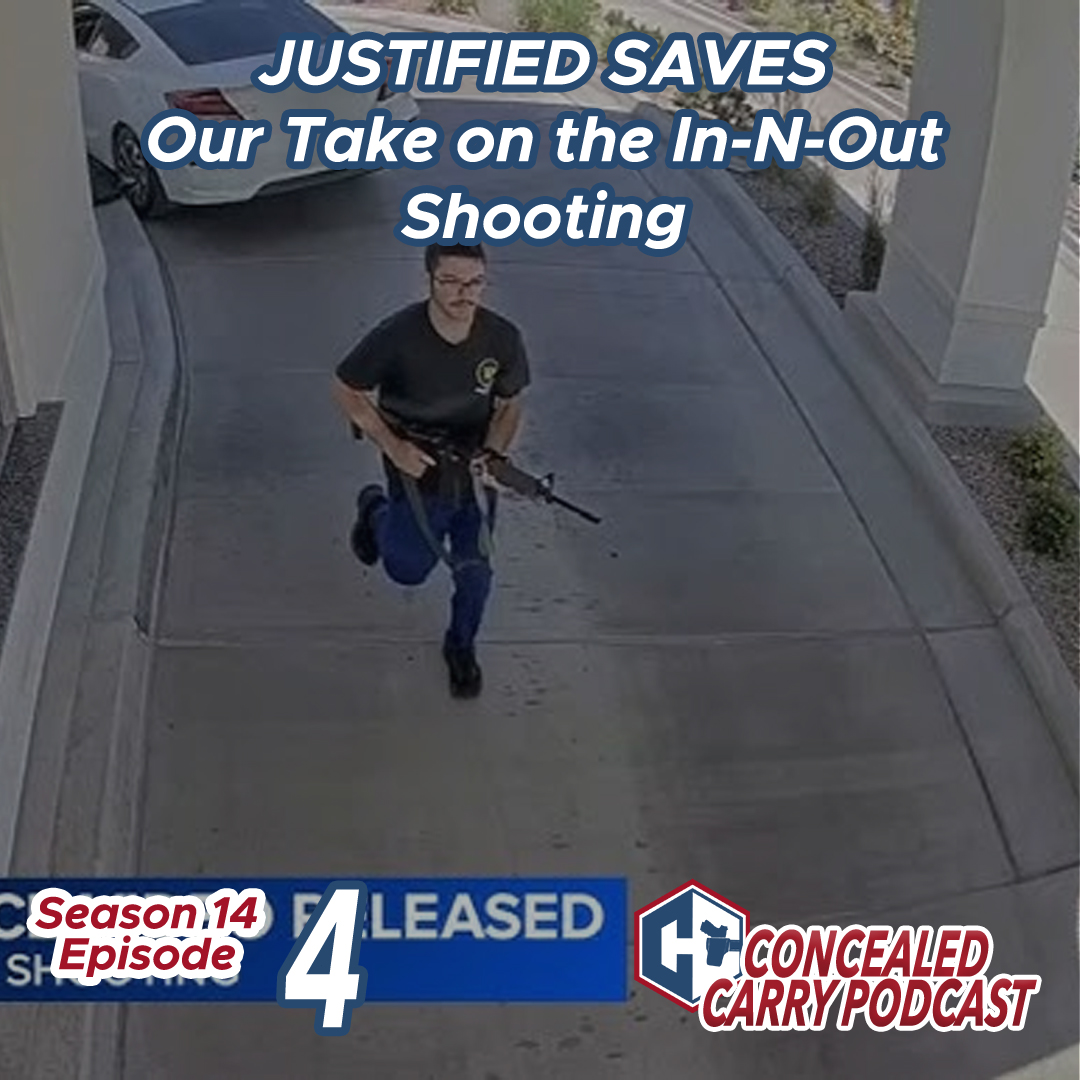
S14E4: JUSTIFIED SAVES – Our Take on the In-N-Out Shooting
About This Episode:
Today, Riley Bowman and Jacob Paulsen have a lot to unpack--and this month, all eyes are on Twin Falls. From a road-rage confrontation that turns into a hard lesson on drawing against an unarmed attacker to a lunchtime rescue nobody saw coming, this episode is packed with real-world defensive gun use stories that test the limits of what you think you know about self-defense.
We dig into the tactical trap of the "unarmed but advancing" threat, a homeowner who'd already been targeted more than once, and a self-defense claim a grieving family is fighting out in public. Plus: our full take on the In-N-Out shooting — what the armed responders got right, what's still up for debate, and the split-second decisions worth studying long after the headlines fade. Tune in so you don't miss!
News Stories Referenced:
- Hancock County prosecutor says shooting of unarmed man falls under self-defense; no charges filed in road rage shooting
- Large police investigation on Avery Street in Rochester
- Tuscumbia homeowner shoots burglary suspect; police report suspect to face charges
- ‘I just want peace’: Man claims self-defense in downtown South Bend shooting
- Dog shot, killed after attacking juvenile in Morton, police say
- Mobile business owner says he shot and killed man in self defense
- Police: Man shot, killed after allegedly stalking victim, breaking into apartment
- Off-duty trooper, former officer, armed bystander confront Idaho gunman who killed 3
Watch this episode
Read the transcript
And welcome to the Concealed Carry Podcast, part of the ConcealedCarry.com network, brought to you by HK. Today is Friday, August 7th, 2026, as of the recording of this live episode. I am your host, Riley Bowman, joined today by... Jacob Paulson. There's the man himself. We are glad to be with you for a Justified Saves episode today. We've got a bunch of great stories.
Probably the most notable one is there's a great example of a justified save just this past weekend in Twin Falls, Idaho. It's going viral amongst the gun folk. Yeah, that's true. That's a good point. There's been mainstream reporting on it, but not nearly as widespread as what it is amongst the more conservative channels and gun channels.
Yes, it's hot to trot. Yeah, yeah. So we intend to share some of our thoughts and our take on the In-N-Out, burger shooting there in Idaho this past Saturday, just a little less than a week ago. Well, a spoiler. In-N-Out is overrated. I don't disagree. Yeah, yeah. I mean, I appreciate the... I appreciate the business and the business model and what they've done to create such a cult following.
And I think they're a pretty cool company. I mean, every In-N-Out location is owned by In-N-Out. It's not a franchise. The family behind the business is particularly the, I think she's the inheritance CEO of the company. Seems like a pretty cool lady. I read an interview with her a while back that, I had some appreciation. They have some good values, family values, Christian values. They're good folks.
But the burger itself, I agree. Overrated. It's just, I mean, good. We're going to get. Props to them for doing good business marketing things. Yeah. But I think I'd rather go to a McDonald's. I hope that's not too strong of an insult. That's a little strong, I think. But I mean it. I'm honest. I would rather go to a McDonald's than In-N-Out.
I'd rather go to Burger King. Sorry, is it getting too strong? Sorry. Sorry to interrupt. I just thought, you know, a little spoiler before we get to the important things. Hey, I appreciate a good burger and fries, and I don't have anything against In-N-Out. I've had it a number of times. Animal style is definitely the way to go. Like, yeah.
Put it on the menu. Yeah. But there are a lot of places I would rather... Eat than In-N-Out for a burger and fries, for sure. Yeah, for sure. Whataburger would be one of those. We're going to get so much hate mail. I would go to Whataburger 10 times out of 10 if it was right next door to an In-N-Out. Yeah, I would never go to the In-N-Out ever.
Yeah. So anyway, now that we're going to get the hate mail rolling in. Hey, if you want to send that hate mail, podcast.concealedcarry.com. That's our email address. Yeah, we just got an email when we were sitting here as we were getting ready to record from somebody who listened to last week's episode who lives in Cheyenne and was reminiscing about the middle-of-nowhere gun range we talked about last week. So, yeah, bring on the email and the messages.
Yeah, yeah. Let us know how much you love In-N-Out. Or don't. Let's see. We've got a comment already coming in. What is it? Five, seven, one stacked. I don't even know what that means. Hello, Kim. Thanks for joining us. If you can interpret that, Jacob, let me know. I think we're talking about FN 5-7. Oh, maybe a reference to the In-N-Out thing, to the shooting.
And one of the heroes of that shooting. Guys, we also have a bunch of other really good stories. And one of the reasons we do the Justified Savings episode is to share lessons learned and things we can get out of these experiences. The likelihood any one of us at any given time or on any given day would be involved in, a shooting, particularly like a mass shooting or, active killer attack you know that kind of thing pretty low or any kind of justified save type incident it's relatively low chance uh for some of us less so than others depending on where you live but it's still a relatively low chance, and uh that means you know this is not the sort of thing that, uh any one person gets a lot of experience in is in self-defense actual you know use of gun incidents right we're in practice.
Us all the time we Never go to the game we think it's highly valuable to study these kinds of incidents and that's what we do here is bringing to you a number of these justified saves i have to let you know every time we go through and pull stories for this, and our sources for these because we're not doing video reviews like our friend john korea or anything like it doesn't matter if they have a video attached to them or not sometimes we get a video sometimes we don't but we pull from all kinds of stories, and I have to filter through and get rid of so many good examples.
Tons and tons of, like, it's interesting because I saw something recently, Jacob, is on some mainstream, I don't remember, CNN or something. It was a more mainstream publication of some sort, and there was a reference, and they were obviously referencing to or quoting from one of the more anti-gun organizations out there, just talking about how, rare it is for citizens to use their gun in self-defense.
Now, I just said a moment ago, it is rare that any one of us would have an incident. But how rare are these sorts of things actually to occur, meaning any kind of justified save or defensive gun use? Not rare at all. I can find an example every single day. Every single day. And those are just... And that's... Just filtering through the ones that are out there and those are the only ones that those are just from the ones that actually get reported on right there's so many more that never even hit the news sites the airwaves and so forth um, and so there's lots of great examples we do the best that we can to bring some to you that are of value in some way, we will get to actually we're gonna do our first sponsor read here in a moment but i do want to let you know our sponsors of Today's episode are CCW Safe, which you can find more at ccwsafe.com, and HK, which you can learn more about at hk-usa.com.
Those are our sponsors today, CCW Safe and HK. But we're going to go ahead and jump right into this first story, Jacob. This is a what not to do out of Hancock County, Indiana. Yeah. It's a road rage situation. And despite being a what not to do, the story starts out by telling us that no charges are being filed. So this is one of those, you know, presumably legal, but not awesome, you know, not awesome situations.
Yeah, it is very clear that, you know, the prosecutor's office said that no charges are filed or will be filed. And so that's fair. So this technically would be considered a justified save, you know, as far as how we define it. But the what not to do aspect of this has more to do with some of the finer, you know, grainier details of the actual incident itself. And there's some takeaways.
There's some really important takeaways, I think, from this incident. You want to give us the facts of this shooting? Yeah, I read to read this one a couple of times because we got two cars. We got a Volkswagen Jetta and a Dodge Journey. Now, first I had to Google Dodge Journey. It's a little crossover funky thing. It's like, what the crap is a Dodge Journey? and a Volkswagen Jetta, I was shocked because, okay, never mind. I'll keep my thoughts to myself.
That was not going to go well. All right. The hate mail would have come more. Okay, so... You had two vehicles cruising, the Jetta and the Dodge Journey. And according to witnesses, the Dodge Journey starts to ride the bumper of the Jetta aggressively. And they come to some sort of construction zone, and the Dodge Journey guy gets out of his Dodge Journey and aggressively approaches the Volkswagen Jetta.
One witness specifically says that the Dodge Journey guy told the Volkswagen Jetta driver, you shouldn't be driving on my road that fast, mother such and such. So apparently we are upset that the Jetta has been driving so fast on our road, and maybe there's other grievances. I like how he says it's my road. Right. You've been driving too fast on my road. So, yeah.
So our Dodge guy, he starts to go back toward his Dodge. But he changes his mind. He's like, you know what? I got more to say to the Jetta driver. So Dodge goes back toward Jetta. Now, Jetta, maybe noting that this guy is coming back toward him, decides he doesn't like that. He doesn't want any more exchange. So Jetta driver steps out of his vehicle with a handgun.
Now, as far as we know, Dodge Journey guy had no gun, had no weapon. There's certainly no mention of it anywhere. Yeah, it actually says in the article, the prosecutor makes no mention of this man being ever armed. Yeah, also doesn't make any mention of them not being armed. It's just not – so we assume, presuming that there was no gun there.
So Volkswagen man says, quote, I wouldn't do that. Don't do that. Get back in your car. So the Jetta guy, he's basically like using his gun and inferring like, dude, stay away. Don't get closer to me. Go back to your Dodge Journey crossover thing, apparently. Yeah. Do you mind? I'm going to put the pause on just a little bit here.
I'll let you continue with the facts here in a moment. But the way I kind of interpret this. Now, understand, folks, we read in between the lines on these stories a lot. Yeah, we do. And it's more about like, you know, it's less about what the actual facts of the incident are and more about what can we get out of this. What kind of situations can we see ourselves placed in that might mirror this or look like this?
I mean, first, try to avoid road rage incidents wherever possible, right? But what I'm talking about here is, you know, it says the Volkswagen driver gets out of the car with a gun. And I'm thinking, you know, in my context, that's strange to me. Because if I was going to get out of my car, getting out of the car with my gun would mean I'm getting out and it's in my holster. like, you know, that or it's in my hand.
But then I started thinking, Jacob, you know, because there's not a context where I would get out unless I was faced with a weapon with gun in hand. All right. Because it's just going to be in my holster. Right. And by the way, I'm not saying I would get out of the car in this incident. In fact, we'll talk about that. I'm sure some more as a lesson learned, but.
The way I can see this happening, and maybe this gives some people some food for thought. So that's why I'm planting this idea here now is some people carry, you know, not on their personal in their car, but they'll have it in a car holster, you know, or put it in their glove box or center console or it's in their cup holder.
And so if you're in that situation and you're like, well, I'm going to, for whatever reason, I'm not saying it's the right answer, get out of the vehicle, but you want to make sure you have a defensive tool available. Because you don't have anything else, and you don't have a holster on you, your only option is to get out of the car with that gun in hand.
I guess you could stuff it in your waistband. But what people are going to do in a situation like that is they're going to just grab the gun. And it doesn't say anything about this guy pointing the gun at the other man until he fired or anything like that or using it in a threatening manner. It could simply have been that he just got out of the car and the gun is in his hand, even though it's down at his side. You see what I'm getting at?
Well, I think he is certainly inferring a threat because a witness says, quote, I wouldn't do that, right? So don't do that. I wouldn't do that. Get back in your car, end quote. So I think that's suggestive that certainly he's holding the gun in some way that's – like he wants – he makes sure the other man sees it. You're reading that quote a little bit off. That supposedly is what the Volkswagen driver said to – The Dodge guy. Yeah, okay. I thought you said a witness said.
Well, the witness says that this is what was said. Yeah, okay, gotcha. This is based on a witness statement. Yeah, yeah, yeah, okay. The witness statement said that the Jetta gun-toting man told the Dodge Journey guy, I wouldn't do that. Don't do that. Don't do that. Get back in your car. So that verbiage suggests to me that he was holding or displaying the gun in some way, that he intended the Dodge driver to see it.
Ah, okay. I gotcha. I gotcha. Yeah, yeah, yeah. Yeah, I mean, so that may be, right? And I'm just saying what I think what I've seen happen in other instances, and that's why I'm bringing this into the conversation here, is someone gets out of a vehicle with a gun in hand. We've seen other situations like this. I'm basically asking the question, Jacob, why? Why would you do that?
Especially if you're not... In a, you're not facing an imminent deadly threat. Right? Yeah, I mean. So you're either making, in other words, you're either making a bad decision. You're introducing a gun when one's not warranted yet, or you're doing it out of necessity because you're going to get out with gun. And the only way you have to do that because you don't carry it on your person is to get out with it in your hand.
Yeah, either way bad. Either way bad. All right. Agreed, 100%. So, despite the Jetta's verbal threats or warnings, the Dodge Journeyman keeps advancing, and the Jetta driver then fires several shots, striking Dodge Journeyman more than once. Dodge Journeyman returns to said Dodge Journey and, quote, succumbed to his injuries.
Yeah, yeah. So, here's the biggest thing that sticks out to me on this. I mean that isn't obvious Like, the Jetta driver is innocent as a driver. Like, he is not a participant in a road wage scenario. Like, we see a lot of these stories we read are two people who are both aggressors. Yeah, yeah. Like, it's usually unclear who pissed off, who first. But you usually have two people that are both aggressors, and they come to some confrontation.
But this is different. I mean, in fact, we had that, what, six, four, five, six months ago, with a scenario where two guys were yelling at each other and they pull off on the side of the road and they keep yelling and screaming and fighting and eventually shots fire off and I'm sort of like yeah I mean who's the innocent party here in the moment that it escalates right but this is a scenario where any of us I think could identify with because based on the information we have Jeddah Driver didn't know he'd done anything wrong he wasn't swerving he wasn't flipping someone off he wasn't slamming on his brakes or you know like he just driving along as far as we know, and all of a sudden someone's upset with him. And it's like, what did I do?
And this guy's yelling and screaming at me. And is he leaving? Is he going back to his car? No, wait, maybe he's coming back. So anyway, I guess the point I'm trying to make is that sometimes we think, well, if I'm just good at de-escalation, if I don't escalate a road rage scenario, then I can avoid these situations. And this is a one-sided one.
This is a proof and evidence that sometimes you can do nothing wrong on the road and not be escalating or being rude and still be targeted by someone else who's having a bad day. Yeah, no, I agree. And I think that's a fair point to make because it specifies that this happened in a construction zone. So I can see this happening where the journey driver, the Dodge driver, manages to get in front of the other guy and it's in a construction zone, which sometimes, might mean that you have a restricted lane, meaning that you're maybe down to one lane, you got nowhere else to go. Maybe that Dodge driver at that point, Puts his brakes on and now you can't go anywhere, right? You got traffic behind you. You can't back up.
So like I can see where this could put a person in a position where it's like I am out of options. Yeah, can't go forward, can't go back. But there are still some options here. And I think that's where the biggest lessons to be learned for us as concealed carriers come from with this incident. And where we call into question some of the actions. Again, not trying to like be too hard on the guy here. And again, prosecution has found him to be innocent, okay? which is fine.
But this is still a, hey, this guy may have gotten lucky with this particular prosecutor, right? In a different jurisdiction, this could play out very differently. Right? Yeah, and legal things aside, before this incident happened, there was one more Dodge Journey owner than there is now. Yeah, yeah, and that has a psychological cost.
Yeah, like the man, like someone might have one, like there could be kids out there that don't have a dad now. Yep. Wife that doesn't have a husband, someone who doesn't have a son, doesn't have a brother, and who knows how many family members are impacted by the loss of this man, let alone our presumably innocent victim who now has to live with the fact that they just took someone's life over a road rage incident.
And that bears a psychological and emotional cost. That's the crazy crap here. Yeah. Did you dodge a legal bullet? Probably. You probably did. But more importantly, you fired a bullet that took a life. Like, this is crazy. Yeah. Yep. So it comes down to, get out of the vehicle or not is how I see this. And I don't – I can't –, And we maybe don't have all the facts here, but why? Why get out of the vehicle?
If the other guy doesn't have a weapon. Right, if he's not armed. Okay, we're going to make that assumption here. If he doesn't have a weapon, right, he doesn't have anything he's using to try to gain access to your vehicle, like what can he do to you while you're inside your vehicle with it's secured, doors locked, windows up, right? Like what's the worst he can do?
Yeah. Right? Have you ever seen a guy able to punch out a vehicle window? I haven't. You don't know how hard it is to actually break automobile glass unless you have a very, very sharp pointy thing. I've seen it in the movies so many times. So Riley's clearly wrong. I mean, I'm remembering another vehicle road rage incident in Vegas where one man's kind of the innocent guy. The other guy's the aggressor.
And he refuses to get out of his car when he's being attacked. And so the BG starts destroying his car. Sure, sure. He takes a crowbar, a tire iron or something, starts breaking headlights. You know and so then then the innocent guy gets out of his car and they do a little dance around the car it ultimately he's trying to get back into his car and when he's not able to he has to shoot the other guy so you know again like it's it's like what what would it take like how much has to happen for you to finally say i gotta get out of this car and the answer should be a lot it would take a lot to cause me to get out of this car like you'd have to take out a window that gave you access to one of the humans inside. That's what it would take for me.
Like, yeah, if you had a crowbar and you bust out my driver's side window, and I'm like, oh, now you can hit me in the head with a crowbar. Okay, like now maybe I got to do something. And maybe staying in the car and shooting is the best option. Maybe exiting the car is better. That opens up all sorts of other things. The other thing here, and I've noticed this kind of, I don't know if trend's the right word. It's not, but...
So we've seen over the years a number of instances, Jacob, where an unarmed man continues to advance towards an armed man. There's actually a highly publicized case here out of Aurora or Arvada or someplace, in our Denver metro area where an officer is now facing charges because he shot an unarmed man. Because that unarmed man continued to advance on that officer who already had his gun drawn.
And so just because you have a gun drawn does not mean that the other person, the aggressor, is going to make a logical, reasonable choice of going, oh, hey, man, I don't want to mess with this. Yeah, that's a good point. You know what I mean? We kind of assume or presume or just think that, like, if I show this thing, I win now.
Yep. Argument over, you're going to go away. Yep. It doesn't often work out. And so that's one of the other subtle lessons, I think, of this incident is that once the gun is introduced, especially in a situation where the other party is unarmed, if they call you a bluff, meaning they come at you still like as if you don't have a gun, it almost forces your hand because you have a gun out.
What could happen? Well, they could take it from you, and then you really have a problem. And so you almost get in a position where you feel obligated to now use it, and you're using it against somebody who's not armed. It's a gamble is what it comes down to. You're betting some odds, and if you win the gamble, great. But if you lose the gamble, great.
Man, high risk, high reward, man. Yeah. Well, I know we spent some time on that, but I think there's just a lot of interesting angles of that story there. And we want you to be thinking about this stuff because this is the sort of thing you want to be making decisions before you ever have to make the decisions. And that's what Jacob just did. He's like, you're going to have to do a lot.
You're going to have to cross some major thresholds to get me to come out of my vehicle if I'm the innocent party in a road rage incident. Yeah. And that's a wise decision to make ahead of time. Okay. So you're not just reacting in the moment and you're reacting more emotionally as opposed to using your brain. Okay. At this point, we're going to take a quick break for our sponsor, CCW Safe.
And I think that story is a perfect example for this too, because I'll tell you, hey, we don't have to make perfect decisions as self-defenders, but we do need to make reasonable ones as best as we can. Based on the information we have in the moment. Right, right. We can always look back at a situation. That means ourselves, if we were the first person involved or looking at somebody else's problem.
But we can always look back and find ways to do better and to improve. So you don't have to make the perfect decisions, but you do need to make reasonably good ones. And even when you do make reasonably good decisions, it's still possible you find yourself faced with legal charges or a legal fight of some kind. Even if you're not facing charges, who knows? I mean, maybe the family of this guy that just got shot decides to sue this guy. Yeah, sure.
And I don't know about the laws in, what was it, Indiana, okay, if there's any sort of preclusion that he's been ruled innocent in this case, no charges. The charges just haven't been filed. Yeah, so there's a possibility he could still see a civil lawsuit. Wrongful death suit, right? Yeah, sure. So anyway you want to have a good, I was going to say program, but program is the wrong word. You want to have good people that back you up, like the folks over at CCW Safe.
And that's what they are. They are people that understand how this stuff works. They do their job very well, and they believe in backing their people, their members, with the best insurance, in my opinion, insurance. Okay, legal coverage in the industry. That's CCW Safe, ccwsafe.com. Anything else you want to add? The magic of that company and that product is their critical response team.
As far as I know, they're the only company in that space that has a critical response team. Not someone who takes phone calls in the middle of the night and says, oh, yes, we will send money and lawyers. Like a critical response team that takes the call and says, let's mobilize, let's roll. And that critical response team is made up of former prosecutors and investigators who've been on the scenes of these events many times.
And so that is the magic. When you said it's about the people, that is the magic. They just hit their 15-year anniversary, by the way. I saw they were celebrating 15 years. Yes. Congratulations, CCW Safe, on 15 years of being, in our opinion, the best company in the business. So we hope that you guys will consider joining CCW Safe today.
If you haven't already, go to CCWSafe.com and learn more about their specific programs because you can find one that will fit your needs. I'm pretty confident. And just a reminder that Guardian Nation members save a discount as well off CCWSafe membership. So thank you, CCWSA, for your sponsorship of this podcast and of today's episode.
Let's get to our next story, Jacob. Because I know we've got people that are waiting for us to talk about the In-N-Out thing. That's kind of a big one. But we're going to get through a couple of other good lessons. You're jumping to Rochester, New York. Rochester, New York. All right. It's a relatively brief story. There's not a lot here.
I mean, but there's some context that matters. You're the homeowner. Yep. And your house has been broken into twice in the last couple of months, twice in June. Yeah. And so now fast forward, it's been a couple weeks, months, month. And you can wake up in the middle of the night because you hear someone trying to get through the back door.
Yeah. It's like, here we go again. Yeah. That's exactly why I included this story in today's episode. It was that little detail where the guy, you know, the homeowner apparently tells investigators that, hey, my house has been burglarized. twice since June. So in less than two months. So basically he's averaging more than one break-in in burglary per month this summer, right? Yeah.
And that's a problem. So I suspect... That probably put this guy a little bit more on edge, probably made sure that he was prepared a little bit more. So he's got his gun or he's carrying his gun or he's making sure it's loaded or whatever it is. Because on this fateful morning, it happened at 4.15 a.m. You know, I'm probably guilty of feeling like most bad guys go to bed at some point, Jacob.
You know, like you kind of think, ah, midnight, 1, 2 a.m., maybe 2.30 in the morning, you know. And then things ought to start quieting down, right? But no, no, no, no. We actually have quite a few incidences like this that happen in the wee hours of the morning. 4.15 in the morning. Well, the highest time, like the, what's the word I'm looking for?
The time of day that indexes the highest for home burglaries is like 10.30 in the morning to like 1.30 in the afternoon. Right. So yeah, we associate criminal activity with like a late night thing. Like these are people that sleep in and then stay up late. But the data doesn't support that. Right, right. So these kinds of things can happen any time of day.
And this one happened at 4, 15 in the morning. And as was mentioned, guys had his house burglarized a couple times. So he happened to hear this person trying to break in through the back door. That person apparently gained entry because the intruder was found dead in the man's kitchen in the home. He met officers there, and that's where they found the dead BG.
Yeah, so I mean, the way I presume it is like, oh, so I hear someone's rattling the doorknob, trying to get through the back door, grab gun, go downstairs. Oh, this guy's already in the house. He's in my kitchen. Confrontation. Pa, pa, pa. Yeah. That's how the journalist wrote the sound effect when described by the neighbor that he heard a pa, pa, pa.
Yeah, yeah. And this story was also notable because this was in New York. Now, it's Rochester, which is not New York City necessarily, but we don't actually come across as many justified safe stories out of New York, which I think is probably because there's not as many people that are armed. I could be wrong in that. Well, I mean, Rochester is, like I said, it's not part of the five boroughs or whatever. And so this is a place where there's probably a much more high occasion of people being guns. But, yeah, I mean, the article had to point out that this gun, the man is a licensed carrier and the gun is registered or, you know, something like that. Yeah. Good job, journalist.
Yeah. Here's another story. Tuscumbia, Alabama. Homeowner stops a 3 a.m. break-in. So here we have another early morning or late night, depending on how you want to interpret it. but early morning break into a home, Um, about 3 a.m. on a Saturday when officers received or dispatch received a 911 call, deputies with the sheriff's department there, uh, excuse me, the police department responded.
Then it says deputies assisted at the scene. Um, anyway, homeowner, this is the best detail I've come across a story in a long time. There's not a lot of details to the story. That's why this particular thing stands out. Yeah. Because after it just kind of lays out the groundwork of where it happened and what time it happened and which officer or agencies responded, it then just says this.
Authorities say the homeowner shot the suspect in the feet during the attempted burglary. That's it. That's the whole story. That's all you get. After that, the suspect's taken to the hospital. He's expected to face charges, not life-threatening injuries. That's it. That's it. That's all we get. And we were talking about this one before. And I had read it before, and I said something like, yeah, I got shot in the foot. And you're like, no, feet, plural. And I was like, oh, crap, you're right.
Presumably each foot got shot. Yeah. I mean, so I don't know what happened here, but this is a very fascinating detail. Get out of here, I'm going to make you dance. It makes me think that there were some warnings issued and maybe some warning shots that were aimed downward and aimed at the feet. I don't know the whole context here, but it's just an interesting little detail.
I was telling Jacob, I think this is the first time I've ever read in a story like this. We've covered many of these over the years where it's specified a, bad guy being shot in the feet. We've seen arm or hand or leg many, many, many times, but specifically feet. And not just one foot, but feet. Yeah, who knows? That was intentional or accidental? or just really bad marksmanship?
Yeah, it's really, really, really bad marksmanship if they were trying to hit somewhere else. Yes, yes, yes. So that's kind of an interesting one. Let's go now to Morton, Illinois. This one really got my attention. These sorts of things aren't super common in the justified saves category, Jacob. But we've had a few stories over the years that are similar.
I can specifically remember, I think Matthew and I talked about, I think it was me and Matthew. Maybe it was you. I don't know. Oh, we had one out here in Aurora not that long ago. Sure, sure. But I remember a story once where we talked about it more from the angle of it wasn't a justified save. It was just a, what can we learn from this? and it was a little girl being attacked by a vicious dog and the mother was basically, like, the girl died and the mother failed to defend her daughter from this dog attack.
It was really, really sad. It really, like, hit me in the feels, you know. And it just was one of those lessons of, like, I mean, these kinds of things can happen. And dog attacks are a crazy thing. I mean, most of us don't have vicious dogs and don't have to worry about it. But we might have to worry about somebody else's vicious dog.
And those things can be very unpredictable. They can happen out of nowhere. And you might think, oh, it's just a dog, right? But no, these things can be really, really vicious, and they can do a lot of damage in a very short window of time. Fortunately, this one ended a lot better than the example I was just referring to.
But basically, we had a dog attack. This is Morton, Illinois. It was a juvenile. I don't know how young exactly. Two dogs are involved actually. Yeah, that's right. A pair of attackers. And that's not uncommon either, especially when one initiates, especially if it's more of the alpha, if you will, then other dogs will a lot of times join in.
Two dogs begin attacking, it says, this juvenile, okay? It says there was an animal control officer that found them attacking the juvenile. A village of Morton employee. I assume, maybe that's somebody in addition to the animal control officer, but then it says there's a private citizen who stopped to provide aid, okay?
Before the juvenile was taken to the hospital. Before they're taken to the hospital, okay? It also says here that before officers arrived, the dog that attacked the juvenile charged at the aforementioned citizen. So we've had the attack, right? And a couple of people have stepped in and they've managed to end the attack, the initial attack.
The juvenile is obviously injured and is going to be transported to the hospital. But before cops, like actual sworn law enforcement officers arrive on the scene, the dog that, and it just says, now it says the dog. So one of these two dogs that was involved in this attack now charges at this, the good Samaritan citizen that stopped to help.
At that point, the citizen, and it says, who was a concealed carry license holder, drew and discharged their firearm and killed the dog. The story is really poorly written. I'm still not sure that what you just described as the narrative is exactly what happened. I'm trying to read it as clear as I can. It's certainly a viable possibility that that's how it went down.
But it's just either the detail's not there and or in my opinion it's just not written well. Yeah, it could be. But one way or another what's clear is that a licensed concealed carrier shot a dog that was charging the gun owner. And that the same dog along with another dog had been attacking a juvenile. So that's, you know, you know, a common question I get in firing training classes when we're talking about legal things is people want to know if they can defend their animals with deadly force, which as a general rule is no.
But the opposite of that is, well, but can I defend an animal that is using deadly force? And that answer, of course, is yes. And that's what happened here. And so I think that we always kind of presume that the threats are going to come from other humans, but I suppose the threat could come from an animal. But I'll just add this one last thought, and that is that And mentally rehearsing how I would shoot a dog is tough.
I don't mean like emotionally. It would be tough emotionally because I'm a huge dog guy. But I mean like tactically speaking, dogs move very fast. Absolutely. And if they're in the progress of an attack, then you risk shooting the person they're attacking. And we've covered a story or two where that very thing has happened.
Where the innocent person that's being attacked gets shot. Gets shot. So now in this case, it looks like we sort of pry the dogs off the juvenile and then there's a charge and a shot fired. So, you know, that would seem like some good judicial judgment was used there. But you're also generally probably outdoors. So you're shooting into concrete or asphalt, things that tend to see bullets keep moving in directions that are sometimes highly unpredictable.
Uh so so dog charging at you and shooting that dog that's that's that's not going to be easy yeah and waiting for it to you know latch onto your arm and drag you around and rip the muscles from your bone would be a difficult moment to try and shoot that dog Absolutely and so it's a great reminder and a point here to be made that, we got to absolutely be certain of our backstop wherever we're, firing those rounds because there is a definite possibility, probability maybe even of missing and you got to be accountable for those errant rounds go.
Or depending on the size of the dog, the dog may not be as meaty as a human and our defensive rounds are generally designed for human threats. So it's possible too that you could shoot and hit the dog but still have a round that could pose a threat to somebody else after it passes through that dog. Got to know what your backstop is and make sure you got a clear shot if that's the sort of thing you got to do.
I'll also mention that something like palm pepper spray, which I've got here in my pocket, uh, has been known to be effective against dogs. And so there's other options too, potentially. Um, obviously you won't have that option if you don't carry it. Okay. So, um, it's a good idea to have this. I, you know, I go for my runs in the morning, Jacob, and I, you know, I go for runs where I'm carrying a gun too, but I always make sure I have my pepper spray with me on my morning runs.
Yesterday I got surprised by a dog actually, and fortunately it was friendly, but it initially barked at me and I wasn't aware of it. It was around the corner of a fence, and all of a sudden he's just there and he's rawr, rawr. And then I was like, ooh. Unfortunately, my hand went to my pepper spray. I was getting ready, but then he wagged his tail and looked a lot friendlier, And I was like, oh, okay.
So anyway, just some things to think about there. Let's go to Tulsa, Oklahoma now. This one's a little confusing because it's like someone has a business, but it's like the business is in like a home. I don't know. I mean, that's the part that's confusing. The rest of it's pretty straightforward. Yeah. So I opened the wrong link there. There is a little bit of an image you can see. Sorry, it wasn't.
I did state the wrong location. Mobile, Alabama. That is the next story. It is the business owner you're referring to. So we're going to Mobile. And so you can kind of see there's a fence and there's this carport. It's kind of like behind the business. Yeah. So, I mean, yeah, I think it's the image helps. Yeah. But you have a business.
And there's, like, a fenced-in parking area. Maybe, presumably, it's kind of, like, behind the business, not, like, the retail front of the business. There's a car here, and it's got, like, a number on it. It wouldn't surprise me if this is, like, an auto repair shop or a small time, you know, like, maybe a car dealer of some sort.
There's a warning that your car could get towed if you park in this area on the fence. Anyway. So, the guy's doing something out there behind his business. He said he was repairing the fence. Repairing a fence. And another guy drives up and asks for money. So he gives him some money. Yeah. Maybe not as much as the guy wanted, apparently. And the money-begging man decides that he could get more than what was given and that a good way to get it is to aggress on this man who's repairing a fence in this business parking area.
Right. So he gets out of his – the money-wanting man gets out of his car with his gun, and he aggresses toward our business owner. The business owner sees what's happening, freaks out, and this is where it gets a little bit confusing because he says that he kind of like runs into this carport or back into this carport and tells a bunch of kids who happen to be hanging out there in the moment.
It doesn't say his children. He said a couple of adults and children as well. And tells them to like, run, go away. He's got a gun, you know, kind of thing. Yeah. And so presumably those people do kind of run and go away. And our business guy, fence repairing man, Retrieves a gun from a vehicle that presumably is in the carport thing.
And as the money-wanting man further aggresses, boom, boom. Yeah. End of threat. So there is a fencing company of some sort right there that matches the address. What's a fencing company? Fence repair. So he's repairing. It's called Mobile Fence. and, it's kind of a little bit of a more rural looking industrial kind of area it looks like there could also be a home on the property that's kind of what I interpreted from the story is that this may be a business but, a business on the property where the person lives as.
Well sure sure sure That kind of helps maybe some of the context because you're like what's up with all these people. And he's grilling Hot dogs yeah exactly. Grilling hot dogs when man demands money wants Cash I suspect this is a small family literally family business you know because they probably also live there but, Yeah, so you got this guy that starts threatening the owner of the business.
And he does a couple of things really good here. You know, first he runs through the, it says through a carport where other people, including children, were sitting. And tells them to run and hide before grabbing his own gun. Okay. And then once he gets his gun, he then hides behind a car. Yeah, specifies. So he doesn't like go straight to, you know, like, all right, I'm going to use this gun. No, he's like, I'm going to hide.
Hopefully my kids and whoever else is hidden too. And then he apparently is found by this aggressive man. And that's when he ends up shooting this man. Pa-pa. And, yeah, it's interesting. The thing that I picked up on this, besides there's some interesting details, Jacob. It's one of those stories. And I think we have another one actually still get to come.
Where it talks about someone having to retrieve their firearm. Yeah, it's unclear to me. The first time I read this, I had this impression that he retrieved it from a vehicle. But then rereading it just now, it doesn't say that. It just says that he retrieved his gun. For all we know, he retrieved it from his pants. I mean, I don't know.
But yes, what's clear is that if he had this gun on him, he had more options earlier that he just didn't exercise. There is a detail here it is this is probably what you thought vehicle said let's see, Said Bagley, then shouted Hughes. Oh, the bad guy here is the one that reached into his truck and grabbed a gun. Maybe that's why I like planted in my mind or something.
Yeah. But yeah, so it's unclear if our good guy had the gun on him or not. If he did, then he made a judgment call to not engage immediately, but to retreat to cover and warn off these other innocent people. Sure. Which could have been a very viable, you know, good decision. Or not. I can see that. But I still, and I know, I'm reading into it, and you could read into it a variety of ways. But I think if you have the time to run through the carport, tell these other people, run and hide.
Like, you could also be drawing that gun while you're doing that. You know, so the way it's written before grabbing his own gun makes it seem like he did these other things and then grabbed his gun. Like, because it's somewhere else. I don't know. It sounds that way the way it's written. I agree. I think, though, his use of cover was very prodigious, and that's one thing that calls this new story out to me, is that we see a lot of scenarios where it seems like it's an ambush situation where you really don't have time to seek cover, or we see situations where people just don't seem to seek cover.
But this is a scenario where very clearly and intentionally our good guy put object, both potential cover and certainly concealment between him and the bad guy and then waited for the necessity to have to use the gun. Yeah. So that was all very judicious. So, interesting story. Let's go now to the Tulsa, Oklahoma one. All right, now we're in Tulsa.
Man shot, killed after allegedly stalking victim, breaking into apartment. By the way, if you want to follow along or check out these sources for yourself, you can always find them in the show notes of this episode once it's published in the podcast feed. Authorities are investigating after a man was shot and killed after allegedly breaking into apartment in Tulsa, it says. About 5 a.m. So again, here's another like early morning incident.
And it says that 41-year-old man, he's the suspect in this situation. He's ultimately the one that gets shot and killed. He's the one that broke into the apartment. And then it goes on to say that he stalked and threatened the victim and her boyfriend. So the victim here is a female. And her boyfriend, well, as soon as you say the word stalk or stalking or stalked, Jacob, I immediately think this is a domestic sort of situation, that this guy and this girl are former partners, you know, because, like, yes, stalking does happen between unrelated people, but it's more common, in my experience, between, like, former lovers.
I hear you, but it also has this detail that says, stalked and threatened the victim and her boyfriend near a local nightclub. So that gives me an opposite impression. It's like they ran into this dude and he started following them around and they're like, hey, leave us alone and followed them all the way home. It could be either. Perhaps. But I agree that stalking implies that.
Yeah, I see the word stalk and I'm like, you know, anyway. But he stalked and threatened the victim and her boyfriend at the nightclub. And then it's that next morning he forces his way into their apartment. And that's where apparently the boyfriend shoots and kills him. There's another detail here that's really interesting. Somewhere in the stalking thing near the nightclub, in that moment where they were confronted with or engaged in this man, the man, the bad guy, tells the good guy and his girlfriend that he had served time for murder and was not afraid of law enforcement.
So maybe they're like, hey, back off. We're going to call the cops, dude. and he's like, I've been in jail for murder. You think I'm afraid of cops? Right. I've killed people, you know? So, you know, I think that's important because it sets this precedent for a threat of violence. Yeah. Right? Like, if you're the good guy or the girlfriend of the good guy, the girlfriend's also a good guy. I guess I'm referring to the man as the good guy because he's the one that fires the shots all the time.
So, but if you're among the good guy couple, then I think you have this sense of, like, this guy's not afraid of the cops. Like, you know, he just told us he's killed people before. So, you know, when he comes breaking into the house – Like, you know, it's not some random 14-year-old boy. Like, this is the guy who's been trying to attack us, who threatened us, per se, or at least let it be known that he's not afraid to kill people and he's not afraid to cops.
Yeah. That's relevant. Yeah. It is. There's clearly – and that's where I thought, you know, maybe there's a little more of a history between these people, you know, than what we get from this story. Because, like, how do they learn that detail? I don't know. You know, that's kind of interesting. Unclear, sir. But we don't know. But one thing I was going to say, if this was, and I'm not saying it was, but if this were...
Like a former lover of this woman, okay, who's upset that she's no longer with him and now she's with somebody else. And so he's mad about that and he's stalking her and he's traced him down to this nightclub and then has found out where they live. You know, because that sort of thing happens pretty often, unfortunately.
What I wanted to add to this, just assuming those things, and I know I'm making big assumptions. We have legislators that want to put laws in place well we have one unfortunately here in Colorado now with a waiting period to be able to purchase a gun and stuff like that, because supposedly those things reduce crime which history has shown does not.
But I worry about those kinds of things because it's not uncommon to have a woman who's very vulnerable has just gotten out of a bad relationship and has a bad dude that's still trying to come after her. And, those are very difficult times. And that woman has a right to self-defense. And she may never have had to think about it before, but now she does.
And maybe, yeah, she needs training, yes. But you've got to solve problems, you know, the most important problems first. And the number one rule of a gunfight is bring a gun and have a gun, right? or in any kind of bad, violent situation. And so anyway, it's just another data point, I put in my little database, Jacob, of this is the kind of situation, potentially, if it's that kind of situation where you got this ex-lover situation and you want a woman to be able to defend herself, she's got to have the means to do that.
And putting roadblocks in the way of achieving that aren't the way to go about it. We also have to remember that most of the bad guys in most of these stories are not rational. Like you, we, most, you know, if you're listening to or watching this podcast, you're probably a pretty rational person. And the problem with being rational is that we tend to see the world through the paradigm of which we are.
And so it's harder for us to recognize or anticipate what, you know, the actions of a very unrational person would be. And so, you know, someone would stalk you like this and force the way into your home and, you know, with who knows what intent. Like, people who are listening to my voice, like, we wouldn't do that. So, sometimes we have to remind ourselves that there are people who would do that. And that's a problem.
Mm-hmm. It is. All right. Jacob, we're going to forego the second to last story just because of time. And because we've been keeping people waiting on hearing our take on this in and out shooting in Idaho. Yeah. And that is really the big story of the day. It's a huge story. And it's one that's still being investigated. And there's still going to be probably details that have yet to come out that really need to come out.
But it has been long enough. I think it's fair enough to comment, at least about what we do know at this point about it and to share it. And chances are, if you're watching or listening to this podcast, you're probably already familiar with this incident. So the details you may already be fairly familiar with. But let's just rehash it really quick. And first, there's a little bit of a personal connection for me because this happened in Twin Falls, Idaho.
I'm the Idaho boy. You're the Wyoming kid. And I'm not from the Twin Falls area, although it's not that far. It's like two and a half hours from where I grew up. Sure. That's a pretty spot. Yeah, it is. I mean, just north of Twin Falls is Snake River Canyon or Gorge. It's a really impressive sight to behold. There's a bridge. It's called Perrin Bridge. You drive across this bridge.
If you're coming from the interstate, you drive across Perrin Bridge to get across into actual Twin Falls. And... That bridge is super famous, like tons of daredevil types jump off of it, you know, base jump, all that. Evil Knievel tried to jump himself in a car across that gorge back like 50 years ago, you know, and so.
It's gorgeous. Yeah, it's a pretty cool spot. It's big. In 2005, I asked my wife to marry me on the center of that bridge. No kidding. At sunset. Wow, okay. Yeah. Riley's a romantic. I don't know what to tell you. But yeah, to your point, this is an area you know well. I know it. And in fact, was there not that long ago because just a little more than a year ago, we stopped there as part of a family trip. We wanted our kids to see...
We wanted to share with them that moment where I asked my wife to marry me. In fact, we happened to be able to stop there really close to sunset and go out into the middle of that bridge and watch sunset over that canyon. Man, what a romantic going back to the scene. The exact same way it happened when I asked her to marry me.
That's cool. This was just like a year, year and a half ago. Two summers ago, I ate at the Noodles & Company that's down the road from this In-N-Out. There you go. Yeah, I was coming back from Boise. Yeah. So, yeah. Yeah. So, anyway, kind of hits close to home. And, in fact, I think they were maybe just starting to build this In-N-Out location when I was there the last time.
I remember there being some construction there. It's on the corner near the visitor center to this bridge. But, anyway. But, yeah, the noodles are companies there. So, you really have no reason to go to an In-N-Out. Yeah. Continue. So this In-N-Out just opened basically a week before this thing happened, before this incident happened.
And anyone that knows an In-N-Out grand opening, it's a crazy thing. They just, you know, a couple years ago had an In-N-Out open up near where I live. And, you know, they had to have special traffic control, you know, because cars are lined up around the block, you know, waiting to go through there, waiting for hours. That's the thing I don't get, Jacob.
Well, animal styles would change your life. You can't get me to wait for hours to eat anywhere. It does not matter. So anyway. You know, there are some barbecue places in this country, like real famous ones, like Texas, like only open on Saturday. Have to be there by 5 a.m. if you want to get a meal by 11 a.m. I'd wait for those.
Maybe. But not in and out. Maybe. Yeah. So anyway, August 1st, Saturday, last week, the perpetrator is 24 years old. Apparently he drove, he was in the drive-through lane himself, as far as we gather. You know, video that was captured shows him going back into a white vehicle and opening the trunk. And I presume that he would not have been opening the trunk if he wasn't familiar with that vehicle.
Uh and it seemed watching that like he was going to get something else out more ammo a different gun i don't know uh which he apparently wasn't successful in doing that at least that we saw in the video. But he actually started the shooting inside the In-N-Out. People scatter. They run away. He then goes outside, starts shooting at people and passing cars and shooting at cars that are parked in the lot.
It's well known that there were a couple of Teslas parked there charging, and he fired into those vehicles. There's a lot of conflicting information or at least confusing information or information that sounds like, for instance, We know one of the injured victims, Jacob, was a man who is like an Uber driver, and he drove a Tesla, and that he was parked there, presumably charging his car, and he gets wounded.
So he's in his, and I think it did happen, I think he got shot outside of his car, but his car was parked right there. And yet we have video showing this guy shooting into the windshield of another vehicle, and we know that in one of those vehicles was also somebody who was shot and killed. So it sounds like there's a couple of Teslas that have victims, unfortunately, associated with them.
The unique thing about the Teslas is if they're plugged in charging, they can't just leave. You have to manually get out and unplug the Tesla before the Tesla will actually let you drive away. That's a safety feature so people aren't driving off and ripping electrical cords out of chargers and stuff. Seems reasonable. So, shoots and kills three people, wounds I think seven others.
And all in the space of just a few minutes. And, of course, what we know as of right now, what's being reported is now famous Jordan Salinas. He's the civilian that chose to engage the shooter, famously with a 5.7 FN 5.7 pistol with a suppressor on it. In a shoulder holster. In a shoulder, out of a shoulder holster. We'll talk about that.
An off-duty police officer, I think State Trooper, was also involved. But then there's talk about, and he's also one of the injured, not the off-duty trooper, but a former police officer who confronted the shooter and did so unarmed. Even though he was carrying a gun, he talked, his name is Austin James. He expressed concern of being mistaken, you know, in this active shooting event.
And he therefore didn't draw his gun. It sounded like he rounded the corner of the building or something and then was face-to-face with the shooter and got himself shot and was unable to defend himself because he had chosen not to draw out his gun. Anyway, a very chaotic event. What police have stated is that the actions of the off-duty trooper and Jordan Salinas returning fire likely was a factor in driving away the shooter away from the incident and eventually led to him committing suicide, a short time after that.
Anything else relevant detail-wise? Uh, the off-duty trooper who engaged the shooter, uh, they said did so from inside the restaurant. Okay. Um, and I, and, uh, uh, our good guy Samaritan did so from outside the restaurant. So, you know, it's the, some of the timeline related elements there are unclear to me and maybe one day we'll find out.
Uh, but you know, maybe, maybe what drives the shooter outside is that someone inside is shooting at him. So maybe he goes outside and that's maybe when he can, you know, is confronted by another defender who's shooting at him. I think, yeah, as far as the narrative, I think that roughly covers it up. Yeah. Okay. To clarify, he did not, because you said he committed suicide, he didn't go very far. He basically retreated from the in and out into a different section of the parking lot of the general business area, and that's where he ended his life.
And no word about if he was hit by any of the rounds, fired by these responding, these other shooters that tried to take action. But that's actually not really relevant. If they manage to distract the shooter, keep him from achieving his goals, whatever they were, take his focus away from finding victims. Because, I mean, the way this is going to go is once he's started the shooting and people start scattering, then it becomes essentially a hunt, right?
Now he's like, okay, where's my next victim? Where's my next victim? It's hard to do that when you're trying to dodge bullets coming your way because bullets are now going both ways. So these guys that stepped in and tried to do something about it, whether they landed around or not, this is my first analysis point, Jacob, is that they made a difference in the outcome of this whole thing.
Active shooters are cowards, and both from a logical perspective, but more importantly, like from the data of this. Ed Monk just reminded us of this in the webinar he did last month, which is in Guardian University, if people haven't seen it. The data is really clear. The number one way to end an attack immediately is to send bullets, like, to confront them.
It doesn't matter if you hit them. Like, these kind of aggressors are cowards. The second they meet opposition, they end it. It's just the way it works. Either they end it by taking their own lives or they surrender. It's just consistent. Like this is one of those like 98% of the time kind of statistics. So opposition is all it takes to end these attacks.
So yeah, I mean, I don't know if he shot him, if shots landed and this guy was bleeding out or I don't know. But what's clear is that he stopped shooting other people the second he met armed opposition. Yep. Yeah. And so huge, huge, huge props to Jordan Salinas. Who's, of course, the famous citizen, civilian shooter dude, the off-duty trooper that was involved as well, and also Austin James, who is the man that attempted to engage the shooter without drawing his gun, because I think all three of these men made a difference in the outcome and saved lives in this situation.
Going back to the Ed Monk webinar, Jacob, guys, you really should go watch that, by the way. There's a lot of, I mean, how timely that, it could not have been more timely to have that webinar with Ed, just really a few weeks ago before this thing happened here, because so many lessons to be taken away from that. And to your point, you just talked about, like what I got the most out of that webinar, and from watching Ed present other times too, like at TAC Conrader this year, is that an active shooter event, It's all about the time.
Yeah, that's the reason his book is called First 30 Seconds. First 30 Seconds, right? As soon as that first shot's fired, the clock is running, okay? And, I mean, the thinking is that every minute on average, right? Yep. One person dead. Yeah. And obviously over time, the number of people per minute that died decreases.
But, yeah, like for all intents and purposes. Yeah. The averages per minute of an active shooter event, that equals one death, over all the data, all the different shootings have happened. And so the number one thing is, you just said, Jacob, that needs to happen is something has to counter the carnage, the violence, the actions that these cowardly shooters are taking.
And the sooner that happens, the sooner we actually save lives. Even the injured people Seven injured people that could have all Bled out and died, I mean I don't know how many of them had Vital wounds, but that's when we End the attack that allows medical Personnel to get on scene and start Saving lives as well So even Outside of the ten people who were Shot, three dead, seven injured You have to consider that seven injured Is seven injured because The speed at which we're able to get Medical personnel to them Speaking of Austin James, the former police officer, he was shot in the humerus.
That's your main arm bone. And it said he had an arterial bleed. It severed his artery, presumably his brachial artery, right? Which would be just on the inside of that humerus. His wife, who is an ER nurse, fortunate for him, and a friend that was apparently with them, who was also an ER nurse, went to work on him. They probably couldn't have done that until the situation was over.
And he was losing blood fast. They talked about how they had to apply a tourniquet to him. That's a one to three minute dead scenario. Yeah, I mean, so that's perfect point, Jacob, that the time matters, not just in terms of actual people getting shot, but those that are, I mean, yeah, they're obviously shot, but you know what I mean?
People dying, but also people may die further if we don't get it ended soon enough that we can get folks to the hospital that need to get to the hospital. That guy, Austin James, was definitely one of those that needed to get to hospital ASAP. So yeah, really sad, tragic event. Uh, of course we don't, none of us like seeing these sorts of things happen, no matter where they happen, how they happen, when they happen.
Um, but I think it would have been worse if there hadn't been multiple people in the area, Jacob, that were willing to take action and were armed. And I think if you're going to try to commit a mass shooting, uh, there's better places as far as targets to choose in Twin Falls, Idaho. Yeah. Yeah. I mean, that's exactly what I'm just thinking, right?
Like the meme that's flying around the internet is something like, you know, Idaho, we shoot back kind of thing. Like there's so many places you could, okay, we should not advise mass killers on this podcast, but that was a poor choice of venue. Yeah. So, and we don't know what his intents were or his purposes were and his motives.
Maybe he achieved exactly what he wanted to achieve. He just wanted to create whatever carnage he could. I don't know. But generally these guys, like they want to give. They want fame. Yeah, they want to get that kill count as high as they can. And it's going to be hard to do that if people can actually defend themselves and are willing to defend themselves.
And so, yeah, that's how this one went down. And despite my comments about not liking In-N-Out Burger, I just want to be clear that that's not the kind of thing that we settle with violence. Oh, yeah. Jeez. Yeah, of course not. All right. On a more serious tone, there's a lot of commentary right now running around the internet about this man's choice of loadout, right?
He's carrying an unusual caliber and gun with a suppressor, which is very unusual, and in an unusual kind of holster. It's not uncommon in scenarios like this where we have big mass shootings and someone comes to rescue that we end up hearing a lot from that person in the end. They're going to be interviewed. Media is going to do stories.
We learned a lot about our rescuer in the Sutherland Springs. Sutherland Springs, yeah. Thank you. Sutherland Springs, Texas, shooting. Wilford. Yeah, Stephen Wilford. Elijah Dickens. We've heard things from him. So that's not totally out of the ordinary, but there are a couple things that stand out about this particular defender.
One, again, the caliber and carry and things like that, but also this is a person who trained a lot. This is a person who is highly competent, like a you or a me. Someone in our community that goes to classes and goes to the range often. That's what you get from this guy. We don't know how much like professional level training he's done, but he has a YouTube channel and a social media, you know, a couple of social media accounts where he was posting kind of training like content.
Like I go to the range. This is what I was doing. This is what I was working on today kind of stuff. And he said in one of his interviews how, he was inspired to get more serious about practicing and training and preparing himself from a shooting that happened in Boise back in 2021 that was another active shooter event.
And that kind of got his wheels and gears turning and going, okay, you know, like, you know, this, and I think that's kind of how this sort of thing happens for a lot of people. Something happens kind of close to you or somewhere where you kind of feel connected to it and it just, Hey, that means it could have happened maybe to me.
And so Jordan started really getting after it and practicing and training. Um, Here would be my caution. Obviously, everyone needs training. We should be training no matter what. We should be practicing. We should be preparing ourselves because we just never know when that time can come, whether it's a mass shooting, or it's defending ourselves at the gas station or it's a road rage situation like we started talking about in the beginning of this episode or a break into your home.
So training is key and practice is super important to make sure those skills are sharp and honed and kept up to par. But my bigger concern with everything I've been seeing surrounding this story, Jacob, is a lot of people really curious about his choice of equipment, And I know that's kind of a fascinating thing in a world where it's kind of, gear-centric. You know, guns and gear and all that is stuff that gun guys and gals are really interested in.
But I've been seeing reports that 5.7s and 5.7-chambered guns have been flying off the shelves. And people asking questions about, I'm wondering about how I can carry my gun too with a suppressor on it. That stuff is irrelevant. And I think it's kind of, it's very interesting to me that that's where people's minds go is, well, the hero of the in-and-out shooting was using a FN-57 with a suppressor on it, so that's what I'm going to use too, because that's a proven, tool. And that's the wrong way to look at it.
It's also factually incorrect. I mean, there's no evidence that the tool or ammo he carried had any impact whatsoever on the outcome of this event. Right, right. Like, yeah, we, we, there's no report that he landed any rounds. So I'm not saying it's good. I'm not saying it's bad. I'm just saying there's no data that supports it was good. Yeah.
And there's another point to that, actually, Jacob, that there's been people that have criticized him, uh, you know, as far as like, well, he didn't get any rounds on target, you know, and that's the wrong thing to be doing here too, folks, because one, he was willing to step up when few were, or at least were able to do so.
Uh and and and that's just that's just a really that's that's a that's a shot below the belt okay it's it's uncalled for and it it actually is just a poor fallacy and argument well. And currently unknown i might add like we don't know that he got shot yeah Yeah that's that's also very true um but uh, You know, you should be carrying and using the tool that suits your purposes for you the best and that you know how to use and that you are competent and skilled in using.
And I'll tell you the tool, like the specific tool, and we've tested this across a lot of different guns. And I've seen a lot of different things with different shooters over the years with different guns and equipment too. The tool matters far less than you think it does, as long as it's effective, meaning that it fires a round that can get the job done.
That it's reliable so that it's going to work when you need it to, and then it will continue to work when you need it to. And that you can deploy it and put it to use effectively and quickly and efficiently. Like, that's all the tool matters. The rest of it is all dependent on you. And so rather than getting on the next crazy fad, you know, whatever thing, well, I'm going to go buy a 5.7 now, that's less important than taking the tool you probably already own and use and carry and finding ways to make yourself better with it. That's my take.
But also go buy a 5.7 because 5.7 is cool. I mean, if you don't already have one, I mean, I think everyone should have a 5.7. It's America. You're welcome. I mean, at the same time, do you not own a shotgun yet? You should probably own a shotgun or two or three. Buying more guns is more better. Somebody just got his first lever action.
I did. I just got my first lever action rifle today. I'm super excited. It was a gift. It's the first time anyone's ever bought me a gun. So thanks, bro. But I think buying guns is always a good thing, is all I'm saying. But yeah, if this is the motive, like, oh, clearly I need to be carrying a 5.7 or I need to be putting a suppressor on my gun, it's like...
A what? Yeah. Yeah. I mean, suppressing the shots had no impact on the outcome of this event. Yeah. So, I mean, and that's not any down to, you know, whatever the guy's name, Justin or whatever it is. Jordan. Yeah, Jordan, thank you. Like, it's cool, man. Carry what you want. Like, all good. Like, I'm happy for you. I mean, if you stopped to put a suppressor on that gun before you engaged, now I'm pissed off.
But if you're really carrying it with suppressed in a shoulder holster, like, that's cool, man. That's your jam. And that's the thing. That's what's apparent from this whole thing. Because he posted content about it. That's the tool that for whatever reason he chose to use and carry. And he practiced with. So that was his thing. And he practiced with it. And as far as we know, effective.
And we don't know the context too of, well, he didn't land any hits. Well, how far was he trying to shoot? We don't know how far it was to the bad guy. We don't know if that bad guy was partially obscured or behind cover to some degree. There's all kinds of factors as to why he might not have hit him. Or we may find out in the end, like you said a second ago, Jacob, that maybe he actually did get hits on him.
They just didn't kill him right away. It's too early. And then he committed suicide. This event took place like six days ago from when we're recording this. So, you know, there's just more info will come. Yeah. We just, yeah, yeah, yeah. Sorry. All right. Well, it's over time, and so we'll wrap it up, and I suspect we'll probably talk about this incident some more down the road, especially if more has learned about it.
That's significant, and I think this is a significant event overall, and kind of the overall picture, the history of everything to do with firearms and personal defense and the Second Amendment because this shows –, Absolute positive and essential nature and argument for the Second Amendment that regular men and women can and should be their own first responders.
They must be. Yeah. And so, yeah. Because imagine if this happened and this was in a, let's just say it was a jurisdiction where Jordan Salinas and Austin James and others couldn't be armed. Then the killing would have just continued until law enforcement responded I'd be curious to know what the first law enforcement response on scene would be time wise I don't know, we know on average nationwide LE response is somewhere in the 15 minute range and for active shootings it's 7 to 10 so anyway, Well, we'll wrap it up. Oh, we didn't actually, I apologize.
I skipped over the second sponsor read I had in my notes. Mentioned at the beginning of the episode, this episode is sponsored by HK. But guys, we just talked about how the equipment doesn't matter, and it doesn't. But what does matter is that you choose good equipment and good quality equipment and equipment that you know will work.
And our choice for our personal defense guns are HKs. Wait, can I get an HK in 5.7? No. Okay. You can get one in 4.6. That's true. Yeah. You can get an MP7, I suppose. Yeah, yeah, yeah. It's a similar round. Yeah, there you go. That's fun. Let's do that. Let's get one of those. Sorry, sorry, HK. I wasn't trying to be... I guess I was trying to be funny.
It was good. It was perfect. But we choose HK because they have a reputation and a history known for reliability, durability, performance, ruggedness, and quality. I hope that you would choose them as well. Go to HK-USA.com to learn more. Visit your local dealer and purchase an HK today. All right. And at the beginning of the episode, we also mentioned our other sponsor of this episode was CCW Safe.
And I did the sponsor read on them, but you can check them out at CCWSAFE.com. Please support our sponsors that support us and make this possible in doing what we do. We thank you for that support. And final words, Jacob? Anything? Nope. So we'll leave you with a reminder to train right, train often, and train safe. So you can fight hard, fight fast, and fight true. Take care. Take care.
A reminder that laws vary from place to place, and we encourage listeners to seek local legal advice to understand applicable laws. Concealed Carry, Inc., its brands and properties, and the Concealed Carry podcast is not a legal service, nor are we attorneys at law. We make our best-fade effort to share Concealed Carry-related insights and information about firearm-related incidents and the laws pertaining, based on our own understanding and experience.
But things can be different where you live, or laws may have changed by the time you listen to this. We cannot be held liable for your actions based on the information shared in this podcast. Please exercise care with all things pertaining to firearm use, Concealed Carry, and always practice following basic firearm safety rules.
More information about safety can be found at concealedcarry.com forward slash safety.
More episodes
-
 S14E7
S14E7
-
 S14E6
S14E6
-
 S14E2
S14E2
-
 S14E1
S14E1

Good discussion, guys. Whether they hit the shooter, at least the in n out defenders seemed to have avoided shooting any bystanders. It’s a win in this type of chaos if anyone challenged/ threatened the shooter while managing to not cause any collateral damage.
I read that the responder’s motivation related to having a handicapped brother at the earlier mall shooting He realized that the two of them are more likely than most to be chosen as defenseless targets.
I encourage other women to learn self defense skills, and feel one of the healthiest arguments is to emphasize their preparation can allow them to help others. Someone who is not in the helpless victim pool may be able to assist defenders, delay attackers or stop the attack themselves. This may be less scary and seem less selfish to someone beginning to consider risk levels than emphasizing that they are personally in danger. An article on your blog by Matthew Maruster first inspired me to consider avoiding regrets at not helping others.