

S14E5: Top Ways to Get More Out of Your Next Training Class
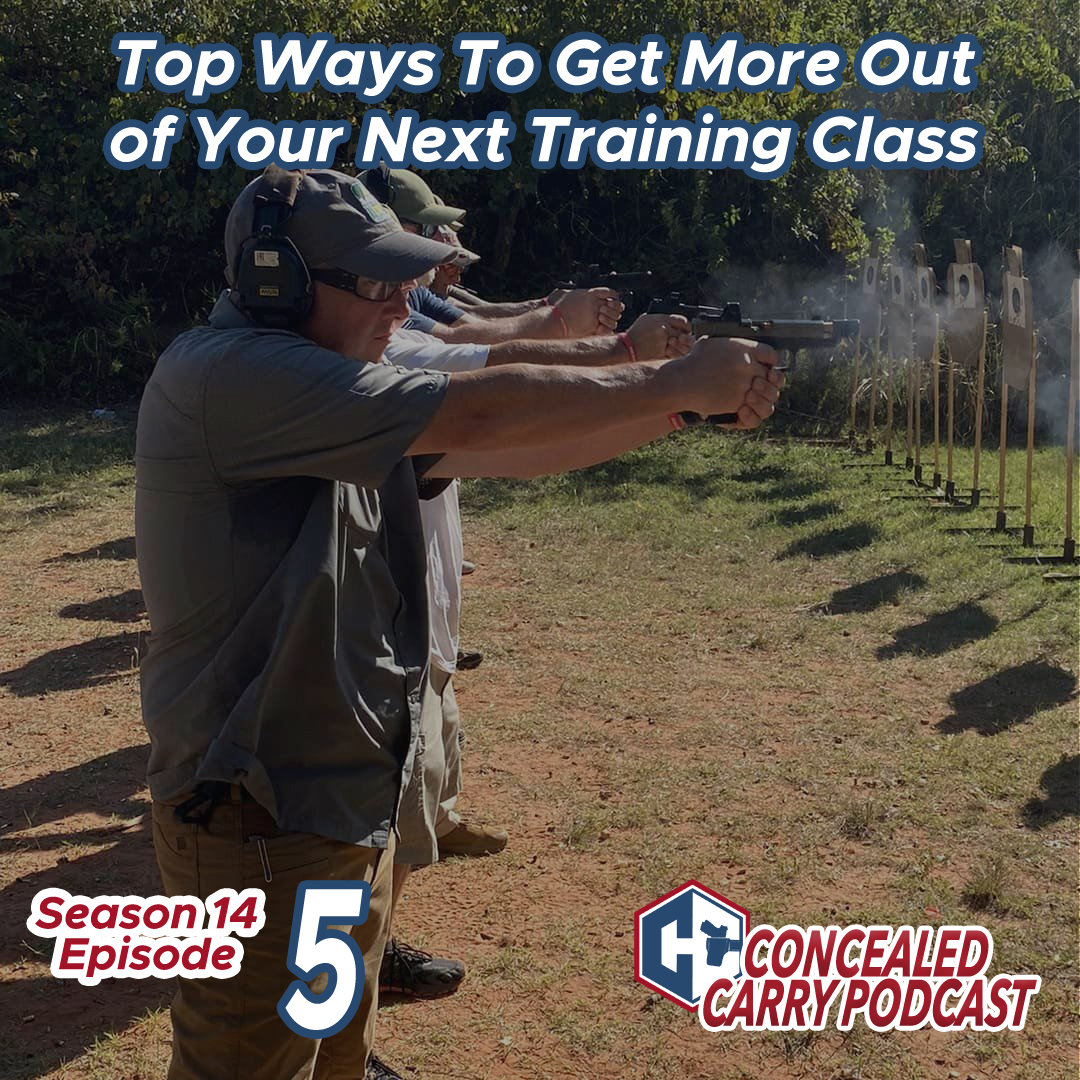
About This Episode:
Today, Riley Bowman and Jacob Paulsen step off the range and into the classroom — because signing up for a training class is the easy part; actually getting your money's worth out of it is another story. Whether you're booking your very first class or your fifteenth, this episode breaks down the habits that separate the students who walk away transformed from the ones who walk away with a certificate and not much else.
We get into how to choose the right class for where you actually are, what to do in the days before you ever set foot on the range, the mindset that makes instruction stick, and the step most students skip entirely once class lets out.
Watch this episode
Read the transcript
This is the Concealed Carry Podcast, Season 14, Episode Number 5. And welcome to the Concealed Carry Podcast, part of the ConcealedCarry.com network, brought to you by HK. Today is Friday, August 14th, 2026, as of the recording of this live episode. And I'm your host, Riley Bowen, and I'm joined by the incredible Jacob Paulson.
He's right there in front of you, folks. No comment. So I feel like we've done plenty of this sort of thing, and that's probably just because we came off of an hour and a half long plus a little bit more than an hour and a half webinar last night. We may talk about that some more here in a little bit, but we're excited to be with you all for another episode of the podcast.
Today, we're talking about top ways to get more out of your next training class. Highly relevant, I think, to just about anybody, and especially in light of our upcoming Guardian Conference, which is basically a month away from today. Pretty exciting. Maybe it's five weeks. I don't know. It's close to a month. Yeah. Well, yeah, I see.
I mean, by the time this goes live in the audio feed, it'll be almost a little less than a month. Yeah because it's the 14th day the conference starts what on the 18th i think of september that would imply i think we're five weeks out but yeah by the time it goes live it'll be be about a month so wow the next month is going to go crazy and crazy fast but we're thankful to be with you all for this episode today we'll do our best over the next month or so to uh deliver on the podcast for you. I feel accomplished just in doing a podcast this week in light of our newest launch, product launch.
Again, we'll talk about that here in a moment, but today, excited to have you with me, Jacob. We've got a couple of episode sponsors I want to make sure we point out. We'll do some longer focused sponsor message reads throughout the episode, But today's episode is sponsored and brought to you by CCW Safe. Of course, we are honored as always to have them as a regular sponsor of the Concealed Carry podcast.
The best program out there, we think, that we believe for covering people in very, very difficult situations that have just had to use a gun or weapon in self-defense. CCWsafe.com is where you can learn more. Today's episode also sponsored by and i'll let you take the lead on this one jacob but it's our latest and greatest newest live course well not live it's not live it's live now but it's a video course on concealed carry.com in guardian university you can see and watch it there you can buy it if you if you're a guardian nation member you already have access to it but uh is a really exciting product we call defense after dark Yeah, Defense After Dark's awesome. It's just shy of four hours of content that was filmed over two full days and nights in conjunction and partnership with Apache Solutions in North Carolina.
The subject matter experts are Dan Brady and here's truly Riley Bowman there. And yeah, it's amazing. I think low light has to revolve to some degree around, I suppose it's a skill, but low light is really about tactics and gear. And so those, I think, are kind of the major highlights of that course. There's definitely some mindset-related things and some skills, shooting skills-related things, certainly. But it's really, I think, the biggest components are about tactics and gear.
And it's important because we spend so much time in the dark. 6 p.m. to 6 a.m. is where something like, depending on the crime, like 65 to 80% of things like robberies, carjacking, sexual assaults, and other related sexual sex crimes take place in that time frame. So diminished lighting, whether that's the parking lot of the Walmart or the gas station or in your house while you're sleeping, that's a thing.
And knowing how to utilize a light and what it's capable of doing and what it's not capable of and the tactics to deploy it, I think that's pretty critical skill for this audience. Absolutely. Yeah. And we're excited to, as I mentioned, bring this course to you. We spent a lot of time working on it, time planning it in the months leading up to going out to North Carolina.
The time actually on the range at Apache Solutions with Dan filming it, which that was a process. It was quite challenging actually filming this course by nature of it needing to be in low light conditions for a lot of the course. But there's other things we didn't want to be just, you know, filming in the dark. So like figuring out how we were going to plan all those shots and do them and at what time of day.
It was just it was quite a project. And then, of course, all the post-processing involved with that going through the course, editing it. Our guy, Corey, is amazing with this stuff. Reviewing everything he did work-wise, getting it put together, and getting it polished and put together for you guys to now partake in during a special launch, which is right now.
I know that some of this may not apply if you catch this episode after the fact because the launch only goes through next Thursday. And again, today is August 14th. But even if you don't catch during launch, it's still worthwhile. Go to concealedcarry.com forward slash DAD for Defense After Dark. Concealedcarry.com forward slash dad and that's a quick link to Defense After Dark I had said Jacob we would just do we would just mention sponsors and do more you know in depth sponsor reads throughout the episode but I kind of just did it didn't give CCW Safe as much love and attention as our own Defense After Dark course so we'll come back to CCW Safe here in a little bit So before we jump into the topic, top ways of how to get more out of your next training class, I felt like we ought to provide a little bit of an update, Not necessarily a correction, but definitely an update on our last episode.
So a week ago, Jacob, you and I recorded the episode. We were talking about Justified Saves. And of course, at that time, like the most recent, most prominent Justified Saves story out there was this active shooter event out of Twin Falls, Idaho, at the In-N-Out Burger place. And which, by the way, I'm surprised we haven't gotten too much hate mail about, you know, how we trashed on In-N-Out Burgers during the episode. But We're probably going to get hate mail because people are like, why are you making light of such a serious situation?
But you'll just have to go listen to the episode to find out. But almost quite literally, sorry, I'm going to use the word literally here. As we finished recording that episode, Jacob, the Twin Falls Police Department did a press conference. And they released a whole bunch more video. Video surveillance from basically that in and out restaurant obviously the cameras the camera angles were from the restaurant itself there were some shots from outside the restaurant in the drive through area there were some shots inside the restaurant and so it's like whoa all of a sudden we have even more detailed information about what occurred and so we wanted to make sure we corrected the record i don't think we necessarily got anything wrong or at least too wrong it's just more context about the incident itself.
And we thought that on the heels of having just released that episode, we ought to just touch on that for a few minutes and make sure people have the latest and greatest information. What do you think of the video that you watched from the police department there? I think the thing that changed the most in my mind from kind of how I originally perceived this event as happening to what I more better understand from having seen all the video, is that a significant amount, if not all of this attack, really took place from outside the restaurant.
And the drive-through window kind of being a major, you know, the major entry point for the shooter. So on two different occasions, you know, he basically was firing into the drive-through window from outside, from the drive-through. And that was, it just changes the dynamic a lot because it's so, it's just different. Like I don't know of any other incident like that.
Like in all, you know, traditional, if we can use the word traditional, that feels weird. But in other active shooter scenarios where we've seen at restaurants like this, even at fast food kind of places, they go into the restaurant. In the 80s, there was a huge, massive shooting at a McDonald's. And we've seen other ones since then in Arby's and other places too.
But they go into the restaurant. This guy, he was shooting through the drive-thru. And that just changes things for me. Certainly it would change things if I was an employee of one of these places. But it changes you know i guess what i might perceive if i'm in this place if i'm sitting in an in and out which is highly unlikely i would never go to one, and i'm getting my meal or waiting for my meal or eating my meal and i start hearing shots and and maybe what i'm seeing is the employees behind the counter scattering screaming whatever, i guess i would assume that it's like some guy in a car, who's at the drive like shooting into the i would be like confused i'm like wait I'm like, what's going on here?
And I might even be, you know, I might consider, you know, exiting or evacuating the restaurant. I might run into a guy who's on foot standing there with a handgun and eventually a rifle. Mm-hmm. Yeah, I'm with you there, because some of the reporting we saw talked about shooting inside the restaurant. And it becomes more clear now that the shooting that was taking place inside the restaurant was actually the off-duty trooper, I believe he was, who essentially exchanged some shots with the shooter.
He was inside. In fact, by that point, he was obviously a patron in the restaurant. But when the shooting began, he made, and of course, employees started scattering away from the drive-thru window. He went towards the window and exchanged shots through the drive-thru window with the shooter. Let's not forget that the very first shots fired and the first victim, and I believe he lost his life, unfortunately, was actually the vehicle in front of the shooters.
And he was actually himself at the window at that time, the first victim. He's at the window, and the shooter approaches him. The shooter gets out of his vehicle, approaches the first victim along the side of his car, shoots him through the window. I think it was an open window because, again, he's at the drive-through, and shoots the first victim right there in his car.
Uh it seems apparent that that victim at least is initially able to drive the car some we don't know how far but he he then gets out of the way of the drive-through window and that's when the shooter starts shooting through the the window and uh shoots the um Shoots the the female employee of uh in and out right there as well uh and so and then it just like spirals from there you know it just starts it just turns into chaos the The off-duty cop who exchanges, you know, you get some inside camera angles of what he's doing there. And he's trying to slice the pie and, you know, see what's going on and see where the threat is. And I'm sure he's wondering what the heck is going on too.
And, you know, he gets up near the window. And as I mentioned, there's some shots that are exchanged there through the window. So the shooter, the perpetrator of all this, he actually goes back to the window a couple of times and continues looking for more victims there. There are a couple other things that came out of this, Jacob.
There's, first of all, some people are aware of the former police officer who went in search of the problem. And he was armed but chose not to draw his firearm, he said, at least initially, because he was afraid maybe he'd be mistaken for the bad guy, whether by another citizen or by a cop who's responding or whatever. He goes forward from his vehicle and he gets shot like he comes around the corner and the bad guy sees him almost immediately and shoots him shoots him in the arm which apparently was his dominant arm because he then retreats and he then draws his pistol and this is a rare thing that we've I mean we've almost we almost never see this especially on the citizen side like we see this occasionally with some police officer involved shootings but I think it's the first time I could think of where a civilian, uh, for whatever reason draws their firearm with their support hand.
And so he drew his firearm at that point and, uh, did not engage. And part of the reason, this was quite a lesson. And I think it was a lesson for this gentleman and it's a lesson for all the rest of us. The reason why he wasn't able to do anything at that point is he didn't have a round chambered. So he draws his gun. His right arm is out of commission because it was shot, It severed artery, it shattered his humerus bone.
And, you know, he's like, oh, man, he draws his gun with his left hand and extends it, and then nothing. And I think he's like, oh, crap, I don't have a round chambered. That doesn't mean you can't chamber around one-handed, but it seemed that he wasn't quite prepared or, you know, there's a lot going on. I can't blame the guy. I mean, he just had his arm essentially, you know, completely blown away.
And, and yeah, there's a lot going on there. So he doesn't have a round chamber. He's not able to engage a shooter. There's a female, a woman that runs up. She's actually running towards danger. And I don't think she realizes at the time. And she encounters the shooter right there at his, she's at the back of his car. He's at the front of his car.
He sees her she sees him she ducks she swerves you know she kind of does this number and he leaves her alone actually she grabs his gun i don't know if it's because she grabs his gun or if he just spares her but anyway he just takes off at that point and it's shortly after that that our good samaritan jordan salinas engages him along the the where the main road is you know They're out kind of in the landscape now, and they exchange shots there.
So pretty wild stuff and a lot of lessons to be learned. Now, the woman that picked up the shooter's first gun, because it was his handgun, which he used for the first ambush shots, it jammed on him. It malfunctioned. We don't know exactly how or what. He drops that gun. He gets his rifle, and that's when he starts using the rifle for the rest of the attack.
She picks up his handgun and apparently tries to get it working, but doesn't know how or whatever. Or it could have just been, it was just straight up broken. And, you know, that could have happened. But she couldn't get his gun in commission. And so she wasn't able to use it against him. Makes you ask the question, where's her gun in the first place, right? So anyway, just so many really, really interesting lessons that came out of this further surveillance video from that press conference.
Yeah. I mean, you had an undercover cop and a retired cop, both who came more prepared than the average citizen that had a gun, but neither of whom were really prepared for that kind of firepower. The off-duty cop just did not have the ammo necessary, and it was a scramble. I mean, he is not with his wits about him trying to return fire.
He is trying to stay upright because people are you know knocking him over he's knocking them over people are scrambling for, you know cover and and he's trying to engage and he's short on firepower i mean he just does not have a lot of ammo to to utilize and then as you mentioned the other guy who can't get his gun into the fight, at all because you know he can't or doesn't know how to get around in the chamber, without two hands so yeah there's there's some relevant lessons but i think you know for me the high-level takeaway now having a little more details is, you have three not one, three citizens that basically tried to interfere with and counter attack this shooter and that is perhaps the most remarkable thing about this event, We could say four, I guess, if you want to count the woman who picked up the gun. So, I mean, more than one is just wild.
Yeah. Four is just crazy. Yeah. And, you know, in the face of, like, I've seen some anti-gun organizations in the last week or two spouting their, you know, their bull crap about these kinds of things. And one of the things they love to just harp on is, oh, I can't have all these good people with guns around because they're going to just end up shooting one another.
Somehow no good guy has shot another good guy here, you know, and there's that many of them around. Bad guy behavior tends to be pretty obvious. Yeah. Yeah. Again, I don't want to be too judgmental, but probably the biggest lesson of all. I mean, you got three or, again, arguably four people that, with a gun in hand at some point, tried to interfere or intervene.
And I do believe the actions of all those individuals actually made a difference or played a part in changing the course of the shooter's actions. For instance, at the time that Jordan Salinas shot at the shooter, he was actually actively shooting at just random cars on the main street, you know, in front of the in and out.
And because of Jordan now beginning to engage him, that seems to probably have brought that to a close. He did, after that fact, go away from Jordan. And that's actually where the footage many people are familiar with, seeing the shooter shoot into some Teslas, which is where we know a couple of people were wounded and one was killed.
That actually came after Jordan Salinas' engagement. And so the sad thing about that is, again, I do commend all these people as heroes. I do think that their actions made a difference. But nobody got a hit on this guy. And it just makes me go, oh, you know, we got to do better because you got four people that could have engaged the shooter with shots or did, and nobody managed to connect.
Now, it doesn't mean that we have to shoot the shooter, necessarily bring it to an end, but there might have been even more lives saved if some people had landed hits on the guy. And so it just makes me want to go back and train harder. And that's a perfect segue because that's what we're here talking about today is how to get the most out of your next training class.
We got to do better. Yeah. That is the core summary. Four different people potentially could have engaged a shooter with a gun. Several did. And no one got a single hit. So, yeah. There you go. There's the update. We've corrected the record as far as we can. Go catch last week's episode if you missed it and you hear us talk about that incident as well as a whole bunch of other Justified Save incidents.
But let's get into today's core topic, top ways to get more out of your next training class, as I just mentioned a moment ago. Jacob, you wrote an article on the site. It's actually titled 12 Ways to Get More Out of Your Next Training Class. I don't know that we're going to get all 12 in this episode here today. And that's okay because you can go read the article for yourselves.
It's in the link of the show. It's linked in the show notes in the description of the YouTube video or on Facebook or whatever. You'll find the link to the article. But we will talk about as many of these as we have time for or the most important ones as we see it. I'm going to pick some and Jacob's going to pick some. And so let's get into those top ways, Jacob.
Yeah. The first one is to me the simplest, and that is just bring gear that already works. There's an association, and okay, we have to acknowledge that people, you might be listening to this and you might be getting ready for your first gun class. If you're getting ready for your first gun class, then you probably own your first gun and you don't really have a great sense for how reliable your gear is, the gun, the magazines, the holster, whatever else you're bringing with to your mag carriers, you know.
And so it just is what it is, you know, like this one's not for you. Just come with what you got and we'll sort you out. But for those of you who have owned guns for some time, you go to the range with some regularity and now you're going to a class or the next class for you. There's a tendency that we see often that people buy new gear for the class.
And that's what I'm trying to basically say, don't do that. Or if you want to do that, that's fine, but do it far enough in advance that you can actually work with that gear before the class arrives. And I, I, I get the, like, it's exciting. Like, I'm going to this, I'm going to the Guardian conference. It's really exciting. And I'm taking this class from so-and-so I'm really pumped about it.
And so I'm going to, you know, it's like, you're going on a vacation. You want to buy new like clothes and suitcases. Like I'm going to buy a new gun, new, new mags, new holster, new optic, new, you know, it's like, don't, don't actually do that. Or if you want to do that's fine, but also bring the reliable thing that's been proven and tested for you over the last several years so that if the new crap doesn't work well, you can revert back to something that's proven.
Yeah. Yeah. You make a couple of good points in that section of the article. You talk about, for instance, one of the best things a person could do if they're looking at the gear list and they're like, ah, you know, I don't have some of this and maybe I should get it and I don't know what to buy because there's, I'll tell you, it can be overwhelming to shop for whether it's holsters or even guns themselves.
It could be magazines or ammo or whatever. And you're like, I'll just tell you straight up, holsters is one of the, biggest offenders in this particular thing. We see people show up with a holster that they're not familiar with, they just brand new, they've never really tried with it or tried anything with it before. And it's subpar, you know, like it, it's poor quality, it's poor design, it's whatever.
And so you, you have a suggestion here. It's actually in bold in print, email the instructor before the class. And I was like, yeah, that's such a great point. And I've definitely gotten those emails. I would like to get more of those emails as an instructor where someone's like, Riley, I see you recommend the following.
I don't have that. What should I get? I am happy to counsel with you to say, okay, what's your gun? What equipment are you currently running? Where do you carry? Okay, here's what you're going to want to look for. Because the big problem is I think what happens with a lot of people is they buy what they see advertised or used by social media influencers online.
Or they go to their local shields or academy or bass pro or cabela's and they just oh well that looks like that'll get the job done and they buy something off the shelf and i'll just tell you most of the stuff in the big box stores it's it's designed and marketed to be marketable at a big box store and not necessarily to be the best quality gear and so email us email the instructor and just say, what should I get?
And I'm happy to help you make sure you get outfitted the proper way so that you save money in the long run and save trouble. And then try, if possible, to get that well in advance of the class so you have some time to actually familiarize yourself with whatever that gear is so you're not just using it for the first time the day of class.
That's a good one. I'm going to go right down the list here. Number two, Jacob, bring more magazines than they told you. Now, this is excellent because I put on my course descriptions like, okay, come with five magazines. If you're using standard capacity, double stack, like... Let's just say 12 at least, and usually more like 15 rounds per magazine, I'll usually be like, hey, bring five magazines. And truthfully, I'm okay with it. Like, that's good.
But your recommendation, Jacob, was whatever number the instructor tells you, bring double. And your reason is sublime because you're like, look, here's the deal. You're in this class. You're going to be doing hopefully a lot of shooting. And you know that what's going to happen is you're going to, you're going to come to the line, you're going to get an explanation, you're going to do a drill, you're going to shoot that drill.
And then there's going to be at some point some downtime where you go and top off or load up magazine, magazines again. And so what happens is so often is people have just enough to do the drill or the different shooting exercises the instructor has planned. And they're basically like, and I see the anxiety almost, you know, come up in people's faces. Oh man, I got to get some ammo in these mags.
And, uh, and, and, and then they're, you know, the first opportunity they have, they're off to the, to the shooting bench to where their gear is. And they're, you know, stuffing rounds of mags. And there's times that happens, you know, they're so quick to do that, that I'm working with other students. And I'll tell you, I've learned some real nuggets about shooting from just observing an instructor working with another student, not me, but somebody else, because I'm seeing it from a third person view.
And that has huge, immense value as well. Yes, it's hugely valuable for an instructor to give me direct feedback, but there's so much you can learn from what an instructor has to say as you're watching that student do XYZ thing and instructors instructing them on how to do that correctly or fix it or to do it better. And so as much as possible, you want to make sure you're engaged in the class.
And if you're constantly feeling like you got to go stuff mags, it's just taking away from opportunities for you to be even more engaged than you might otherwise be. Yeah. There's another one on my list in the article that just basically says, watch every other rep from every other student. And we can kind of combine that in this conversation.
A massive amount of learning is done by watching other people get coached. It's humongous. It's one of my soapbox items, frankly, is that if you're not the one, sometimes everyone's on a line, right? If everyone's on a line, everyone's shooting at once, then you can only do so much to hear what the instructor whispers in the ear of the guy down at the other end of the line.
That is what it is. But oftentimes exercises are kind of done one person at a time. Okay, everybody get in a line, one person at a time is going to do this drill or this test or whatever the thing is. And those are the opportunities where I see a lot of people on their phones or they have to go run top-off meds or whatever the thing is, or they're talking to each other and they're not paying attention to the person who's currently running the drill or the exercise or whatever the thing is.
Massive missed opportunity. So in addition to come with double the magazines i'll add these other little kind of ancillary thoughts preload all the magazines the night before because then you show up ready to go and you're not like rushing to load them all two um. If in the moments if you ever have to go back and load mags and it's not a clear break time like there are other people are up on the line run back and grab handfuls of ammo and shove them in your pocket come back to the line and load the mags while you're there listening, so that's be better than you hanging back at the bench you know loading mags missing everything and bring a mag loader so that the you when you are loading mags you minimize the amount of time that takes you like this sounds like a weird soapbox issue, but i i just think that it is one of the like massive missed opportunities, is you're not hearing everything that's being said by the person who is being paid to set it to say it, because you're not there when they're saying it you're busy loading mags yeah.
I'm glad you touched on that as far as having ammo in your pocket. That's been a big one for me. Whenever I've been a student, I've always tried to just dump a bunch of, usually a couple handfuls, so a good 50, 60 rounds. We're talking usually pistol rounds, so like 90 millimeter, whatever. It doesn't take up that much space.
It'll add a little bit of weight to your pants or your pocket or whatever, but I'll just dump a couple handfuls of ammo in my pocket. I'm doing that constantly when I'm in classes. I could do it without being distracting to anybody else. I can just stand there and just kind of shoving rounds in mags while instructors talking.
And along with that, I know that one of the things that someone might be thinking is, and I get this question all the time from students that show up to my classes, because they're there, they're ready to go on day one, they got all their gear kind of set up and out and ready to rock and roll. And then they're like, do I go ahead and load mags? And I'm always like, yes, load your mags, load them up, have them full all the time.
And I know that some people show up because they're thinking maybe, and maybe it's because they've been in classes that did this. And I have been in a class or two over the years where we had portions of the class or specific drills that required a specific round count in the max. By that way, that kind of stuff drives me bonkers.
I, I, I just, I don't believe in that really at all. Maybe at one time I did, but I, and what I mean is I, I just, Hey, hey, this is a shooting class. This is a training course. I want you to get as much out as you can. I have no drills where you have to have a certain number of rounds in your mags. So just load everything up, have it all ready to go.
And that just makes it so much easier. But anyway, you could still load your mags ahead of class. And if you have a question, you could email the instructor. Say, hey, do I show up with mags fully loaded? And worst case scenario, if you show up with everything already loaded, what are they going to tell you to do? Okay, download them. Guess what's easier, downloading or loading? Anyway.
All right. I acknowledge that sometimes certain drills or exercises require a less than full mag in order to do them. And that's fine. That's not an issue. But on the whole, you're going to be better off showing up with all your mags loaded. And if you're really concerned about it, show up with 10 mags, 9 loaded and 1 empty and go forth.
That's usually the most common thing I've seen is that an instructor will be like, I need you to have an empty mag because they want you to practice something like combat reloads. And so they want you to start with one in the chamber, an empty mag, you fire one, you reload, that kind of thing. Here's the next one. Jacob, I like this one. I thought this was wise advice. I think I'd do it by nature is just how I am as a person. I want to know as much about a thing before I go and do the thing.
But I don't think everybody is that way. So you have here, learn what you can about the instructor and the curriculum. And you're implying before you take the class. All right. And so, you know, this is a good thing. I hope you kind of already know about an instructor before you sign up for a class with them. I would think that's kind of why you sign up to take a class from somebody but that might not necessarily always be the case or it might be that you just on the the advice of somebody else the recommendation of somebody else you're like oh i'll go take that i'll sign up for that class but you know nothing about the instructor really so look them up go to their website read all the information in the descriptions You can search youtube search their social media social media is great a lot of instructors now at least have some content in their social media some video of them from a class previously where they're talking about something or they're demonstrating a drill or that kind of stuff.
And you can kind of get to know them a little bit through those mediums ahead of time. And it sets you up for kind of knowing how they think, how they operate, what's important to them as an instructor. And that, I think, helps kind of cue you up for the class itself. And it helps you come a little bit more prepared. Also, the other thing too, Jacob, and I know you've probably got some thoughts on this you want to add, but I do get questions from students ahead of my classes that a lot of times can be answered if they had just read everything that was on my website about the class in the first place.
Now, I'm not going to be all like, how dare you ask that question? But it would be nice at times if folks would just actually read what I've taken the time to type up and put in the description or on my website somewhere for them to have available to them to come a little bit better prepared. Yeah. Again, you know, there's some context here too, right?
Like I'm thinking about, you know, someone who shows up to their first ever gun class, like there's no world where they have listened to this episode probably. So it doesn't matter, but they have no expectations. They don't even know how gun class works, let alone how this particular class or this particular instructor runs things.
So I get it. But yeah, I think for those of us who are, you know, you'd call yourself a training junkie, you take classes. It's like, dig into it, man. Like, Dig into it because it just sets you up. You're going to show up with a foundation on which you can build while everybody else is still building the foundation. That's all it is.
Mm-hmm. And I know you got some more thoughts about that very thing, too, about what you can do before a class. But before we do that, I mentioned earlier we'd do a more formal sponsor message read for CCW Safe. So we're going to take a moment and just recognize one of our big sponsors of the podcast, which is CCW Safe. They've been a longtime sponsor.
We're thankful to them for their support of the Concealed Carry podcast all this time. They're real big, too. It's important to them that people get training, good quality training. It's one of the reasons why they're a sponsor of the Guardian Conference, which, as we mentioned in the beginning of the episode, is coming up here in just a little more than a month.
And we hope, actually, by the way, there's still time to sign up for the Guardian Conference. But CCW Safe, huge supporters and believers of the Second Amendment. Huge supporters and believers of people having good top-notch representation in legal matters particularly dealing with use of force and they are our choice for who we would recommend you relying upon for that to provide for your legal defense to provide for expert witnesses to provide for investigation work that takes place as part of a case that's ongoing that where you had to use force or whatever, to reimburse you for certain costs incurred through that defense, whether it's psychological, whether it's cleanup of a scene, whether it's reimbursing you for a gun that's now been taken into evidence.
All those things are things that you can have covered by CCWSAFE. So please consider joining CCWSAFE today by going to ccwsafe.com and learning more about their various programs. And you can come and meet and converse directly with many of the Upper Echelon folks from CCW Safe at the 2026 Guardian Conference in Oklahoma City next month, third weekend of September.
Still time to sign up for the event. It's a great place to get some amazing, quality, world-class instruction and training. And they always have a couple of their experts, including Don West and Sean Vincent. Jennifer Chance is usually there as well, part of the kind of a trio of like just world-class attorneys that really know this stuff.
And put on a really great presentation every year about various topics that relate directly to self-defense and how to deal with the legal implications, the aftermath, and so forth. So ccwsafe.com, or if you want to be at the conference, guardianconference.com. Anything else you want to add, Jacob? It's just a good time, and also we're very thankful to them for their support of the conference, which is significant.
Yeah. It wouldn't happen without their support. So thank you guys for your support of our sponsors that make the podcast and the Guardian Conference possible. Jacob, next main way you can get the most out of your next class. In 2017, you and I decided to go all the way to New Hampshire and take a class or two, yeah, I guess one, at SIG Academy.
And so before we left, because I think I was a little bit less than confident in my rifle skills, this was a rifle class, you and I went to the range a couple days before we hopped on the plane. And we went through a couple of drills and we practiced a couple of things and you showed me a couple of things. I guess you were, still are I don't know if you still are but anyway, you're a post-certified, rifle instructor and so it was really helpful for me to kind of get some of, that experience like just a, couple little things and that paid off pretty big a couple of days later when we were in New Hampshire at that class and some things were fresh in my mind, right?
It wasn't like, ah, six months ago, I picked up my rifle and got some rounds through it. It was like two days ago I did that. And so that went a long way to making me more capable and more prepared. So I think that that's the big one here. The way I word it in the article is knock the rust off before you get there. I don't think you need to go like build some crazy skills and go through hundreds of rounds of ammo, So, but just, you know, like way too many people show up in class and when asked when last time they went, they were, you know, didn't need shooting.
It's like a year ago, you know, the last time I took this class, you know, kind of thing. And you're like, oh, okay. So it would seem sensible to just get your gun out. Maybe you don't even have to go to the range. Maybe you could just do some dry practice, a couple of repetitions of draw and things like that. That would seem like it's going to go a long way to helping you, you know, get more out of your class.
Yeah. And it doesn't even have to be live fire necessarily. You can knock a lot of rust off in dry fire. So you could ask the same thing, Jacob, of people who come to classes. Like, okay, when's the last time you just touched your gun, practiced drawing it from the holster, and sometimes you'd be surprised at the responses you get. This is great advice.
So people hopefully should make it a habit anyway to practice regularly. By regularly like a couple times a week would be ideal honestly just doing some dry fire If you're not if that's not your regular habit then start making it a habit and a great opportunity is to get kind of that extra motivation because you got a class coming up and so start doing some practice for that you can go do some live fire practice but do some dry fire practice and get yourself ready for that class and then try to continue that that practice that habit after the the class as well would be another recommendation this is really good advice uh it's really this is a big one for me jacob go in with an open mind for real uh this one could be challenging because we're all different unique people we bring to the table a variety of you know different experiences and backgrounds and so forth uh and there's certain things we've been doing already for a long time a certain way and that might be for very good and valid reasons.
But I've always tried to do this because I love learning and being a student. And so I have definitely gone to classes where an instructor does things very differently than how I normally do them or teaches things very differently. But even if that's the case, I have tried to do this. I'm not going to say I'm perfect at it, but this is so important.
You go to the class, you go, okay, I'm going to put aside at the doorway, the gate, whatever it is, I'm going to leave behind me my usual ways, my usual things that I do, whatever it is, and try to forget about that as much as possible and just completely immerse myself in the experience of learning from this person I'm paying good money to teach me.
Uh it's as an instructor you see this on the other side jacob kind of from this other perspective where i've definitely had students that come to my class and i almost feel like they're there to try to teach me or they're there to show everybody else how much they know and or i'm like hey you know let's try this they're like wow you know i'd rather not because this is how i do it it's like why did you come here man like why did you pay me hundreds of dollars to do this class and and you know so it's it's just interesting to see that that attitude and so that's this point that you're making here is hey try to put the attitude aside and just purely learn oh i think you're muted Thank you.
There we are. I think there's two different places this comes from. And I'm only bringing this up because I think that there's more than gun class world we can improve ourselves by thinking about this. One is just pride and ego, right? Like, hey, I know stuff. Therefore. I don't need to learn stuff. Or I came to learn a thing me not already know. This thing me know.
So me not need, you tell me how. And and and also pride and ego drives this like me no thing therefore feel obligated to tell other people thing because you know obviously other people not know thing i know. But but the i think if that's the case i'm like that's the thing that drives you like you as it's that's the challenge then the answer is like eat some humility bro, like it's all the time i'm in i'm in a class and i someone feels like they have to share a thought and i'm like dude all of us already know that, You're just the one who felt like you should interrupt class to tell everyone.
So thanks a lot for interrupting the class that I'm paying for. And now I didn't come to pay to hear from you. But then there's a second issue here. And I think that issue is also worth bringing up. And that is that some of us are just very, I don't know, I'm sure there's a term for this, but like we're concrete, logical thinkers.
And we don't do well with conflicting information in our mind. So like we believe that you know awesome instructor person told us to grip the gun this way and now this other person's telling us to grip a gun differently and the brain doesn't like that the brain rejects it it's like but but wait like no like there can't be two right ways like there's got like no, you know like and so some of some of you listening like that's just your personality is you struggle with that, and so that causes you to sort of push back a little bit sometimes unintentionally almost like, but I like, but like, but I, not, not compute, sir, not know, not know how reconcile thing. Right. So.
If that's the case, then for you, you need to change some, understanding, some mentality-related things that when you go into that environment, this is an environment where that's not the place on the line in front of the group to challenge those things. It's the place to just accept what you're being taught and do it and later bring it up in a different conversation or reconcile it as you need to.
And also understanding in advance that there's sometimes more than one right way to do a thing. That's the reason you go to these classes because it's not about who teaches grip right or who's got the best reload technique. It's about learning all the different grips and all the different reload techniques so you can decide what you like best and what works for you.
That's kind of one of the big points of doing this thing. Those are good thoughts. By the way, got Christopher Bean joining us on Facebook and Ivan from Norway, he commented a moment ago, which is really good to see you, Ivan. But Chris's comments, I think, is also really valid. And I think he's referring to when we were talking a moment ago about knocking the rust off before you go to a class.
He says, be mindful not to overdo it, though. I've seen people coming, so people coming to class, tank from practicing for a class. Cramming rarely yields what people hope. And that's not what we're talking about. We're not talking about like cramming, like you would cram for a college exam. We're just talking about, you know, Don't show up to class not having touched your gun for a month or three.
So get some reps in, you know, get the draw so things are a little smoother than they maybe normally would be. That should be your habit anyway. That's what we're really talking about here. And I'm glad that Chris is pointing that out about not, you know, overdoing it. And I've seen some students show up. It's clear they've put in work specifically for a class. And this would be an example of overdoing it.
And they're so, like, they want so badly to do well in my classes that they put in all this work and they put all this effort and then they come with these huge expectations for themselves that, oh, you know, I'm going to just go crush Riley's, you know, pistol IQ test and all this stuff. And it's like, bro, that's not the attitude I want you coming with.
I want you coming with the attitude of learning and taking out of this what you can, not coming to crush some, you know, shooting test of mine. All right, Jacob, what's your next thing? And this is probably, I think, maybe one or two more here because Jacob's got a hard stop in about nine minutes. And so start kind of winding this down, but maybe one or two more.
Take notes, take video. So... Class is valuable during the time while you're in class. But if you want class to continue to be valuable after the class, then you need to take homework. And the homework is informed by your notes, unless you just have like this amazing memory that I do not have. But for me, because my memory sucks, or it's normal, I'm not sure which, maybe I'm just getting old.
You know, taking notes means that I can do homework later. I can write down things like specific insights, like, oh, man, he said this thing that was like big for me. Like I'm going to write that down. I can write down things that I, like a drill that I enjoy. Like that was cool. I liked how that tested my ability to do this and that.
So I'm going to write that down. I can also write down notes related to just things that I'm observing. I suck at like, man, I, every single time, like I do a reload, I can't reacquire the grip properly. So I'm going to write that down, like reacquire grip after to reload, whatever it is. So the notes inform the homework that I'm going to go do.
And so if I'm not taking notes, then I end up a week later being like, yeah, that was a good class. That was really good. But I –. No one masters a skill at class. You're there to find out what you don't know and then go work on it later. And I said, take notes and take video. So take video, I think, is a part of this. And different people learn different ways.
But video and not video of other people, like get people to take video of you. And you find these people at the range. Like in a class, the people who are the video people, they find each other always on the line. And then they trade. Like when it's my turn to shoot, I hand you my phone and you film me. And then it's your turn to shoot, you hand me your phone and I film you.
And those people always find each other. And sometimes they're doing it because it's going to look really cool on Instagram. And I mean, teach their own, that's their prerogative. But sometimes it's about like, well, I want to be able to review this later and look at what I'm doing. And that I think has significant value. So take notes, take video.
Yeah. Let me just speak to the taking video part from the angle of taking video of an instructor teaching a class, make sure that you talk with them ahead of time about that as well, all right? Make sure that you ask permission. That's just, I think, basic respect for an instructor. Not everyone's going to see this the same way.
I have a pretty open policy with regards to that. I basically always say you can film and photograph whatever you want as long as it's for your personal use. If you're going to do something beyond that with it, though, I'd like to know how you're going to use that. And we'll have a conversation about that. And so I would just point that out. You said, hey, make sure you tell an instructor that, hey, I'm using my phone for notes ahead of time.
I actually don't care. I've had people come up and be like, hey, just letting you know. It's not me just texting on my phone. On, I'm actually taking notes, I'm like, cool, bro. I'm going to deliver my best product I can as an instructor, no matter what you're doing. I don't care what you're doing. That's on you. But it does make me happy, at least, that you're using that opportunity productively in taking notes. I'm kind of that way.
Sometimes I've written hand notes, but more or less I tend to just go to my phone. And I usually express that, that that's what I'm doing to the instructor so that they know. So I'm going to pick one more and it could have been mentally rehearsed before it's your turn, because that's a huge one for me. But I'll just leave that out there and people can go and read that for themselves in the article. But that's a big one.
But I wanted to touch on this one, which is... Pick your next class before you leave the parking lot, all right? Training is, I can't overstate how valuable it can be when you approach it with the right attitude and mindset, the right preparation, and when you take notes and do all these things so that you maximize the opportunity to then carry that forward and apply it to your training plan and your practice and everything you do going forward.
I have absolutely enjoyed every class I've taken. There's been some that were better than others for sure, but I've always enjoyed them and I've always felt like I got something out of them. And, you know, for a while there, I'm not able to sustain it nowadays as much as I once could. But for a while there, for several of years, I had the goal of taking 80 hours per year of training.
And it made a big difference for me. I grew a lot through those experiences. I grew a lot because of the training courses themselves. I grew more because of what I noted down from those classes that was meaningful to me at that time. And some of those takeaways I would sometimes write down in my notes were not something the instructor explicitly stated.
It was something that he or she said that made me go, huh, And connecting dots and having light bulbs go off somewhere else in my brain that then started, well, connecting dots for me. And I'd write those takeaways down. That's just as important as, I would just say it's actually more important than me just scribbling down exactly word for word something an instructor says.
It's more important for me to take something that goes ding in my head and go, ooh, let me record that little nugget. Because there's a high probability that. Two days from now, two weeks from now, two months from now, I will not remember that nugget because those are fleeting moments, fleeting thoughts that come and go really quickly. And those have been hugely valuable for me.
But just also getting out there and associating with more people and with other instructors and seeing how they do things have made me a better instructor and student and shooter all along the way. And some of my biggest growth came during those years where I was training regularly. So pick your next class before you leave the one you're finishing this weekend or next month or whatever and get a plan for it or sign up for it right then and there if you can, if you can afford it.
But do it and then set that as a goal to continue. Yeah, I think that even if you, I mean, the way it's worded in the article is a little presumptuous. It says pick your next class before you leave the parking lot. That's probably not likely because you have to actually go like research it. But the point is, what do I want next?
What do I want next? I would say we would measure this by saying, if I came up to you and said, hey, what's the next class you're going to take? Would you respond with, hey, you know what? Actually, I'm deciding between XYZ class that's coming up in August and then this other one that's in October. I haven't signed up for either yet, but I can't decide between those.
I'd be like, cool, awesome. Like the point is you're like looking for the next class and you're working it out. But if I ask the same question and you say something like, I don't know, then that's the concern, right? Like let's progress. And I think it's hard to put some timestamp on it because we all have different, amounts of resources available.
But probably about once a year, you should be doing something. Probably about once a year, you should be doing something. I would say at a minimum, at a minimum. If it's important to you enough to progress as a shooter, as a defender, it's a pretty good minimum. I was going to also just add to that, that you're exactly right.
You might not know right at that moment you're leaving a class, like what should be the next one be, but it's not uncommon that I've attended somebody's class. And during that class, they've mentioned something that they learned in somebody else's class. And I go, hmm, I might want to go train with that person too. Most quality instructors I know in this industry reference other instructors and give credit to them.
And that's kind of also in my notes you'll even see I'm going to take a class with that guy or I'm going to look that guy up that kind of stuff We are out of time a final comment here from Chris Bean a class is a waypoint hopefully not the destination wise words my friend so a reminder of today's episode sponsors CCWsafe CCWsafe.com and our newly released defense after dark low light video course available online at our website during this special launch period you can go to or after the fact it just not all the bonuses will be available and stuff but you can go to concealed carry.com forward slash dad for the defense after dark course and uh jacob anything else you got Nope that's a wrap for me.
All right good good uh i'll just throw out there as a reminder if you guys want to get in touch with us the best way to reach us is email our podcast hotline at podcast at concealed carry.com that's for all the hate mail that's all so for the questions the comments the feedback whatever you got for us podcast at concealed carry.com so with that we will bid you adieu.
Until next time, a reminder to train right, train often, and train safe. So you can fight hard, fight fast, and fight true. Take care. A reminder that laws vary from place to place, and we encourage listeners to seek local legal advice to understand applicable laws. Concealed Carry, Inc., its brands and properties, and the Concealed Carry podcast is not a legal service, nor are we attorneys at law.
We make our best faith effort to share Concealed Carry-related insights and information about firearm-related incidents and the laws pertaining, based on our own understanding and experience. But things can be different where you live, or laws may have changed by the time you listen to this. We cannot be held liable for your actions based on the information shared in this podcast. Please exercise care with all things pertaining to firearm use, concealed carry, and always practice following basic firearm safety rules.
More information about safety can be found at concealedcarry.com forward slash safety. Thank you.
More episodes
-
 S14E8
S14E8
-
 S14E7
S14E7
-
 S14E3
S14E3
-
 S14E2
S14E2
