
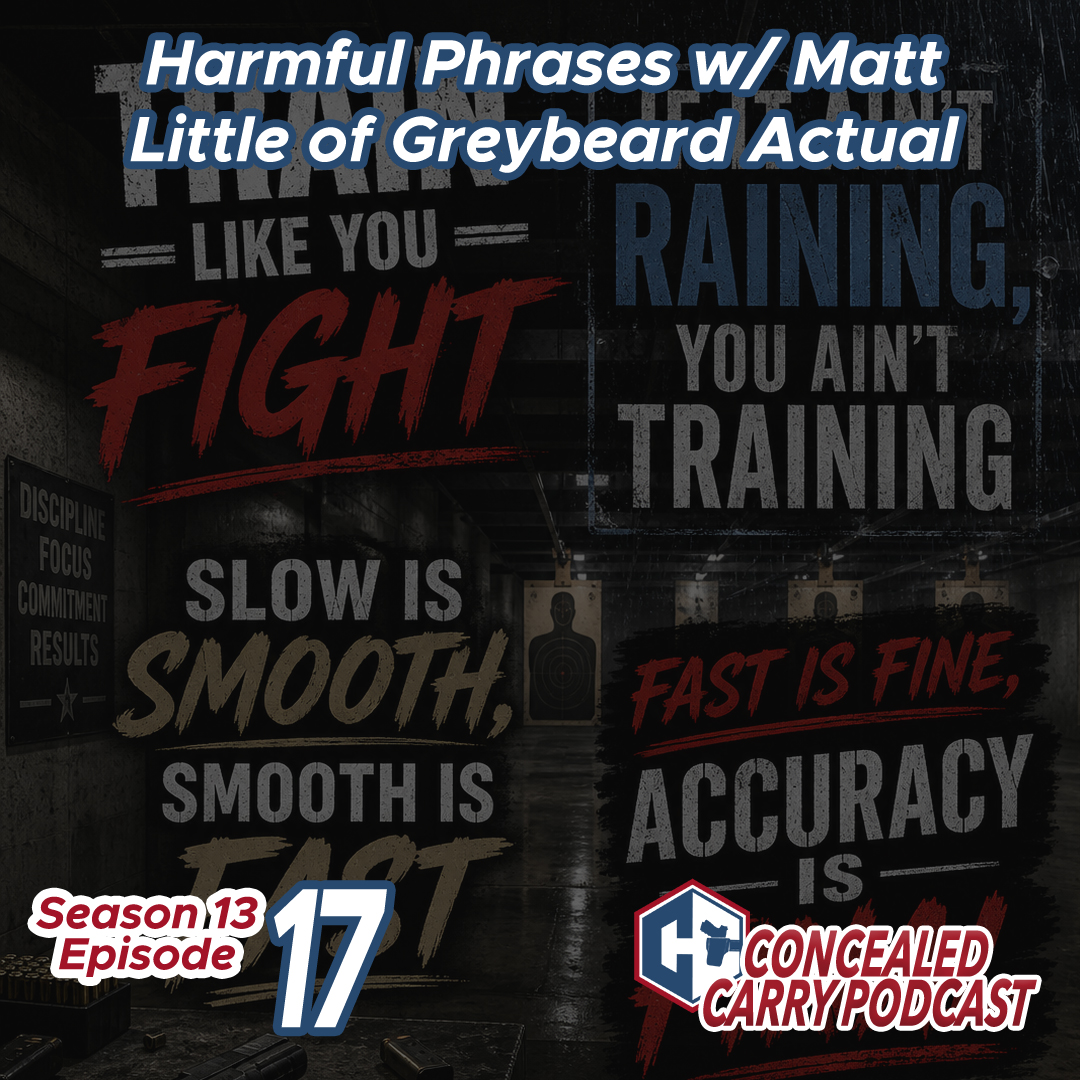
About This Episode:
In this episode of the Concealed Carry Podcast, I speak with Matt Little from Graybeard Actual about the impact of language in training methodologies. We critically evaluate the overused phrase "train like you fight," emphasizing the need for context in training to enhance skill development.
Our discussion highlights the role of discomfort—both physical and psychological—in pushing boundaries during training sessions. We examine structured drills for effective skill acquisition, while also cautioning against the pitfalls of popular phrases like "slow is smooth, smooth is fast," particularly for advanced shooters.
We explore the differences between competitive and tactical shooting and stress the significance of maintaining accuracy and discipline. The episode concludes with actionable insights for shooters to foster a growth-oriented training environment.
Watch this episode
Read the transcript
And welcome to the Concealed Carry Podcast, part of the ConcealedCarry.com network, brought to you by HK. Today is Thursday, April 30th, 2026, as of the recording. This is a live recording of this episode. And I am your host, Riley Bowman. And I'm joined today by a special guest and friend of mine, Matt Little of Graybeard Actual. Hello, Matt.
Hello. Hello, everybody. I'm looking forward to the show. I think we're going to have a good time, Riley. We are going to have a good time, especially starting off like that. We're going to talk about harmful phrases, particularly things that hold us back in training and in some cases can actually get people in trouble.
And I'm looking forward to hearing your thoughts on that. As always, Matt's one of my most favorite people and a trusted individual in this regard because of your unique background and experience. So looking forward to today's discussion. I am too. I think some of these are actually some of my biggest pet peeves in training, so this should be a lot of fun. Yep, yep.
We'll get into that momentarily, but today's episode, first of all, sponsored by Guardian University, which is actually our video library available at concealedcarry.com. The best way to get there, the shortcut, if you will, is you can go to concealedcarry.com forward slash videos. And we actually announced this on the podcast recently, but I'm intentionally calling it out as a sponsor, if you will, of today's episode, just to encourage you all to go and check it out.
If you want to support us here at the Concealed Carry Podcast, if you like what you see or hear here, or you just want to find some way to give back a little bit for a free podcast, well, the easy thing you could do is just go to concealedcarry.com forward slash videos. You'll see we've got over 2 000 videos in our video library there at guardian university Some of them are are paid or at least only available to members of guardian nation which of course you can look into that as well if you don't if you don't know what that membership is i'll talk about that some more here in a moment but we've worked really hard recently to completely redesign and revamp guardian university uh so it's it's a lot cleaner looking it's easier to navigate it's usually your fine stuff you can if you go to the concealed carry.com forward slash videos you'll see you can select courses you can select shows and topics uh you can actually create your own list meaning that you can favorite videos and add those to your own list uh so you can go back and you know find things later you save you know basically the whole idea here with Guardian University is to make it as similar to like a YouTube or whatever as possible.
So pretty excited with the interface now. And you'll see there's just a whole bunch of content available at Guardian University. You'll see that some of them will have in the upper right corner a little Guardian Nation logo. That means that those are only available to members or if you've purchased those videos a la carte.
So if you see that, that's what that means. But join Guardian Nation and you'll be able to have access to everything for completely free. It's included in the membership, right? So that's our other episode sponsor is Guardian Nation. Go to GuardianNation.com to learn more. But this is only one of the many great benefits of membership is to have full and complete access to Guardian University.
So hope that you'll do that. Again, ConcealedCarry.com forward slash videos and Guardian Nation membership. GuardianNation.com. Those are two things I'll point you to as far as sponsorships today go. We appreciate your support of our sponsors that make it possible to do what we do on the podcast, including having excellent guests like Matt.
We've got some comments already rolling in. Thanks, guys. We've got Eddie who's watching on Facebook saying, howdy, guys. Now, is that a good old Texas howdy, or is that just a howdy, like a regular howdy? Because they do things different down in Texas like where Matt's at. Let's give him the benefit of the doubt we'll say it's a Texas hug Texas is the greatest country in North America.
I love it. And we got Messy Rides on YouTube saying, let's go. Absolutely. And somebody's already chiming in. In fact, the first comment of today's show, I'm not sure, DMLA6371, whoever you are, but thank you for joining, saying, how about the phrase, I'll be shooting limited optics today? As far as harmful phrases go, I don't know. I like limited optics.
I've been having fun in that division this last year a little bit. So thanks for tuning in, guys. If you have comments, want to share them with us and you're watching live, you can drop those, whether you're on Facebook or YouTube, just drop them in the comments. They come right into the interface here and I can put them up on the screen and share them.
I won't share anything that's like ridiculous or unrelated to what we're talking about generally just so we stay on topic, but appreciate your comments and questions. Also, if you want to just reach out and you're catching this after the fact, you can always contact us at podcast at concealed carry.com. That's our email address that comes into, to Jacob and I here at the podcast.
So podcast at concealed carry.com. Well, Matt, let's get into the topic. Uh, harmful phrases. All right. Where do you want to start? Oh, that's just so many. Um, Why don't we start with train like you fight? Yeah. Let's start with that one. Yeah. Because I think that's a big one. And it's not that you should never try to simulate the fight in training.
I mean, obviously, that should be part of your training. But people tend to take this and they run with it and they make it where everything they do has to be a full-blown representation of an actual fight. And that's not the best way to get better, right? That's not the best way to build your skills. It's not the best way to actually get good at the fight.
Like if you look at UFC fighters, none of them do nothing but spar in the octagon every time they practice or train, right? Football teams. There's no football team that does nothing but put on the pads and scrimmage. But somehow there are guys on SWAT teams who feel like they should put on every piece of kit they own every time they go to the range so they train like they fight.
And I just think it's harmful for actual skill development and figuring out what things work and how they work. Yeah. You know, what do you think? I completely agree. In fact, I'm going to use this opportunity because I probably should have reintroduced you a little bit to those watching the podcast here or listening. You've been on before, of course, and you guys are welcome to go back and catch.
I think we've had you on at least twice, if I recall. I think so. I think it's twice. And I remember one of those episodes, we were talking, well, I don't remember what the main topic was, but I remember we talked a fair bit about training methodologies or, well, like we talked about the different training, I'm at a loss for the word all of a sudden, Different types of drills. Different types of drills.
Yeah. Like experimentation drills, isolation drills, combination drills, and so on. And that was really good. And I think that's actually relevant to how we, you know, that's one example of how we might train as we're talking about training as you fight. But I wanted to just take the opportunity to reintroduce you to listeners and viewers.
You might know a thing or two about fighting. So tell us a little bit about your background in fighting, Matt. So, well, I started out as a martial artist when I was young. Then I joined the Army at 18, made my way to Special Forces. I wound up, nothing was going on because of Mogadishu. So I wound up being in 20th Special Forces Group, which is in the Guard, and becoming a Chicago cop so I could get some action that way. So I did 21 years as a Chicago cop.
Once the towers fell, we were bouncing back and forth with 20th Group to Afghanistan. I spent some time in Iraq as well. And I did about 25-ish years in the military all total and 21 years as a cop and then retired and started my business. So a little bit of competitive shooting in there too. So I got a pretty good look at several different ways of looking at this problem.
So I know plenty of people that have done more of each of those things. I don't really know anybody else that's done as much of each of those things combined. Yeah, yeah. For whatever that's worth. Yeah, well, and I agree with your assessment on that because, I mean, I know a number of people that have similar backgrounds.
But as you said, to have full careers in military, especially, you know, special forces and police and competitive shooting, as you said, you see kind of all the different sides that most people typically see. And of course, now you've been living as a cop, you're kind of also in that civilian world space, too. But you've been retired now for how many years?
Since uh the beginning of 2019 so five-ish six-ish years yeah so. I mean you to what i'm saying you you see all the kind of main sides of the coin so to speak or the whatever of you know the different worlds people live in that care about fighting about martial arts and i'm being very broad as i use that term and uh you know people that carry guns or other defensive tools so there you go there's there's matt's background uh we could go deeper than that but You can go catch other episodes of ours and hear more about Matt and some things I'm sure will come up in the course of this discussion.
But back to you throwing the question back to me about, you know, what do you think about training like a fight? And, you know, I see this get used. I agree. Like sometimes people will throw on all their kit, all their gear because, well, that's how I'm going to fight. So that's how I should train. And I think it's important to...
I mean, that's why I brought up the different types of drills, you know, like experimentation drills, isolation drills, combination drills, because those are specific and unique and individual ways of training specific skills. And we could say in shooting but you could use a similar approach in martial arts in combat sports in you know any number of things that are skill oriented and you could break those into similar categories of well i'm doing you know this mode of practice right now it's more experimentation or now i'm isolating into a very specific thing because i want to really work on that one thing and then okay now i want to put it in combination with other things and see if it It still holds up when we start adding some pressure and some, you know, more dynamic and, you know, just more variables, you know, at play here.
And I'm using that as an avenue to answer your question to suggest that if you think, like you said, you brought up, you know, football scrimmaging or whatever. If you think training should be done, you know, full contact, full speed, full everything all the time, then you're probably not taking advantage of some of those other opportunities, some of those other maybe modes of practice that actually help you develop skill the most effectively.
You know, I'm going to, if you don't mind, I'm going to quote a friend of mine, Bryce Frank. Bryce is a really good dude, former pro kickboxer. He's a SWAT boss in an Illinois department. Does BJJ now. And he said something that I really love. He said, you know, Matt, nobody ever paid me to win a round of sparring. You know, sparring for him was technical development. And it was closer to the real fight than, you know, drill work or hitting the heavy bag or pad work.
But it's still learning. It's still a learning process. And I think that like really validation drills, you know, testing is the time to actually make it as close to a fight as you can and do that pressure testing to see what's working, what's not working. And that's vital. That's absolutely important. But if you treat everything like it's pressure testing, you'll never try anything you're not confident or comfortable with, which means you won't get better.
So like to use a martial arts analogy, if I'm treating my sparring like a fight, I have to win. If I'm treating my roles at the BJJ gym, like something I have to win, that I'm not going to try something I'm not good at yet. Yeah. Does that make sense? And even if you do, it's probably not going to work very well. Right? True. True. Because you just will not have, I mean, like, if you try to take something into the fight for the first time ever that you've never actually practiced, you're probably going to fail.
Yeah. And, like, to put it back into shooting, I know that I'm sure everybody else has had this experience that shoots competitively, but I know I have, where i'll be in a match and i mean to be fair locals should kind of be treated like sparring sessions really you know what i mean that's the time to try new things but i've gone up to stages and i've gone like well you know i'm going to try this and under the stress of competing it never seems to go like it would if you if you practice at first right you know it's uh hollywood loves to show people pulling things through because they're pure of heart in the end and doing better than they did training but it's a myth it's a hollywood lie it doesn't happen in real life.
Yeah well as we've established with your background and experience uh you would you would know i would think so um train like you fight you know so here's another one like in in that same vein i've i've heard people say things like uh you know, well, if it ain't raining, you ain't training kind of thing. And, you know, it's like, I get that.
In fact, I just spent the weekend teaching a small private class and a few hours west of here. And it was, it was crappy weather all weekend. I mean, it rained on us every day. You know, it was cold, it was wet, it was not ideal. And so that quote, that quote, that phrase definitely was brought up if it ain't raining you ain't training and and and so that's that's that's okay like i get it like you know whatever the conditions are we're going to go out and do the thing uh and i'm not i'm not you know throwing shade at that at all okay just so you know you know who you are uh out there because he listens to the podcast uh regular regularly uh but you know there's something we said about that that it's okay to like it's good to have those opportunities when conditions are less than ideal to get out and get some training in and sometimes you have no other choice but that but i will say this uh in this i think ties back to the train like you fight phrase is that if there's times when if conditions are less than ideal and you really are trying to focus on a specific skill In other words, when it's more like an isolation drill, let's say, that you're really wanting to focus on, if you've got a bunch of other things that are complicating matters, then it'll take away from your ability to drill down and really isolate that thing that you're trying to work on. Does that make sense?
Yeah. No, I have really strong beliefs on this one, too, because I kind of look at those as training distractors. Exactly. And the idea is when you're trying to build skill, you want to remove as many distractors as possible. Yep. and then you layer them back on to test the skill right so like a certain amount of training when you're miserable is really valuable because you need to know you can perform when you're miserable yeah like you need to know that right yep but it's not the time you're going to develop skill what you're doing then is you're just kind of hanging on through the misery yep and trying to do as well as you can and if you do too much of that you're not getting skill development because that's really not skill development like it's kind of a question of what are you training yep You're training the ability to perform while miserable for environmental reasons or because of kit reasons, gear reasons, contextual reasons.
You're trying to perform as close as you can to your best given those distractors. But you're not going to improve your best doing that, if that makes sense. That's exactly what I'm saying. And so it's a tricky thing sometimes because, I mean, especially when you have a class that's on the schedule, you're going to do the class, right?
So even if conditions are less than ideal, there's times that I had to remind students of mine that, hey, I know you didn't do as well as you thought you could. You didn't do as well as you probably actually could. You did not deliver just now your actual baseline level of skill. And that's okay because there's all these other factors. Like you can't feel your hands right now.
Things are wet. You're a little bit cold and miserable. Guess what? Those are going to be factors. And I know some people are like, well, yeah, but that's, you know, we don't get to pick and choose our time of or day or weather condition of fight. It's like, I know, I get that. That's okay. But the distinction here is there is like training and validation, which you mentioned a bit ago, and those things are valid.
But there's also skill development, and I find that skill development happens best when we can actually focus on the skill development, right? I think it becomes a question of what are you training? What are you working on improving? because some things are skills and some things are attributes, right? And the ability to put up with physical discomfort, psychological discomfort, stress, that's an attribute that you do need to train, but it's separate from training the skill.
The skill needs to be trained without that, and then you can add that in and train those things while maintaining the skill at as high a level as possible. That's a perfect distinction right there. Yeah, I like that. Hey, just recognizing a couple other comments here, uh brian saying on youtube this is a texas howdy from a born and raised texan texas a&m grad uh project 1868 says if it's snowing i ain't going and then uh i like that variation that's fun uh messy rides commenting would you say it's okay to train till failure i know that's broad but could you could say start slow speed up reps until you finally fail and then dial it back.
I think this might be a good... Can I... Yeah, I want to address that one because I have some thoughts on that because I think the way people look at this a lot of times, especially more defensive-minded shooters, is kind of an error, right? And it's not their fault. It's the way they've been taught. But yes, you absolutely go until you fail. But the problem is if you dial it back, if you, here's my next phrase, if you slow down and get your hits, you're not actually improving.
What you're doing is going back to your comfort zone, right? So what you wind up with is kind of this sine wave effect where you go faster and make it more difficult. Then once it starts to break, you dial it back down to where you can get all the hits back into your comfort zone. So the sine waves aren't actually increasing in skill. They're just kind of going up and down in place, if that makes sense.
I think a better way to look at it, and this is specifically for like isolation work, right? Trying to build speed and accuracy. Push it till it breaks. It starts to break. Not completely off the rails, not driving off the cliff, but until it starts to break. And then rather than dialing it back down, stay right there and try to figure it out.
And then once you figure it out at that pace, at that difficulty, turn it up a little bit more until it breaks a little bit again. And then stay there until you figure that out. That's kind of the way I like to look at it for isolation. What do you think, Riley? I agree. I think that is how it works, how it should work, especially if we're talking in the context of shooting, because that's what I know the most.
Although I imagine it can be applied elsewhere, too. But usually what happens is, especially once a shooter has a pretty solid base, meaning like their grip is pretty solid. They don't have any major issues with, say, stance. Just overall, like their fundamentals are pretty solid. Usually what is not quite there yet matching the biomechanical or the physical or the technical skill is things like their vision.
It's like what you're describing is you start, you know, picking up the pace or the speed and then the wheels start to fall off. That may not be because of a technical reason. Like the grip may still be there. Stance may still be there. All that may still be fine. but it's like but what else is missing that's usually that vision visual piece and vision slash the brain requires some amount of exposure to a thing to start picking up on patterns and cues right and so you're like well how come i'm not seeing that how come i'm not able to keep that in the a zone on the target when i'm going at this pace and i'm trying to transition you know trying to do all these transitions across the target array maybe there's movement involved like whatever you're trying to do all these different things let's say like you need some amount of exposure to the to that higher rate of speed before your brain goes oh there's there is something here and there's things we can do visual you know training wise to help speed up that process but for sure at the end of the day like what has to happen ultimately is we push ourselves to this newer threshold and hang out there and see if we can't start like you said figuring it out and that i think is usually more of a a vision catching up to the speed of the gun the speed of what you're doing you know everything else what do you think Yeah. And I think it's, people misunderstand, I think, especially like newer shooters.
When we talk about vision, they start thinking that we're talking about visual acuity and that's not it at all. It's the speed of visual perception. It really is more a brain thing than an eye thing. Yeah, exactly. Long as you're moving the eyes to the right place, it's how quickly can my brain pick up on the input? Yep.
And it's like when I teach shot calling to newer shooters, invariably there's at least part of the class that looks at me like I'm talking about some kind of black magic, like they can't even comprehend it yet. And that's because they're not seeing what the sites are doing in recoil yet. And it's not their fault. They haven't been exposed to that enough times trying to see it to get that visual speed, that perceptual speed built up, I think.
An analogy from martial arts, one of the things I really like about the Filipino martial arts is they start with weapons. It's technically a stick, but it's really meant to be a stand-in for a blade first. And the tip of that stick is moving way faster than somebody's punch or kick, right? So after a year or two of working with those, when you go back to an empty hand encounter, it seems very slow.
Or like CQB when I was still at work. When I made master in USPSA, all of a sudden CQB felt much slower to me than it had before because I was used to operating at a faster pace. My brain was picking things up at a faster pace and I could be more aware. And it was like kind of a secret sauce, even though I didn't need to go any faster in CQB than I was already going.
But I could see more at the same speed, if that makes sense. Yeah, absolutely. I appreciate the example, too. I mean, as you brought in, I assume you're referring to like Kali or Screema, right? Like with the sticks, especially because like that's, that's a, that's a, I think that's a really cool connection there talking about how it's like, well, if I can start picking up what's happening with this stick or this weapon, then hands are much easier, much easier.
It's sort of like the opposite of training wheels almost in a way, you know, like there's, There's a place for training wheels, but yeah, if you can make riding a bike, if you can start there, I know that's hard to do, then when you go to training wheels, it's like, oh, it's like slow motion. I kind of think of it like as overspeed training for a sprinter or a swimmer.
Right. Like when the swimmer swims with the artificial current at their back, so they're going faster than they normally would. Yep. You know, or the sprinter gets pulled along with the bungee cord. Because they're forced to work faster than they're comfortable working, right? Yep. And like, for instance, this is the way I do a Blake drill.
Like, I don't treat a Blake drill like a target array that I would shoot, the way I would shoot a target array in a match or in real life. Right. Right? Right. For a blake drill, I'm going to set the artificial pace and try to make the sights be there. And they won't always be there because I'm setting a pace faster than I'm comfortable with. But that's the way to increase that pace, that visual perception, I think.
Yeah, I agree. And that's where we need to spend our time at in practice. I had it here on the screen, but I just turned it off. But Messi rides following up to his question about training to failure. And then he commented almost sitting in the discomfort or failure for a bit and working it out and that that's what we're talking about here uh and so like let's say you really want to improve the speed and efficiency of transitions you brought up a blake drill uh matt which not everybody listening or watching maybe knows what a blake drill is but just just to well why don't you explain it rather than me so People so it's it's typically it's typically three targets at seven or ten yards depending on who you talk to about a target's distance apart and the idea is you kind of well not everybody may know what a bill drill is but hopefully they do so bill drills six shots one target seven yards from the holster blake drill is six shots but they're divided evenly between three targets from the holster so it's two on each target, and the idea is you want to do it at the same speed you do a bill drill at you want the splits and transitions to be the same speed, which is really, really difficult to do. It's a very, very hard thing to do. Mm-hmm.
Yeah. Okay. Perfect. So you're just basically taking that six shot bill drill, spreading out across six or excuse me, three targets. And yeah, so we did that very same thing in the class I was teaching this last weekend. In fact, it's also kind of a part of my pistol IQ standards. The transition part of that is essentially a Blake drill.
And that's intentional for a reason because it falls on the heels of a bill drill, right? And so you want to really work on your efficiency of your transitions you let's just say your baseline is like normally you can do that blake drill with splits and transition speed of 0.25 okay just throwing out a number here that's pretty that's pretty spicy you Can that is pretty spicy.
You could definitely pick it up but like that's that's pretty spicy but let's just say that's where you are and you want to get even better even faster even more efficient so now you start trying to push it more like 0.22 0.20 and pretty soon that's going to start feeling real uncomfortable like what messy rides was saying a minute ago sitting in that discomfort for a while and trying to work it out and sometimes you're going to nail it and other times like you said the sites just aren't going to quite be there because you're just not quite getting off target three and getting on target, excuse me, target two and not getting on target three soon enough.
And so, but you push yourself in that way and you work it again and again and again and again. And then at some point you go, oh, now I'm seeing something that I wasn't seeing before. I mean, it was always there, but now the brain is like, oh, hey, there's something here. And now you can maybe start doing something with that and building upon it.
I mean, is that kind of where your mind is at? It is, and I just had a thought. I want to thank Messy Rides personally because now I've got a new teaching cue that I'm going to use in class. So, Here's the problem with training like you fight, or if it's not raining, we're not training. All training is about discomfort. Everything you do in training is about discomfort, but it's about different types of discomfort depending on what you're training.
And people tend to confuse the physical discomfort of the environment or the exertion or of wearing all the kit with the psychological discomfort of pushing things just a little bit faster are more difficult in complexity or accuracy than you're used to. And you've got to know which discomfort it is you need for the training effect you're trying to create.
So if I'm trying to create more speed, more accuracy, I want that psychological discomfort. If I'm trying to create the mental toughness of being able to function, if I'm cold, injured, tired, exhausted, then I want that environmental discomfort. If I'm trying to train the physical discomfort of operating in regular clothes or kit or like a carry concealed or any of that stuff, then I need to seek out that discomfort.
But I don't want to combine the different kinds of discomfort. I want to work on one at a time. So I want to isolate what's making me uncomfortable so that I can improve on it. Yeah, that's very good. I appreciate you for articulating that in another way. And again, thank you, Messy Rides on YouTube for your own contribution to this. I was just thinking...
I'll give you attribution in class. I'm telling Messi, right? I'll give him attribution in class. There's some other comments here I'll get to, but I was just thinking that, you know, another place where this kind of like saying comes up and gets applied is stuff like, for instance, like I've had students, you've probably had this too, Matt, where they're like, they're going to come take a class from you.
And they're like, you know, I normally carry a... Let's just say it's an OG Smith & Weston Shield 1.0, you know? Just like the current iteration of Shields are awesome pistols. The original was okay, too, but it left a lot to be desired, especially compared to, you know, some of its competitors now. But they're like, you know, what I carry is a Smith & Weston Shield.
It's like, okay, cool, bro. So I'm going to take your, you know, two-day 800-round count class that, you know, With this shield, with OG, again, 1.0 capacity of what, like seven or eight rounds, and it's like, okay, I appreciate the desire to train like you fight, meaning that you're going to run the gear you actually run on a daily basis in your concealed context. right?
I get that. That's cool. That is important to do. But you might get more out of my class if you run a gun or gear that just removes some of the disadvantages of your normal concealed carry gear. Like you might carry normally something that is technically you're compromising somewhere and you're compromising because of your lifestyle, how you got to dress, the environment you find yourself in whatever it is that's why you're not packing around a full-size gun all the time or whatever okay i understand that but i've had the discussion with students like i if that's what you want to do that's on you but i'm recommending come with a full-size gun that's you know that's going to just give you the you know where you're not thinking about the gun as much you're there focusing on learning what I'm trying to teach you, the techniques, you know, the training methodologies, all of that, it's going to work a lot better and go easier for you.
And your hand's not going to feel so beat up after 800 rounds with a little tiny gun. Thoughts on that? Yeah, I'm a big believer, and I tell people like newer shooters this all the time, newer, you know, concealed carry people. You want the same operating system, right? Like you want your carry gun and your full-size gun to reflect each other in a way that's, it transfers, skill transfers.
Yeah. But you're never going to shoot the tiny gun as well as you shoot the big gun. Yeah. So you should, when you're working on skill, and you're right, it's important to sometimes shoot the carry gun, right? To do that, to do enough of that that you're comfortable with it, that you can see what you have to change and modify compared to the larger pistol.
But you're going to learn better with a full-size pistol. You just are, even if it's not what you carry every day. I just wouldn't switch operating systems, especially if you're a newer shooter. Yeah, no, and that is a good distinction, meaning that, you know, you're not running a... You know, a full size DASA gun for training, but then carrying a micro compact striker fired, you know, totally different operating system or, you know, a full size 2011 in training class, but then you're carrying a Glock 43.
Right. Those would be different operating systems as you as you explain it. So that's that's a good distinction. Comment here from Messy Rides. Discomfort doesn't just equate to physical sweat or stress, but could also translate to mental. absolutely no kit needed stress i don't know no kit needed stress not quite Entirely i think i think he means you can apply stress without it being the kit and he's completely correct yeah and and you should especially not so much in the isolation work but especially like when you validate or even in like a lot of the combination work it should be kind of that mental stress of I want this to be as close to perfect to run as I can make it.
And there's consequences if I don't. Okay. Yeah, that's good. Hello, guys, says Matt on Facebook. Hello, Matt. Thanks for a fellow Matt. And then a comment here from Project 1868. Just about every shooting catchphrase can be harmful if the speaker cannot articulate the reason or history behind it. What some non-harmful statements, what are some, I mean, I assume that's what it should say. What are some non-harmful statements for 2026 and beyond question?
So I think this is a good opportunity to move. Let's talk about some additional of these kind of harmful phrases, Matt. Yeah. And I'd like to touch on something he brought up here, if I could, if you don't mind. Yeah. About how just about every catchphrase can be harmful. And I think that what happens a lot, is, especially like in institutional training, like military and law enforcement, but then a lot of that filters down to concealed carry training, you know, whether basic or advanced, is we tend to be taught a certain way with certain phrases and we repeat those phrases without actually understanding the intent behind it.
So like one of the phrases that I cannot stand is slow is smooth and smooth is fast. Because it doesn't even, it's logically a non-sequitur, right? Like it's actually, logically speaking, it is incorrect. But the intent behind it for beginners can be valid. Because if somebody's spazzing out when they're brand new with a gun, they're not going to be fast because their movements aren't smooth and athletic yet. So they need to get that first.
So that is actually true. But then it becomes a limiting factor immediately after that, right? If you rely on that smooth comfort zone, you'll never truly be fast. So there is some truth to it for beginners, but because people don't understand the intent of the phrase, it becomes a harmful phrase. So I think it's a great example of what Project Agent 68 is bringing up here, is that the people that use that in a harmful way, they use it that way because they don't understand the original intent, I think. Yeah, absolutely.
Yeah, and slow is smooth, smooth is fast. I mean, it's gotten really just blown out of proportion, I think, in training lingo, so to speak. And it also gets kind of linked to that, you know, slow down and get your hits, which you brought up, you know, a little bit ago of, well, if you're missing all the time, well, hey, you know, like you got to go back to slowest moves, smoothest fast, you know.
Do it at a slow pace until you can do it and you can't screw it up and then you can speed up. And I understand, again, where people are coming from, but here's kind of my variation of that phrase, Matt, and this has worked better for me, is that slow can be smooth. But also fast can be smooth too, right? Yeah. And flow is not fast. And that's the non-sequitur part you're referring to is like, and so just because something is slow does not necessarily, and so you can flip this around, just because something is slow does not necessarily mean that it is smooth or will be smooth.
So in other words, speed does not dictate quality. See, smooth is like a qualitative statement, whereas slow or fast are speeds. Objective statements, yeah. And so speed does not dictate quality. That's basically where I'm at with it. And then to go back to what we've been talking for about the last 10 minutes or so, is that it's okay to live in that discomfort zone.
And sometimes pushing things faster, it will make us uncomfortable. And it might look janky and weird and not correct. But if you can hang out with it for a minute or a while and work through that, then eventually you can make that become more smooth as the movements get a little bit more refined and as you get things dialed in a little bit more and as you find opportunities that you wouldn't have otherwise discovered to find efficiencies because when you were going slow, there wasn't a need to find additional efficiency because you were able to just, you know, hey, you're going slow. So the efficiency didn't really matter anymore.
So by pushing to a new level of speed allows you or creates opportunities for you to discover efficiencies. And ultimately, those efficiencies might be what creates the smoothness. So, again, this is where slow is not necessarily smooth and fast might not be either, but neither one of those are a qualitative statement anyway.
So, focus on doing things correctly. And then do it as fast as you can and live in that uncomfortable zone and figure it out. I have so many thoughts on this one. So here's part of it, right? I think that what can make your movement smooth and basically smooth for this would be athletic and precise, right? Like that's kind of a good analogy, a good synonym, I think, for the quality that we're talking about when we talk about smooth.
Is not applying muscular tension the entire way through. Like think about a draw. You know, at the end of a draw, you cut off all the force and let the sights kind of flow into place, kind of glide into place. On a wide target transition, you're going to fire pretty aggressively. Your muscles, I mean, are going to fire pretty aggressively leaving the target.
But then by the time you get to the second target, they're going to be relaxing and just kind of smoothing into place. And I think that quality is an important quality for shooting. Like it's one of the biggest things for shooting because otherwise I wind up wasting more time correcting my sites at the end or by missing and doing a makeup shot.
Then I would have gained by just letting, by going fast the whole way instead of letting the muscles kind of relax at the end of the movement. So as a qualitative thing, I think that's the quality people are talking about when they talk about smooth, right? Or should be, or should be. That's how I think of it. Yeah. Yeah.
I think in the past people confuse the, speed on the clock with what the speed is a product of, right? So I think what makes your shooting objectively fast or slow is what technique you use for your sights and your trigger. And choosing those techniques appropriately for the target is what gets you the accuracy. And the better you are, the more you can get away with a looser, faster technique on both trigger and sights because you've gotten better at shooting.
And I think when people think in terms of fast or slow, it invariably messes me up every time I think in terms of fast or slow, like every single time. I have to think about how much confirmation I need in my sights and how much care I need to take with the trigger press. And if I do that and maintain a good grip and a good structure, a good stance, it'll all take care of itself. And the speed will be the speed that I can achieve with my skill level, right? Yep.
Yeah. If I try to make an artificial pace, either I'm going to wind up with a lot of dead time because I'm going slower than I need to because I need to get my hits. So I'm just kind of hanging out on the sights or hanging out on the trigger because I think somehow that'll magically make me more accurate. Or if I'm trying to go too fast, I'm cutting corners more than my skill level allows.
My visual speed isn't good enough to do it. I'm not refining my sights enough for my current level of skill. I'm not taking enough care on the trigger for my current level of skill. And then i get all sloppy even though i'm going faster i think yep. Yeah absolutely all valid points uh Yeah, I had another thought there, but it has slipped off into the ether.
So, hey, here's another comment here, and I would put this in one of these potentially harmful phrases. I don't know if it's harmful or not, but definitely like what I don't necessarily agree with. And there's this comment here from Clark on Facebook saying, 95% of the way you shoot is how the gun fits in your hand. And I'm rather ambiguous to how, okay, I think we have to clarify a couple things here, and I want to hear your thoughts for sure.
There's fitting of a gun to a hand as far as like, there's a minimum standard that needs to be achieved, right? Like, you need to be able to primarily get your hand wrapped around the grip. And you need to be able to reach the trigger. Those are like the two things that you really need, right? So I can take a pretty large gun and put it in somebody with really small hands, and they might have a hard time kind of wrapping their hand around that grip.
And they certainly, if that's the case, they're probably going to have a hard time reaching the trigger, right? So if that's a problem, if you can't comfortably, like if you can't, I don't mean like comfortably, like as in it feels good, but like if you can't get your hand wrapped around the grip and you can't get your finger reaching forward far enough to where you can get good contact on the trigger Without causing other problems like rubbing your finger on the side of the frame or something like that because you're just barely reaching it, then that's a problem.
So assuming that's not the case, if the gun technically fits your hand, then what most people then are referring to when they talk about gun fit, Matt, is how it feels. Like is it ergonomic does it you know feel right and that's where i'm kind of like yeah i don't think it really matters how it feels to how it actually is capable of shooting in your hand there could be a mental block like if it doesn't feel right i'm not going to shoot good well i i would say that's probably more up here than like the technical biomechanical you know reasons for shooting well or not.
But I wanted to throw this quote at you too. I say it's a quote. I actually just transcribed this from a video that Jerry Michelek filmed a few years ago where he said, because somebody asked this question, he said, if your pistol feels good in your hand, it's probably wrong. You have to form yourself to it and not it to you.
That's straight from Jerry Michelek. Man, you know. So I was like, I don't know, what are your thoughts on stuff like I hear pretty regularly in some of the shooting communities that you got to make that gun fit your hand because if it doesn't fit right, you're not going to shoot good. You know, it's funny because I didn't know Jerry said that, but what I was going to do was flip his quote around, his comment here, and say 95% of the way you shoot is how your hand fits the gun.
And that's, that I think is the key is an example, like Angela, you know, Angela, she's got a little bitty Smurfette hands. My wife, she has very small hands. She shoots a full size 2011 and she shoots it really well. Yeah. Her hands don't even meet on the grip. Like the, the palm, the base of her palms don't touch on the side of the grip.
And she still runs that gun really fast. She's got fast. So I don't think, I think that usually what we talk about when you say how the gun fits in your hand, we're talking about two different things, right? We're talking about surface area for friction and we're talking about that subjective feel. Okay. I don't think friction matters as much as leverage. I think friction can help, but friction's the small force multiplier where leverage is the big one, right?
And the other thing I think is that I don't think the feel matters except for this. The gun you're going to shoot the best is the one you enjoy shooting enough to put the most practice on. So if you love a gun and you love the way it feels in your hand, you're going to practice more and shoot more. So you probably over time will become better with that gun.
So that's not a bad thing to think, but you can get used to all kinds of grip angles, all kinds of grip sizes. All of those things can be trained through. And people demonstrate that all the time who carry a gun for a living and have to carry a particular gun. You know, I had to carry Glocks for years for both jobs, for both the military and the police.
And I'm not a Glock fan, but I had to carry them anyway. So I shot them all the time because that's what I had to do. Right. And, you know, there's other examples like that all over kind of institutional firearms use. Right. So you can learn to shoot any gun that's not a substandard piece of equipment unless your hands are just so small. like you said, you can't reach the controls.
So we are definitely in agreement on that. And that's a great example of a phrase, I think, that here's where I think it's potentially harmful. And I understand, and I said something similar, too, that there is something to be said about a gun that feels right to you, that feels like it fits your hand, that feels like it's, like, you know, a glove, like, that fits your hand. Like, oh, yeah.
Like, there's something to be said about that making the shooting experience more enjoyable. And therefore, you do it more. But like you see years ago when I was just a little you know reserve cop and uh What I started out with shooting, going through the academy with and everything, was a SIG SP-2022, which, by the way, I think it's a fine gun.
I like it. I still like it. I think it's a fine gun. I shot well with it. I liked it. I carried it. I shot it. It was awesome. You know what I didn't like about it? It was hard to find accessories for. It was hard to find holsters. It was on a different level where it came to Glocks in terms of the amount of aftermarket support and equipment that I could get for it.
Even just finding mags for it was more challenging. And so I eventually switched to carrying a Glock. And I didn't like that necessarily because I didn't really like how a Glock felt. But I also just started putting the time. And before I knew it, the Glock started to feel like home. It took some time, you know, took a number of hours and hours and hours of dry fire practice and time on the range.
But now, and I haven't, you know, I haven't carried a Glock regularly for a number of years. But I carried it and practiced with it enough for long enough for a stretch of probably about five years there or whatever. That it, now when you put a Glock on my hand, it feels kind of like I'm going home in a way. which is weird because I still don't really prefer it.
I know what it feels like, and it feels comfortable as far as I have a lot of time on that system. So to your point, you can learn to shoot and to practice and to be effective with just about anything. And I think you can make anything eventually feel comfortable. Just my take. And there are nuances. Like my trigger finger placement is different on a Glock than it is on a 2011. Oh, yeah, sure. Absolutely.
There's differences in grip. You have to kind of work through those things if you're used to one platform and you go to another one. But that doesn't mean you can't get every bit as good with the new platform as you were with the old one or even better. But I do think there is something to be said for a gun that you love to shoot.
Because you'll shoot more. Oh, absolutely. Absolutely. Yeah, I guess I didn't finish my full thought there. The harmful part of phrases like that, though, could be that I think there's advice that is given, especially at the gun counter, that's like, well, choose the one that feels good to somebody that doesn't really know what is good. They don't know what's quality.
They don't know a lot of things. And it's like, well, I'm going to end up choosing some subpar gun maybe for whatever reason because that's what feels good to me. No, no, no. That's not the right approach. So, anyway. Well, and there's, sorry, brother. Oh, yeah, yeah. There's a difference between feels good when you're picking it out of a gun box at the counter and feels good when you're putting 15 magazines of defensive ammo through it.
Like, those are two different kinds of feels good. That's fair. That is very true. Good comment here from Brian on YouTube. Just, I think he's reiterating some of the things we talked about. Having compact and full-size versions of my HKs and Berettas gives me a backup with identical manual arms for training and classes. Yep.
Yep. That sounds like a solid approach. We have just a little bit more time left, Matt. I don't know. Got another phrase you want to throw out into the mix here? If not, I could definitely pull from my bag of things here. Let's do one of yours first, and then I'll think of something. Okay. All right. All right. Let's see here. I'm scrolling through.
I got a document here. Here's one. How about the phrase like tactical shooting or defensive shooting versus competition shooting this is not really I guess a phrase but it's sort of like the words if you will here's my what I'm going to posit along with this is that when someone says to me defensive shooting now I know kind of what they mean you know uh meaning that we're kind of we're talking shooting but in a defensive context um as opposed to maybe a competitive one but sometimes you hear people throw it out there like well i'm more of a defensive shooter and i'm like but what does that really mean like what is defensive shooting as opposed to say competitive shooting isn't So I've got so many thoughts on this, like so many, right?
So first off, shooting is shooting. Like if you're talking about learning to shoot fast and accurately, which both tactical or defensive shooting and competitive shooting are, the physical skills are the same, like completely the same. Right? Even the movement skills are at a fundamental principle-based level the same. Now, what does change, and this is kind of the flip side of this, because this is one of those things where both sides are right and both sides are wrong at the same time, right, is that the context in which you apply your shooting skill does differ between the two.
So the context in which you apply everything is different and that's why i think it's important no matter whether you're more of a competitive shooter than a defensive shooter or vice versa to build a good mental transmission where you can scale your accuracy and speed requirements up and down and to not be so inoculated into one way of doing things that you can't adapt to a new context, because tactics get overlaid on the shooting right like the shooting is still the shooting but you do change the way you address the problem based on the context.
Just like you change the way you address the problem on a stage compared to, you know, whether it's USPSA or IDPA, right? They're very similar from the outside, but you change the way you address things based on the context of the rule set, right? Well, the real world has a rule set too. It's a little bit different than either one of those because both of those are, they're valuable games, but they are games.
Now, none of this is saying that the skill you're developing in competition isn't incredibly valuable. I'm a huge proponent of competitive shooting for soldiers, for law enforcement, for concealed carriers. It's going to make you better without a doubt. But sometimes people that only think about the competitive shooting also forget about the fact that there is a different context.
So like the pace, the pace of your splits is going to be different. The way you address multiple targets is going to be different. The way you address vision barriers, whether they're concealment or cover in the real world or whether it's a wall at a stage, are going to be different. From a contextual standpoint, that doesn't mean that the techniques, the physical techniques are any different because they're not.
You're applying them differently. So, like, I think this is a case where both sides have it a bit right and both sides have it a bit wrong, if that makes sense. We end up talking past each other, you know. Yeah, yeah. And it's, you know, all too often, all the tactics in the world won't help you if you can't hit what you're aiming at fast enough.
And all the shooting skill in the world won't help you if you get shot because you took the wrong place and stood in the wrong position for too long and forgot the bullets were coming back at you. Like, both of those things are true, right? I love it when people say there's, you know, you can't miss fast enough. And that's true. But you can hit too slowly, too. Yeah.
Right? But there is a time factor in both sets of contexts, both competitive and real world. And at least in the competitive one, you know to some degree how fast you need to be to have a good score or to win. In the real world, that time is just totally dependent on how good the other person is. And that's an unknown. You have no idea.
Or how behind the power curve you are times how good they are. And you don't really know what that is. So you have to be as fast as you can be while still being accurate enough. Yeah. That whole like speed is fine, but accuracy is final is kind of true and kind of not true. I think the way Earp meant it is true because in the same paragraph, he also says you have to go as fast as your muscles will allow.
So he's talking about being fast. He's saying you have to be fast and accurate. Yep. And I think that when you think about what an acceptable scoring zone is for each context, it changes. It changes from USPSA to IDPA to the real world. But if you're good enough and you train with the sense of I can scale this up and down in my head and address each of these different contexts differently, then you're only going to get better at the real world by shooting competitively.
That's the only possible result, I think. And thank you by the way because you said you would maybe bring into the conversation uh one more uh harmful phrase so to speak and i think you did that with the uh fast or speed is fine but accuracy is final uh yeah uh which is which is perfect because that gets thrown out you know out there quite a quite a bit about uh you know kind of but usually usually it seems like that said by someone who is trying to justify their lack of skill for being you know fast or fast enough uh because the only thing that ultimately matters is accuracy but the i'll let you sorry but the full quote by the way from wyatt erp is speed is fine but accuracy is final you must learn to be slow in a hurry yes anyway and And to me i think that was a way of and this is something that i really meant to touch on when you're talking about how fast or slow is the wrong way to look at it right that mental flow state that you need to be in for your best performance whether you call it the zone or the flow state our martial artists call it no mind you know zan shen everybody describes it the same way and people who have been in like officer involved shootings talk about this too, where everything seems timeless and you want that because that is your best performance.
That's when your subconscious will perform at its best. But if I think about fast or slow, that pulls me right out of that. I get right out of that mental state I need to be in. And I think that's like one of the biggest problems with thinking slow down and get your hits or speed up is that now I'm no longer, my brain is not functioning optimally.
I'm not letting my subconscious do its job. My conscious mind is interfering with the subconscious. And I think Wyatt Earp was describing the same thing. When you learn to make haste slowly, what does that sound like? You're moving as fast as you can, but it feels like no time is passing, which is the same thing you feel in a shooting. Yeah.
Yeah. You know, earlier, I've actually mentioned the follow up with this when you said it earlier, but you were talking earlier instead of about being so much speed oriented, you started describing in language process focused things like, you know, getting my sights aligned and, you know, the appropriate sight picture, like whatever that is based on the target.
And that was basically my thought was instead of thinking about speed, focus on process and focus on executing that process as soon as you can, right? But if you distill the process down to its simplest form, meaning you just execute step by step by step by step a process, by nature that should happen in an efficient way.
It's all this other noise that you know we allow to kind of get in the way of of completing that process in an efficient manner if that makes sense it's kind of how i think of it yeah No absolutely i think you have to stay plugged into that process. And if you look at stage design What is every stage that's difficult trying to do they're trying to put things in your head to pull you out of that process things to make you think about.
That aren't normal conscious thought things you got to think about and that's what takes us out of that that flow state And to go back to my previous life, people that aren't good shooters are never good at CQB, ever, because they have to consciously think about the shooting, and that interferes with all the things they have to be thinking about for CQB.
So to be good at CQB, the footsteps part, the shooting part, all those physical tasks have to be subconscious, and your conscious mind has to make the big decisions. We're going left at this hallway intersection. We're going right. I need to pin this door. I need to fill in that gap, right? That's what your conscious mind should be doing, and it can only do that if everything else is running like a background program, like background software.
So anybody that's not good at shooting, they can't be good at CQB. It's just they're thinking too much about getting their hits. They're slowing down to get their hits. Yes, yes. Great point. I'm going to throw at you one – I'm going to call it one final question because we're about to our time mark here. But since it came up and we were talking about defensive shooting or tactical shooting versus competitive shooting, and I think you made some amazing points about that.
Do you feel like your efforts in competitive shooting ever created problems for you on the tactical side? Yes, but not in the way people think. Yeah, so that's where I'd like to – can we spend just a moment and elaborate on that? Yeah, definitely not in the way people think. So early on in my competition career, I was really trying to get faster because I was very accurate, but by competition standards, I was rather slow like most soldiers and cops are, right?
I wasn't super slow because I'd always kind of tried to be a fast shooter, but I was fast by those standards, not by competition standards. So I went through about six months where I just blazed and let the chips fall where they may. But one of the things I did wrong that hurt me on the other side, and thankfully I was able to realize it and rein it in before it had any bad effects professionally, like before I actually made a mistake in the real situation.
It was causing me to be too sloppy all the time. You get addicted to that speed, to that push, to that pace. So what I started doing is something I still recommend to everybody now, whether they carry for work or not, is you need to do some work at the end, especially at the end of each training session, but definitely, definitely that.
But also probably for earlier on, you should probably do it at the end of each drill where you push for speed. Your last rep should be a no fail rep. Where whatever the parameters you set for failure are, you cannot fail, right? You can't have a miss. You can't have a no shoot. You can't have a Delta, whatever those standards you set for yourself are and make those standards apply to whether you carry concealed or whether you shoot in a match, what your standards would be in a match or whether you carry a gun for work, what the standards are at work.
Apply those standards to yourself on that last rep to reset that mental transmission I talked about so that you won't do that. I've heard you mention that before, and I like that approach of finishing up, because I might spend, just depending on what I'm working on, of course, but let's just say I spend a whole practice session working on a whole bunch of Blake drills.
That has value, that has benefit, especially if I'm looking to really improve my transition efficiency, but also is accompanied with some pretty spicy shooting. And uh just to put the brakes on a little bit and put on you know some kind of shooting challenge or a drill or something like you just said that i finish up with that requires me to execute it perfectly uh carefully precisely whatever that is i think that's uh i think that's good advice to walk away you know knowing that you you have the discipline still to um do whatever you got to do.
Yeah. And I think that that discipline and that mental transmission, they kind of go hand in hand, although they are two different attributes because the discipline is what keeps you in the right gear, right? And the mental transmission is what gives you the different gears. I think that is maybe even more important, a skill to develop as a shooter than any of the hard skills like trigger press and sight picture and all of that.
Because if you have the discipline, you'll shoot at your current rate of skill when you need to. If you don't have the discipline, you'll push too much. Yeah. Yes. Yeah. Good advice right there that's a probably pretty good place to i think wrap this up uh i really appreciate your thoughts today matt this was fantastic we covered a lot of ground a lot of different subjects some great comments and questions from folks in the chat thank you for joining those of you that did so live with us again if you're unable to catch it live please feel free to email us your comments thoughts questions concerns whatever to podcast at concealed carry.com matt before we uh officially wrap up and let you go though where can people find you if they you know want to look you up online or maybe shoot you a message on social or whatever uh what do you want to share for where people can find you so On instagram and facebook it's graybeard actual on instagram it's got an underscore between the two um same thing on youtube and i've got a website, graybirdactual.com it's on the website you can type in g-r-e-y or g-r-a-y they'll both take you there i bought both urls because i knew they were spelled both ways um i've got a book on amazon that i'm pretty proud of so uh the way is in training on amazon yeah and that's that's probably about it you can email me through my website and if you have any questions reach out to me on instagram or reach out to me in an email um it may take me a day or two to get back to you i'm not always the best at that. You can ask Riley, he'll back you up.
But I promise you that I will eventually get back to you. Yeah. Yeah. Yeah, totally. Yeah. Good stuff. And you've got some great resources. You've got a great blog. You got, I mean, you write up some posts and articles and things on your website that I think have a lot of excellent food for thought. I mean, if you, if you just want to feast at the table of training and shooting and fighting and warrior wisdom uh go read matt's blog at graveyardactual.com uh also you got some excellent drills like your three four five uh and uh your the v uh fluid fluid be like you got some you got some drills published on your site that are that are awesome that people can you know put put to practice and do different things with um and yeah and you're not doing a really uh open enrollment classes these days but uh but you you've just put out some great content oh you have your own you know podcast you you do uh i think about once a week you you have yeah once a week interviews on your youtube channel the Ways in Training also is the name of the podcast. It's on my YouTube channel and it's also on all the podcast feeds.
So if you subscribe to any podcast, not fast or slow, podcast. If you subscribe to any podcast feed, it's on there as well. Yeah. There you go. I'm glad I remembered that because you failed to plug it yourself. So I'm not a good businessman. I'm really not. I'm just not. So folks, check him out. I think you'll enjoy. He has some awesome guests and topics discussed on his podcast as well.
Well, before we wrap up, a reminder that today's episode is made possible by your support of our newly redesigned, reworked, reengineered video library on our website, which you can find at concealedcarry.com forward slash videos. Guardian University is a great repository of video content, lots of training content, lots of informational content.
And then also the Guardian Nation membership, which comes with a lot of benefits. It's one of the biggest ones being the full and complete access to Guardian University and all of our training videos. I mean, we've got full-fledged feature-length training videos. Well, one of the more recent ones that comes to mind is Red Dot course that we filmed last year and is up there and has a lot of great information and wisdom for you if you're just looking to transition or get better at using an optic on a pistol.
We've got another great one coming here very soon. And we're actively working through the editing on that. So look forward to look for more information on that here soon. But those are sponsors. And with your support, we're able to continue doing this and continue having awesome guests like Matt on the podcast. So go ahead. Thanks for having me, Riley. It's always a good conversation.
I enjoy these. Always a pleasure. Always a pleasure. I'm sure we'll do it again. So until next time, though, a reminder to train right, train often, and train safe so you can fight hard, fight fast, and fight true. Take care. A reminder that laws vary from place to place, and we encourage listeners to seek local legal advice to understand applicable laws.
Concealed Carry, Inc., its brands and properties, and the Concealed Carry podcast is not a legal service, nor are we attorneys at law. We make our best faith effort to share Concealed Carry-related insights and information about firearm-related incidents and the laws pertaining, based on our own understanding and experience.
But things can be different where you live, or laws may have changed by the time you listen to this. We cannot be held liable for your actions based on the information shared in this podcast. Please exercise care with all things pertaining to firearm use, Concealed Carry, and always practice following basic firearm safety rules.
More information about safety can be found at concealedcarry.com forward slash safety. Thank you.
More episodes
-
 S14E11
-
 S14E10
-
 S14E9
-
 S14E8

One Response
I’m not sure training always needs to be so intense. Training soft skills to perfection could result in fewer inconsistencies during crunch time.