
3 Applications of BarrelBlok for Law Enforcement and Military
This article appeared first on BlokSafety.com: 3 Applications of BarrelBlok for Law Enforcement and Military
Training armed professionals requires realism, repetition, and discipline. It also requires redundancy.
Across law enforcement agencies and military units, negligent discharges often occur during administrative handling. They happen in classrooms. They happen at home. They happen during training exercises that were supposed to be controlled.
BarrelBlok is designed to eliminate preventable risk in three critical environments:
- Academy and classroom instruction
- At-home dry fire and maintenance
- Scenario-based and force-on-force training
Below is a practical breakdown of each application—along with real-world examples that show why this matters.
1. Academy & Classroom Training: Rendering Firearms Inert from Day One
When new recruits enter an academy, they typically begin learning:
- Safe handling procedures
- Grip and stance fundamentals
- Administrative loading and unloading
- Trigger control mechanics
- Policy and use-of-force considerations
Real firearms are often present in classroom environments—and history shows that “classroom” does not automatically mean “risk-free.”
Real-World Example
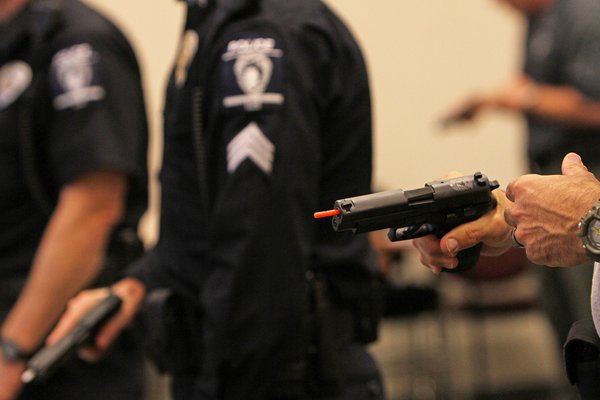
In 2023, Louisville Metro Police Department (LMPD) reported that an instructor accidentally discharged a firearm during training, striking a recruit in the ballistic vest. The recruit survived, but the department characterized the incident as a serious training failure.
How BarrelBlok Changes Academy Safety
BarrelBlok introduces a physical barrier that prevents a live round from being chambered. With BarrelBlok installed, the barrel is physically blocked and the firearm cannot discharge.
Just as important, it provides visual confirmation not only to recruits, but to instructors and staff in the room:
- Recruits can clearly see their firearm is inert
- Instructors can visually verify from across the room that all firearms are blocked
- Supervisors can walk through and instantly confirm safe status
When paired with the included MagBlok, recruits can still perform realistic manipulations without creating training scars that often come from running a firearm with an empty magazine. They can insert and seat a magazine and rack the slide as part of various reload, malfunction clearance, or other manipulation drills without slide lock creating any training scars.
It’s also worth noting that several of the nation’s largest firearm agencies currently issue a BarrelBlok to every officer during an academy, reinforcing a culture of mechanical redundancy from day one.
2. Off-Duty Dry Fire & Qualification Preparation
Skill with a firearm is perishable. Departments qualify officers. Military units qualify soldiers. But real improvement often happens between range days.
More and more agencies are turning to dry fire as an effective training tool, especially as budget cuts and rising costs affect ammunition availability. Dry fire allows officers to:
- Improve trigger control
- Refine presentation and draw stroke
- Increase reload efficiency
- Prepare for qualification shoots
- Maintain readiness between live-fire sessions
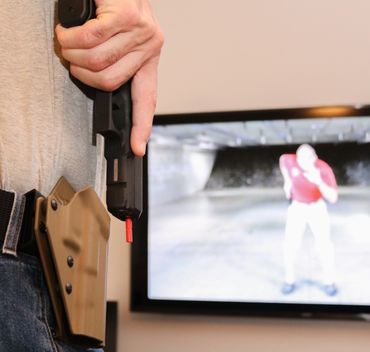
Dry fire works. But it has one catastrophic failure point: if a live round is chambered, a “dry” trigger press becomes a discharge.
Real-World Examples
In Colorado, reporting described an off-duty accidental discharge involving the Thornton Police Chief inside a residence. No one was injured, but it underscores how administrative handling incidents can occur even among experienced professionals.
In Connecticut, reporting described a State Police trooper charged in connection with an unlawful discharge incident involving a service weapon at his home.
No officer wants to be a headline relating to an at-home ND.
How BarrelBlok Makes Dry Fire Safer
With BarrelBlok installed:
- A live round cannot be chambered
- The barrel is physically blocked
- The firearm cannot fire
- The inert status is visible and unmistakable
When paired with MagBlok, officers can still perform full manipulations realistically—without sacrificing safety. That means more reps, better preparation for qualifications, and fewer preventable incidents at home.
If agencies are encouraging dry fire as a cost-effective training solution, providing the mechanical safeguard that makes it truly safe is a smart move for performance and liability reduction.
3. Scenario-Based & Force-on-Force Training
Scenario-based training builds decision-making under stress. Force-on-force exercises help develop shoot / no-shoot judgment, threat discrimination, communication under pressure, team movement and coordination, and building clearing procedures.
These environments are dynamic by design. That realism is necessary—but it also increases the consequences of a single safety failure.
Real-World Example: Texas Officer Critically Wounded
Police1 reported on a Texas officer who was shot in the face with a live round during what was supposed to be a training exercise. The officer was critically wounded and later sued the training company involved—highlighting how catastrophic the consequences can be when live ammunition contaminates a training environment.
The Pattern in Force-on-Force Failures
When training tragedies occur, investigators commonly find the same contributing factors:
- Live rounds mistakenly brought into the training area
- A missed chamber check
- Administrative complacency
- Human verification systems failing under stress
Policies, checklists, and safety officers matter—but they are human systems, and human systems can fail.
How BarrelBlok Adds Mechanical Redundancy
BarrelBlok provides a physical obstruction in the barrel. With BarrelBlok installed:
- A live round cannot be chambered
- The firearm cannot discharge
- The inert status is visually obvious
- Instructors can verify safe configuration instantly
When paired with MagBlok, participants can still insert magazines, manipulate the slide, press the trigger, and perform realistic scenario work—without risking a live discharge.
In high-stress training environments, mechanical redundancy removes the most catastrophic failure mode from the equation.
The Common Thread: Administrative Handling Is the Risk
Across all three environments—academies, at-home practice, and scenario training—negligent discharges typically stem from:
- Administrative handling
- Assumption instead of verification
- Complacency with “unloaded” firearms
- Mixing live ammunition with training
BarrelBlok doesn’t replace safety rules. It reinforces them. It adds redundancy. And redundancy prevents tragedy.
Final Thoughts
Law enforcement and military professionals carry immense responsibility. Training should build skill—not introduce preventable risk.
BarrelBlok supports three clear applications:
- Render academy firearms inert for classroom and early training
- Enable safe off-duty dry fire and maintenance for skill development and qualification prep
- Protect scenario-based and force-on-force environments with mechanical certainty
When the objective is to develop capable, confident, and disciplined armed professionals, mechanical certainty should be standard—not optional.
