

NRA Sues Michigan Over Permit-to-Purchase Denials
You can pass the exact same federal background check the FBI runs on every gun buyer in America, and in Michigan a local police chief can still look at you and say no.
That is the system the National Rifle Association just dragged into federal court.
On June 14, the NRA and three Michigan gun rights groups filed Moser v. Nessel in the U.S. District Court for the Western District of Michigan, Southern Division. The 51-page complaint targets Michigan’s License to Purchase, the permit a resident without a Concealed Pistol License has to get before buying a handgun. The case landed in front of Judge Robert Jonker, a George W. Bush appointee.
Joining the NRA are the Michigan Coalition for Responsible Gun Owners, Michigan Gun Owners, and Michigan Open Carry, along with four individual plaintiffs whose denials are the heart of the case.

Local gun groups like these are critical to maintaining our rights across America
The redundant permit problem
Here is the core of it. A law-abiding adult walks into a gun shop, passes the federal NICS check that already screens for every disqualifier on the books, and still gets turned away because a separate state permit never got signed.
Michigan’s permit-to-purchase scheme dates back to 1927. The complaint argues it is redundant, discretionary, and unconstitutional under the Supreme Court’s 2022 decision in New York State Rifle & Pistol Association v. Bruen, the case the NRA itself carried to victory.
The statute lets a local agency deny a License to Purchase on “probable cause” that the applicant would be a threat or would commit an offense with the gun. The plaintiffs call that a predictive, standardless guess with no meaningful appeal. The complaint sums it up in one line: the law is “shall issue” in form but “may issue” in operation.
That is the exact discretionary licensing Bruen warned against. A right you have to ask permission for, and that an official can deny on a hunch, is not a right. It is a privilege with a gatekeeper.
Four people, four denials
The individual plaintiffs show how the discretion plays out in the real world.
Dean Moser says Troy police denied him over old “contacts” that were misrepresented, and the written denial did not even identify the source of the information. When he applied in Battle Creek, he says he was denied automatically based on Troy’s earlier decision. Neither department gave him an appeal.
Thomas Overly was denied by Kentwood police. He went to the FBI, which confirmed he had no prohibiting record and issued him a federal identification number. Kentwood still refused to let him buy.
David Raney says the Kalamazoo County Sheriff’s Office turned him away before he could even fill out an application, telling him he was not a county resident. No application, no record, no path to fight it.
Reagan Janson was denied by Walker police on “probable cause,” because the department believed she had applied in other jurisdictions.
Four people. Four federally cleared buyers. Four local denials with no real way to appeal.
The registry nobody voted for
The suit goes after more than the permit. Every handgun sale in Michigan gets reported to a statewide database run by the Michigan State Police, linking specific guns to specific owners.
The plaintiffs call that a de facto registry with no historical pedigree, the precise kind of regulation Bruen put under the microscope. Pair a discretionary permission slip with a permanent record of who owns what, and you have a system that treats lawful gun ownership as something the state manages rather than a right you actually hold.
What the lawsuit actually asks for
What the plaintiffs want is direct. The complaint brings a facial challenge to the licensing and registration provisions, plus as-applied claims for each individual, under both the Second Amendment and the Fourteenth Amendment’s Due Process Clause. They are asking the court to declare those provisions unconstitutional, block their enforcement, stop the ongoing collection of pistol ownership data, and order the state to purge the firearm records tied to the plaintiffs.
The defendants include Attorney General Dana Nessel, Michigan State Police Director Col. James Grady II, and the cities, police chiefs, and county sheriff who administered the denials.
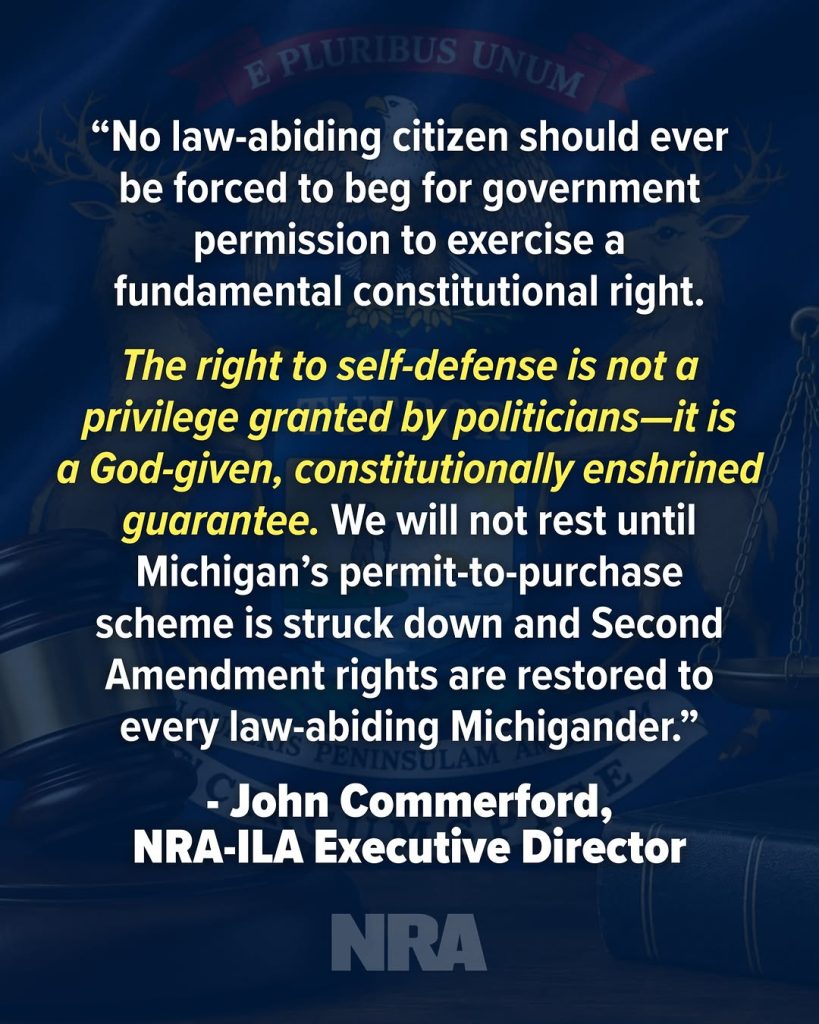
Why Michigan’s fight reaches Colorado and Other States
This case does not stay in Michigan, and that is the part worth watching.
Permit-to-purchase laws are the same basic move dressed up in different paperwork: a state permission slip stacked on top of the federal background check that already does the job. A federal ruling against Michigan’s version would give every plaintiff challenging the next one a precedent to build on.
Look at Colorado. Starting August 1, 2026, Senate Bill 25-003 requires anyone buying a “specified semiautomatic firearm” to obtain a Firearms Safety Course Eligibility Card from their sheriff and complete a state-approved training course first. The covered category is broad, sweeping in most semiautomatic rifles and shotguns that take a detachable magazine. Call it what it is. It is a permit you have to earn before you can buy a common firearm, and the Second Amendment Foundation has already pointed to this Michigan case as a reason that scheme should worry.
Then there is Illinois, where the FOID card has worked as a purchase permit for decades. No card, no gun, no matter how clean your record is. Same logic, same constitutional problem.
If Moser v. Nessel establishes that a state cannot stack a discretionary permit on top of a federal background check, that reasoning does not care which state’s name is on the statute.
The bottom line
A background check that already screens for every legal disqualifier, followed by a second permit a local official can deny on a feeling, is two systems doing one job, with the second one handing out vetoes.
We hope this lawsuit kills Michigan’s scheme and builds momentum against the ones coming online in Colorado and sitting on the books in other states. Either way, it is a case worth tracking as it moves through the Western District.
In the meantime, the smartest thing any carrier can do is know exactly what their own state requires before they ever walk into a shop. If you want a plain-English handle on the gun laws that actually apply to you, American Gun Law breaks it down state by state.

Its past time the state of Michigan stop punishing everyone for maintaining what were initialy racist gun control laws. Review the below website for background. The legislature passed in 1927 a law to prohibit gun possession and purchases by blacks by allowing the counties to determine who could and couldn’t purchase hanguns, in order to maintain white supremacy based on the Dr. Ossian Sweet trial. Now, its time to undo the racism and stop punishing law-abiding citizens regardless of race.
https://famous-trials.com/sweet/131-chronology
I am luckily enough to live in the Gun Shine state of Florida