

The Diligent Mindset: The Fight Against Complacency & Justification
A man left his house in sweatpants to grab a soda at the gas station.
He almost didn’t bring his gun. The holster he usually wore didn’t really work with the sweats. But he grabbed it anyway and set it in the center console when he got into the car. He figured he’d be in and out, and if anything happened, he was right there. The drive was three minutes.
When he went to get his soda, the bad guy was already there. A knife was at the female clerk’s throat. The attacker was forcing her out, telling her nobody would find her body.
The defender had nothing. His gun was in his car.

AI generated image for educational purposes
What happened next was a fight he should not have had to have. He went hands-on with a knife-armed attacker. He took blows. He fought his way to his car, retrieved his firearm from the console, and resolved the situation. He and the clerk came out of it alive.
I heard this story from the man involved. He came on The Concealed Carry Podcast and told it in his own words.
What stuck with me wasn’t the action. It was the way he talked about the small decisions he made that day, and how he wished he had made them differently.
And we should say it plainly: that’s a good outcome. He saved a woman’s life and his own. But it’s a good outcome that looks a little too much like luck.
The fight he had was a fight he didn’t need to have, if he had simply had his gun where it belonged. Which is to say, on his body.
This is the dimension of mindset where good defenders lose battles they would otherwise win. We call it diligence.
What Diligence Actually Means
In the pillar article on the six components of a concealed carry mindset, I described diligence as daily preparedness. The practice of being ready today, not in some abstract future.
The cleanest way to draw the line between diligence and discipline, which I covered last week, is this. Discipline is about becoming a capable defender. The long arc of training, courses, study, and skill development. Diligence is about being a ready defender. Today. This errand. Right now.
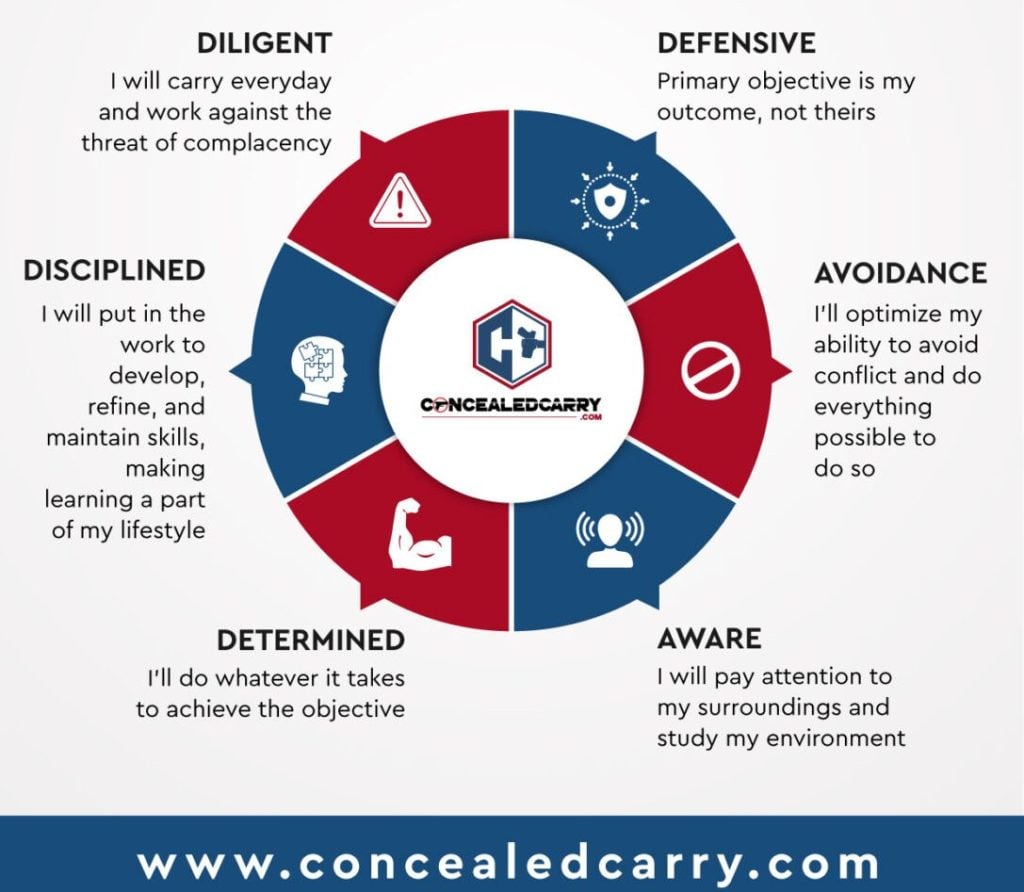
You can be disciplined without being diligent. You can be diligent without being disciplined. The complete defender is both.
But here’s the harder truth about diligence. It isn’t really about willpower. The threat to diligence isn’t laziness, dramatically conceived. The threat is the quiet, polite, reasonable-sounding voice in your head that shows up with a series of small justifications:
- “I’m just running to the gas station real quick.”
- “These pants don’t really work with the holster.”
- “I’m home now. I can take it off.”
- “It’s just a short trip.”
- “It’s daytime.”
- “It’s a safe area.”
Each one sounds reasonable. Each one would land as reasonable to someone listening over your shoulder. Each one is, in its own quiet way, a hole in the wall.
Diligence is the practice of recognizing those voices for what they are and refusing them. Not because you’re paranoid. Because you decided, once, that you don’t bargain with yourself about this.
The Gas Station Decoded
Go back to the sweatpants story.
That defender didn’t fail because he didn’t care about being prepared. He carried as a habit. He owned a gun. He even thought about whether to bring it on the soda run. He brought it.
He failed because he had three small justifications in a row, none of which would have sounded irrational to anyone listening.
First, “it’s a quick errand.” So he didn’t take the time to change into clothes that worked with his holster.
Second, “my holster doesn’t really work with these sweats.” So he didn’t put the gun on his body.
Third, “I’ll just leave it in the console. The car is right there.” So the gun was in the car when the fight happened.
Three quiet, sensible compromises. And the result was a knife fight when he should have been in a defensive incident on his terms.
Here’s what makes this DGU instructive. He wasn’t wrong about any of those justifications in isolation. The errand was quick. The holster did not work with the sweats. The car was close. He was responding to real circumstances with what looked like reasonable adjustments.
The problem is that diligence isn’t situational. Diligence is the unbroken chain. The moment you let a real, reasonable-sounding circumstance break a link, you have set yourself up to find out, the hard way, what was on the other side of that link.
He found out. The clerk almost found out. They were lucky.
The fix isn’t more willpower. The fix is structural. If your holster doesn’t work with your sweatpants, you don’t skip carrying that day. You own a holster that works with your sweatpants. If you don’t want to wear a stiff IWB at home, you wear a pocket holster, an Enigma, or something else that is both safe and effective. The diligent armed citizen doesn’t fight the carry-or-don’t battle in the moment, when reasonable-sounding voices have all the leverage. They fight it once, in advance, by removing the conditions that make those voices persuasive.
What Most People Get Wrong
“Just a Quick Errand”
The shortest trips are some of the most dangerous statistically. Gas stations, convenience stores, ATMs, drive-throughs. These are predator hunting grounds because they’re predictable, repeated, and they involve people pulling out wallets. The duration of the errand has no real relationship to the likelihood of an incident. Sometimes inverse.
“I’m Home Now”
The home is one of the most common locations for serious violent encounters. Home invasions, domestic disputes, and incidents involving guests are real categories of risk. The fact that you’ve crossed your own threshold doesn’t disarm the world outside it. At minimum, the gun should be reachable. The diligent carrier is not the carrier who leaves their pistol in a safe upstairs while they’re downstairs.
“These Clothes Don’t Work”
The clothing problem is the most common excuse for not carrying, and it’s the one most cleanly solved by structural decisions made in advance. If your wardrobe defeats your holster, you need a different holster or clothes, not a different policy. The diligent carrier has a kit that adapts to what they wear, not the other way around.
Half-Carrying
A gun in the glove box is not on you. A gun in the center console is not on you. A gun in a drawer in another room is not on you. The whole logic of carrying a firearm is built on having it within reach in the moments that count. Those moments don’t wait for you to walk back to where you left the gun.
Behaviors of a Diligent Mindset
What does it look like to live this out? A few behaviors I’d point to:
- Carries every day, in every legal location, including at home. The diligent carrier has taken the “should I today” question off the table. The answer is yes. Always yes.
- Owns multiple carry options for different clothing and activity levels. Not “the holster I have.” A small set that handles whatever the day looks like. Suit. Jeans. Workout clothes. Yard work. Sweats at home. There’s a holster for each.
- Treats the firearm as a daily essential, not a daily decision. Keys, wallet, phone, gun. The diligent carrier doesn’t have to think about it because it’s part of the routine.
- Maintains gear on a schedule. Cleans the firearm. Rotates carry ammunition. Checks holster wear. Replaces light batteries. Inspects mag springs. The diligent carrier isn’t the one with the cleanest gun. They’re the one whose gun is ready every day because they don’t let small maintenance items become big ones.
- Catches and refuses the small justifications. The “just this once” voice. The “it’s only fifteen minutes” voice. The “I’m just going home” voice. The diligent carrier has heard those voices, recognized them, and made a single non-negotiable decision in advance that the answer is no.
How to Build It
A few specific things that work:
- Build the departure routine. Keys, wallet, phone, gun. Make it the same four-item check every time you walk out the door. Once it’s automatic, you stop deciding.
- Solve the clothing problem in advance. Buy holsters that work with the wardrobe you actually wear, not the wardrobe you wish you wore. Have a sweats option. Have a suit option. Have a workout option. The diligent carrier doesn’t pick between their gun and their clothes. They’ve already paid for both.
- Pre-commit to the rule. Sit down once. Decide that you carry, period. Write it down if you have to. The “should I today” question is the question that gets you killed. Take it off the table.
- Audit your week. Once a week, ask yourself how many times you compromised, what the justification was, and what structural fix would have eliminated the situation. Patterns will show up. Fix them.
- Maintain gear on a calendar, not on inspiration. Pick days for ammo rotation, battery checks, holster inspection, and a deeper clean. Put them in your calendar. Don’t trust yourself to remember.
The Takeaway
The man in the gas station survived. The clerk survived. Whether you call that a win depends on whether you grade on outcome or on preparation. The honest answer is that he got away with a chain of small compromises he should not have been able to get away with.
That’s the whole game with diligence. It looks like nothing for years, right up until the day it looks like everything.
This is the last piece in a six-part series on the components of a strong concealed carry mindset. Each piece had a defender at the center, illustrating one dimension of the framework.
The DoorDash driver in Akron showed us defensive only. He didn’t escalate. He didn’t pursue. He went home.
The woman in the gas station parking lot showed us avoidance. She saw the setup. She broke the script. She left.
The man on the Chicago sidewalk, by contrast, was our awareness lesson. He never saw it coming. He was the cost the rest of us shouldn’t have to pay.
The man in the truck showed us determination. He had decided in advance, and so he could act in the moment.
The disciplined carrier didn’t have a single story. They were the long arc behind all of them. The skill set the truck driver drew on. The training the avoidance-minded woman carried into the parking lot. The work done quietly, for years, when nobody was watching.
And the man at the gas station, today, almost got diligence right. He came close enough to teach the lesson. The lesson is that diligence has to be unbroken, because the fight doesn’t care what day of the week it is or what pants you’re wearing.
Six dimensions. One defender, at any given moment, can only display the one being tested. But the complete armed citizen carries all six all the time. The fight you don’t have to have is the one your other five dimensions handled before it ever got near you. The fight you do have to have is the one your sixth dimension put you in position to win.
That’s the whole framework. Build it slowly. Carry it daily. Trust the work.
This is the sixth and final piece in our series on the six components of a strong concealed carry mindset. To revisit the full framework, see the pillar article on developing a defensive mindset.

Thanks for another great article.
I made the decision to carry daily when I made the decision to get my CCW just over five years ago. There have been less than 10 days that I have not fulfilled that promise to myself ~ typically because my morning routine got rushed and interrupted. I solved that problem when I decided to ALSO carry a backup gun ~ I have occasionally inadvertently left my primary but still had the BUG (I nearly always found a way to get back home to pick up the primary during the day).
Every time I consider “maybe not this trip” I forcefully ask myself: What if today is THE day? I don’t like that answer.
I call it a win!