
Resources
-Introduction to Concealed Carry Belts: The Foundation of Your EDC Setup
About This Episode:
In this episode of the Concealed Carry Podcast, I discuss the crucial role of belts specifically designed for concealed carry with my co-host Jacob Paulsen. We reflect on our ten-year anniversary, highlight recent giveaway winners, and emphasize the importance of quality gear in the community.
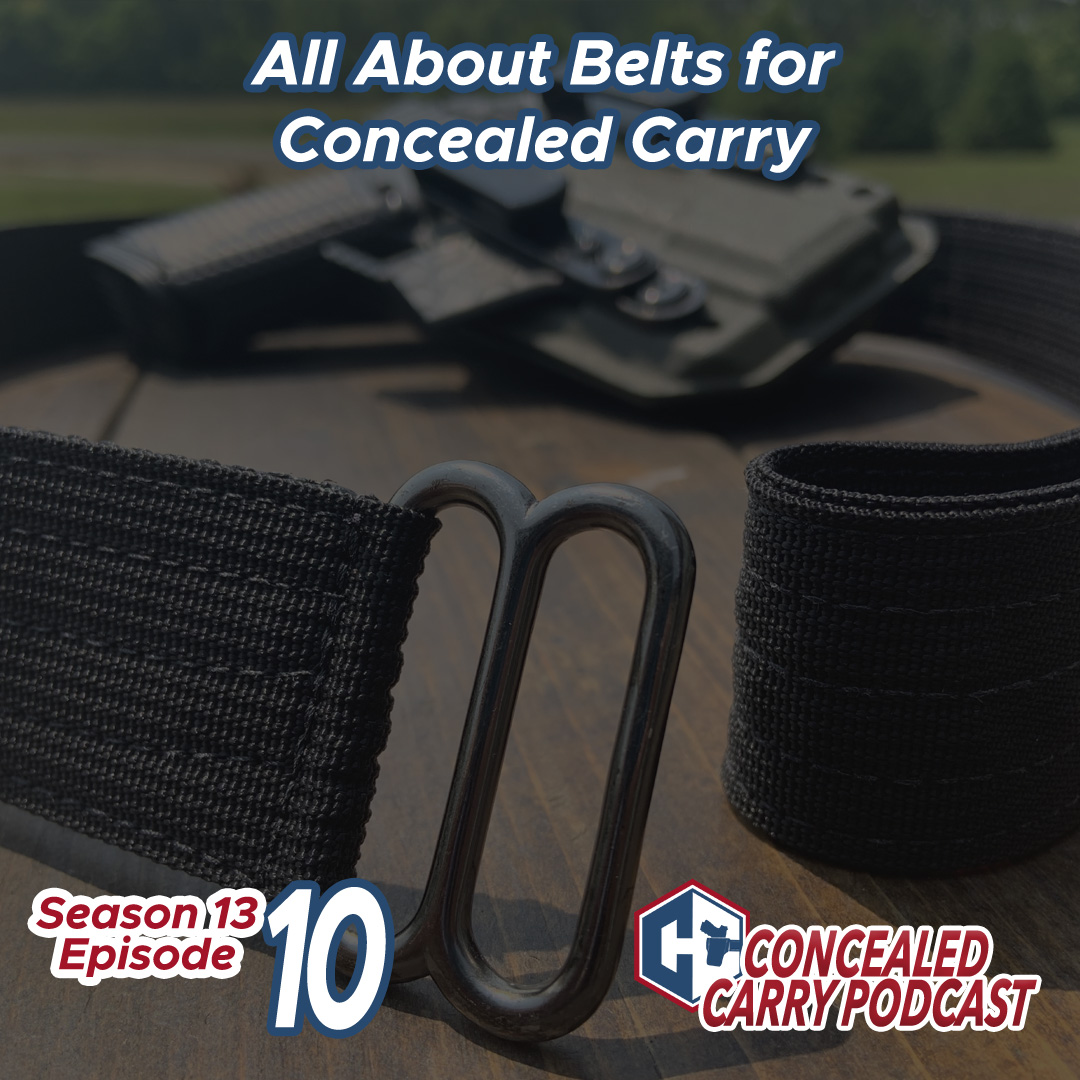
I share my experience with the Foundation Belt from EDC Belt Company and explore various belt types, contrasting them with standard options. We cover key features of a good concealed carry belt, including load distribution, reinforcement methods, and the balance between stiffness and comfort. Additionally, we highlight the significance of low-profile buckles to avoid printing.
Listeners are encouraged to evaluate their current gear and consider investing in a quality, purpose-built belt to enhance comfort and effectiveness in their concealed carry journey.
Watch this episode
Read the transcript
And welcome to the Concealed Carry Podcast, part of the ConcealedCarry.com network, brought to you by HK. Today is Wednesday. I don't know what date it is. March something. 11th? 11th? 11th. March 11th. Wednesday, March 11th, 2026. So everyone knows when we recorded this, we are live on YouTube and Facebook, as we typically are with these podcasts.
And you're welcome to always join us live, of course. But for those of you that are just listening to us, here we are. We're doing the thing. It's Jacob and Riley. It's been 10 years. In fact, we already did the whole 10-year episode. We are going to talk about some – we're going to do a little follow-up from the 10-year giveaway that we did. So we can do that now or we can do a quick sponsor message.
One than the other. Okay. You didn't say which one, though. So, all right. Today's episode, it'll become clear. Well, the title of the episode is all about belts for concealed carry. So, surprise, surprise. Today's episode is sponsored by EDC Belt Company and the Foundation Belt. I've been rocking the Foundation Belt for five-ish years, I think, at least. I don't know. Maybe even a bit longer.
Yeah, it feels... Yeah somewhere there Five five plus years yeah uh i i still have like no complaints really personally about the foundation belt um and yes i'm a biased source because we sell them but yeah but. We were using them before we started selling Oh for sure yeah but my point is is like we're still rocking these bad boys uh for you know a number of years and still very very happy with them we're not going to just talk about the foundation belt today we're talking about a lot of different belts and what goes into a good quality concealed carry built purpose built belt but those of you that are interested in checking out what i think is one of the finest concealed carry belts on the market you head on over to edc belt co edc belt co.com and you can order your foundation belt today you can also order the foundation belt directly on concealed carry.com And you can also check out all of the belts we sell on ConcealedCarry.com.
You just go to the ConcealedCarry.com store and just go to the store and go to shop and select belts. And it'll pull up all the different belts that we have in the store. We'll talk probably about the Wilderness Tactical making some quality belts as well. We sell a number of the Wilderness Tactical models. They're excellent too. I've got a couple of them at home.
Still use them occasionally but I do find myself I go right back to the foundation belt for the most part. There you go. Yeah. That's absolute sponsors. So a few weeks ago, we celebrated the 10-year anniversary of the podcast along with a huge giveaway. It's one of the bigger giveaways I think we've ever done. Yeah. I don't know.
We've done a few giveaways, but this one was big because we had a couple of. – It was a lot of stuff. We had four guns we were giving away. Yes. A bunch of different products from companies like Palm, CRKT, Columbia River Knife and Tool, uh hk there was ammo yeah there was some bad yep some. Targets med kit yeah there's a lot of Stuff a bunch of stuff uh so the winners have been selected from that 10-year anniversary giveaway in.
Some cases many times over Yes and that's one of the things we want to highlight for you right now if you signed up for the giveaway you want to make sure you check your email okay and check your spam folder and all that because we've contacted a few uh originally selected winners that have never gotten back to us and we have a policy of giving you 72 hour window to reply back or we move on to the next winner i think that's more than generous yeah.
And what we don't want to be is the guys who like well we contacted them all if they don't respond i guess they don't get their prizes we want to make sure that we actually you know people do win and do receive each of these prizes. Absolutely. So we can't wait indefinitely. Yeah, 72 hours. That's the deal. So we've already, yeah, we've already moved past several people who didn't reply within 72 hours.
And we have about half of the prizes right now are pending response. Yeah. Yeah. So, and it's been actually a couple of weeks. So people are taking their time getting back to us. Yeah. That's the point. So we're not getting back to us at all. Yeah, that's the problem. Right, right. So we've got, hey, just to highlight, we had 15 total prizes.
Smaller prize winners uh a couple of uh well we had a hk g36 22 long rifle rifle yeah sweet pretty cool um we had a couple of of the brand spanking new tx9 handguns from taris um a mantis blackbeard that's pretty cool right two knives from hk we had trauma kits from Mountain Medical, Victo Spag, a knife from CRKT, some glasses from Tactical RX, a KSG Armory holster voucher, EDC belt, foundation belt, like we're going to talk about today.
Some targets from Throom and some palm pepper spray three packs. A couple of winners of those. Yeah. I'm just giving you the kind of the highlights of the prizes. Could be an email in your spam folder right now telling you that you won one of those things. Yep. So guys, hope that you claim your prizes, those of you that have been selected.
We've got a lot of you that signed up for the giveaway and it was really cool to select the winners. It's less cool when you have to move on from the winners to the next winner. I guess it's cool for that person. But, but hey, we have a grand prize winner. I wanted to highlight this one a little bit. So the grand prize was actually a bundle prize. We had a ticket to the to the Guardian Conference for 2026, a quarter free quarter.
So three months worth of Guardian Nation membership was included as part of this. An HKCC9 gun, okay, and O-Sight SE optic to go on that gun. It fits right on. You know, it's perfect. A CRKT definitive crossbar knife, kind of a cool-looking knife. A POM home and away bundle. It comes with, like, their usual little POM, you know, units, as well as the MK3, which is a larger unit, including also a home defense unit, which is, like, you know.
It looks like riot control level stuff, You know. Huge old canister. It's like you're running around with a fire extinguisher, but it's pepper spray. Right, right. And then there was also 250 rounds from Mags & Co, 9mm ammo. So it was a pretty awesome prize. And the winner did claim that prize. So that was pretty cool. It was locked in.
Yeah. Were you mentioning who that is? Yeah. They're from Texas. I mean, give a first name. Yeah, yeah, yeah. I think it's cool for people to hear. It's not a super common name. I forget. It starts with a W. Let's see here. Wayland is his name. Wayland. There you go. Wayland from Texas. Congrats to Wayland in Texas for the grand prize winner.
That was awesome to see you get a pretty awesome bundle of prizes there. I don't know what that would totally be valued at, but a lot. It's muy bueno. A couple thousand dollars worth of gear. It was fun to celebrate our 10-year anniversary in this fashion. Thanks again, everyone, for your support of the podcast for all these years.
And we'll see where we are in 10 years. Don't know if we'll have another opportunity to do a... That just seems unfathomable. Will there even be podcasts in 10 years? Yeah, right. Maybe we will have moved on. I don't know. Anyway, guys, again, check your email in case you've been selected and we'll look forward to getting more of those winners contacted.
So we're not announcing everybody here, but there you go, Well, let's get back to the podcast topic today, all about belts for concealed carry, Jacob. Yep. I suspect that every single concealed carrier listening to this or watching this is guilty of having used a non-design-for-the-purpose gun belt to conceal a gun. I have. Oh, sure.
I just think it's one of those places where you're sort of like, well, I got to buy all this stuff that the guy told me to in the class. I gotta get a new gun all this stuff and yeah he talked about belts but I have a belt like at least I should try the belt I have right so I think that's just where most of us start is with no gun belt at all let alone maybe an optimal belt but yeah no belt oh I shouldn't say no belt I should say not a gun belt yeah well I mean a standard kind of traditional it holds up to pants If you are if you're new to concealed carry, I would say There's a high probability you never even considered that what you use for a belt, assuming you're carrying on the waist, which we, you know, generally advocate for as being the best practice.
It's not going to be everybody's solution, but most people are probably carrying on or near the waist. And if you're doing so, you might not have considered that, yeah, there's a difference in using just a normal belt and using a belt that's purpose-built, purpose-designed for supporting concealed carry on the waistband.
And that's really what we want to share with you here today because we know there's going to be some of you out there who have never even thought about it. Or maybe you've thought about it, but you just don't know. What really matters and what makes a difference. So we'll talk about that. We'll talk about what goes into, you know, these optimized for concealed carry belts.
I think we also need to clarify what they are not and that they are not like a duty belt. We're not talking about a duty belt or a battle belt for those of you who your brain might go there. But, you know, some of you have an experience, you know, maybe with law enforcement or in private security or, you know, military, whatever it might be.
And when you think of like a gun belt, you think of something that's a little bit more substantial than what we're talking about. A big duty belt is going to have it's going to be pretty significant because it has to support a lot of gear from, I don't know, I'm not a cop, cuffs, radio, I don't know, a bunch of M-A-G's and taser and I don't know, whatever other stuff they put on their belts.
Yep. So that's not what we're talking about when we talk about a concealed carry belt or if I use the word gun belt, I'm I'm really thinking of something more EDC concealed carry focused. Right, right. Likewise, there's certainly a place for kind of a duty belt style or like a range setup perhaps, you know, that you only put on when you're going to the range and you're doing outside waistband work or something.
Our intent is not to talk about that so much today because this is, after all, the concealed carry podcast. Yeah, but you need to know what you might run into if you just Google gun belt. But another variation of belts that could be in that category would be like a competition rig. I don't even own one of those, but you have a few. So a competition rig is designed for some sort of competitive shooting sport that holds all sorts of stuff on it too, primarily a whole bunch of mags.
Yeah, and even if we were to look at those, those are, again, they're purpose built, purpose designed for that specific use. I mean, a competition belt by nature is specific to that sport, really, is kind of what we see. Because what I use in USPSA isn't even what I would use if I was competing in IDPA, for instance. Of course, IDPA is typically done from concealment.
At the very least having like a concealment vest over top of things and and uh the in fact by rules you can't even use the you know the the belt that goes over our top you know like the competition belt that we use in uspsa actually the by rules your belt has to go through your belt loops you know in idpa so anyway not not really the intent of this podcast but just since you mentioned it Yeah.
The point is gun belt could refer to a lot of things. And I think we're trying to talk in today's episode about this sub niche of that, which is a concealed carry belt or an EDC belt, if you prefer. So if you're like me or like you, I suspect, in the beginning, I mean, I remember I carried for a few years with just kind of a normal leather belt.
It wasn't uh i wouldn't say it was a weak weather leather belt but it was traditional just a normal leather belt walmart. Style you know i i bet you today they're probably like 15 bucks on amazon or Something sure i. Mean yeah it's it's black and it's got a buckle and holes every inch or something And yeah yeah i mean it's i think probably one one i the one i used for quite a while was uh was just a two-layer stitched leather belt it was a decent belt it was it was not just your you know cheap off the shelf walmart but it wasn't like a high-end one either i think i paid like 40 bucks for it i.
Was the cheaper the better for me that's that's where i was absolutely But you know i had that belt for quite a few years it served me well in fact i think i still have it somewhere i just it hasn't hasn't been on my waist in quite some time but uh so that's that's what i used for a number of years and you know so it's non-reinforced um i wouldn't have called it flimsy at the time, but I would now knowing what I know and, and, and using different gear now, I'd be like, ah, that thing was flimsy.
Uh, but I thought it was like a pretty stout belt at the time, you know? Sure. So at the time I thought that's, that was the right, thing that was the right play you know that was just a decent quality um relatively thick but not overly so leather belt uh and i at that time i also carried on my hip or you know slightly behind the hip like four o'clock four four thirty four something like that and it worked okay you know.
I mean i didn't know what i didn't know right and i think that's the point of the kind of where we're starting off this episode is if you've never used anything other than a pretty standard traditional belt and as far as you know it's it just does what it does yeah and you you don't know what you're missing out on Yeah so one thing i i noticed after a few years of carrying wearing that belt is that it uh started to sag kind of in you know the location where my gun was carried all the time um and you know i didn't think that was i just thought that was natural and normal and like to be expected, and so I didn't think anything of it.
I didn't think or realize that the belt was not helping me carry my gear and support the gear more effectively than, you know, some of the other options out there. So I think the first time I encountered a. A reinforced belt of some kind was, oh man, early 2010s, you know, I don't know, 2010, 2011, 2012. I don't remember, but I remember the first belt I bought, I think I bought it from, it was some gun store and it was, uh, it was a, a reinforced belt.
And I don't know whether it was steel or if it, you know, some are using like a, like a, some kind of polymer plastic ribbing inside there you know i don't know what it just said it was reinforced i'm like all right cool it's reinforced but it was definitely noticeably stiffer than what i had been previously using and the first thing i noted from the moment of putting that on was oh like now the belt doesn't flex as much with the weight of the gun and it was notable at the time to me and so all of a sudden i'm like oh this is the way to go and so then i started using a number of different brands over the years of just straight-up reinforced belts.
So, I mean, what was your experience? I remember my first belt was a wilderness instructor belt, like my first, you know, gun-ish belt. And it appealed to me, and this is going to sound so silly, but it appealed to me because I saw an ad or someone, whoever, whatever the source was that I learned about it, It said that you could repel with this thing. Like a helicopter could come and pick you up and you could hook in on your belt.
I was like, that sounds awesome. That just sounds like I will never need that. And it sounds so cool. So I was in. I was just like, yeah, I want that. I want the thing that a helicopter could come and pick me up with. So, yeah, I got the Wilderness Instructor Belt. And I love that belt. I wore that belt. I still have that belt.
I still have. I think all of my gun belts I've ever owned. They have their own little section in the closet. But, yeah, I wore that belt for years. And, yes, it made a huge difference. Immediately you can notice, because that's the first thing, the primary objective of the belt, when we're talking about the CDC concealed carry application, is that it's supposed to spread out the weight of the gun around the waist so that you don't have – if all the weight is centered in one spot, then you really have potential health issues.
It's not good for you, for your body, to be supporting all the weight in one place. So the belt is distributing the weight of the gun around the body. And it needs a certain amount of rigidity in order to do that. And so, yes, going from almost no rigidity to suddenly serious rigidity, that was notable. Because when all you're doing is holding up your pants, it really doesn't matter.
You can take some string or a rope and tie up your pants through the belt loops. It'll keep your pants from falling down. But when you put the gun on there, all of a sudden, that holster on there, now you have an issue where you have that weight, a couple pounds. And so, yes, a belt is distributing that, and it made an immediate difference.
So, yeah, likewise, all that, what you said, I noticed that right away is that all of a sudden that reinforced belt was supporting the load of the gun much better and it felt better, you know. And so that became kind of my new norm for a few years. So I think that's probably the first place I wanted to start with is just pointing out, first of all, to carry a gun concealed on your waist.
Uh ideally it's to you want to have a belt that has reinforcement of some kind ideally reinforced uh mostly in this kind of up and down you know plane uh supporting the so the belt's not sagging so much uh downward towards the guys gravity is going to do its thing right you got a gun on your waist yeah and so obviously gravity is going to want to pull that down and so i mean the belt can still be flexible uh you know kind of the side to side plane if you will or but you want in the vertical plane along the face of that belt to be ideally fairly stiff to support that gun weight so yeah.
And i think this this is one of those things that we've talked about before where you you kind of end up sometimes in extremes and without balance Yep and. That's probably the first like the first big aha for me after the obvious one of just like no gun belt, two gun belt, you know, that, that was like, Oh Jesus, way more comfortable distributing the weight.
But then the first big, big aha came when I realized that more stiff is not equal, more better. Well, more stiff, you could argue, is better for supporting the gun. Oh, sure, sure, sure. But there's a downside, I think, is what you're trying to point out. Right, right. It comes with a cost. Yeah, so I remember there was a belt in particular that I had at one point that I was like, man, this is the jam, you know, because it was a really stiff belt, which meant it supported the gun really well.
But you know i i'd only make it three quarters of the way through the day before i'm like oh man you know it's just uncomfortable dig. It on the side a little bit What you're saying is a stiff we can go really stiff with a belt but then it's going to start impacting our comfort uh and i remember the first time we had a conversation about this with uh brian eastridge a few years ago he's he's actually the creator of the foundation belt and he was just talking about how our torsos are shaped our waists are shaped and i don't remember the exact terminology he used at the time but i remember in my mind the way i made sense of it is you know that that our bodies are oval or you know in some cross sections almost like a jelly bean in shape you know if we were to do a cross section right through your through your belly or through your midsection there look at your waist i mean you're kind of either an oval or almost like a jelly bean and well when you take a belt and particularly that a belt that is stiffly reinforced and especially when it's reinforced in a uniform fashion okay from in other words from you know north to east to south to west and back to north again right then what that really means is that reinforced belt wants to be a circle.
Right. And this is, I remember this was a conversation I had with Brian and he's just like, Hey, you know, a standard belt, it's just like, it's a circle and you're trying to fit, you know, a jelly bean or oval into a circle. And like, yeah, you could do that. And over time, the belt will settle in and break in a little bit too, but you still kind of end up with these like almost pinchy points. And for me, it's like right sort of in the back corners of my hips.
Just almost right behind the center of the side of his. Yeah. You know, I'd feel like this extra pressure back there and stuff. And so that's, that's when I realized, okay, you know, that stiff belt was, was great to a point, but you can go so stiff, especially that now, and especially where it's uniformly stiff like that, that now it's going to start kind of compressing in on those corners a little bit more.
And you see advertising for, you know, can still carry belts where, the one that sticks out in my mind that I'll just never forget is these guys were, the ad basically said, it's so stiff you can stand on it. Yes. Yes. Right? You could stand on our belt and it will not sag or bend or fold. Like, you know. They made a big deal of that to the point that people were taking pictures of themselves standing on their belts.
Yeah, probably it was great viral marketing. Right? Like, check out my new belt. This is me standing on it. But, yeah, there was that huge aha moment for me where I was like, man, if you wear a hula hoop, it's going to be a problem. Yes, yes. And I'm going to talk about hula hoops again here in a minute. Yeah, we're going to have to come back to it. But, yeah, so there's this balance of stiffness where we need the belt to be stiff enough to support the gun, to distribute the weight of the gun, and to prevent sagging of the gun wherever it is on the waistline.
But if it, you know, the stiffer that belt gets, we start to jeopardize comfort. And there's some other practical application things beyond just comfort too. Like if you, if the body, if the belt is not conformed to the body's shape, then as you move, you cause other problems beyond comfort. I mean, comfort continues to be an issue as you move, let alone when you stand still or sit still.
But we also effectively start to print the belt. Yeah, so that's kind of what I mentioned. I was going to talk about hula hoops. And I have experienced this. I have felt this. So you can get to a point that your belt is so stiff on your waist. And it becomes especially noticeable if you carry forward of the hips. So like appendix style carry.
You'll feel this a bit more because of just where that gun is sitting. But um in other words like where the belt is tightest on you is going to be at you know kind of where your hips are right right and where it has a little bit less pressure is in the in the front and back um and so when you have a really stiff belt it can be like a hula hoop and you stick your waist inside that and you can have belts that are so stiff that like It almost feels like there's a hula hoop on your waist to the point where it's almost moving independent of your body.
And that can cause some printing issues. And also, it just feels strange, actually, because I like my gun to feel close to my body and that it's moving with me and not independent of me. And so I had that belt I was referencing a minute ago that was really stiff. Like there would be times like I would, I would twist and I'd, I'd feel like my torso moving separate from like everything else.
And that was just like a really strange feeling. So I did want to talk about concealment a little bit because I think this is important, an important distinction to also make in this discussion that, um. When you go to a stiff reinforced belt, particularly a more traditional one, like, you know, they've made these for a number of years now.
It works pretty well, I think, if you're carrying on the hip. You know, you might have some comfort issues. And we're going to talk about, you know, the alternative to having a uniformly stiff belt. But I think that system works pretty well if you're carrying on or behind the hip, having that style of stiff, reinforced belt.
Uh, when, one thing I remember noticing with a stiff belt is that it actually made my wing or claw on my holster more effective. And that's something, you know, we can go down that rabbit hole a little bit here, but for those that aren't familiar, the claw or wing on your holster, uh, this is a more recent development in holster technology.
You know, it's become really a thing in the last decade or so. They've been around for a while, but for a long time, holsters didn't use this technology, right? But once we started adding that claw or wing to the holster, it helps tuck the grip. It basically helps orient the grip in towards the body. And that's dependent upon the belt actually applying pressure to that wing.
Yes. And so if you're using, you know, sometimes I've seen questions come up on online in various forums or whatever. People are talking about concealment issues and they're using, you know, a fairly modern holster. It's got a wing on it and they're like, I'm still struggling to get this grip to tuck in. And it's like, well, what are you using for a belt? You know, and a lot of times it's pretty common to find out they're just using a standard belt. And that's going to be part of the explanation of why that wing is not applying the leverage that it's supposed to.
And so I noticed when I first started using a really stiff belt, it was like, oh, wow, now this thing is really concealing well. But to a point when the belt is so stiff, like it can only suck into the body so tight. And you said like you could almost like see the belt start to print. And I've experienced that. Yeah, it's... Well, speaking of printing, too, remember the buckle.
So, yeah, I mentioned my Wilderness Instructor Belt, and I loved my Wilderness Instructor Belt. I think they... And they're just great. But that's one that has a very specific application. And EDC carry with the t-shirt is probably not the intended application of that particular belt. And it, like a lot of other concealed carry belts, has a very large buckle.
And that buckle, I mean, I've had experiences where friends who know I carry a gun saw the buckle through the shirt and thought it was my gun. We're like, hey, you're printing. And I'm like, that's not my gun. That's my belt buckle. And it's like, talk about a problem. Good job concealing your gun, but your belt buckle is still freaking huge.
People think it's a gun coming through your shirt. Another common one we see a lot, we see a lot of these companies who make belts with what I'll call the Cobra buckle. And it's a generic enough thing now that everybody can go source some Cobra buckles and put them on their belts. But it's a relatively bulky buckle. It just it just prints I mean maybe not depending on what you're wearing or if you're wearing loose enough clothing and things so some of you might say oh it's not an issue for me I don't have that problem you know so clothing can solve all all concealment related issues but certainly if your belt buckle is printing through your shirt more than your gun I'd say yeah i'd say that's a Problem that's a problem for sure yeah yeah no i agree with that yeah i had one with the cobra buckle which i think the buckle is awesome oh great it's very efficient it's easy to click in and click out you know undo and all that um pretty cool little setup, but uh that you know that was a belt that was just too stiff uh it caused some comfort issues for sure like it'd be interesting to go back to one of those now and i'm sure i'd very quickly dislike it because I'd be like, oh, wow, compared to, you know, what I'm using right now, it's, it's just not even, it's night and day difference in terms of comfort.
So, so, um, let's talk a, kind of shift a little bit. Unless, you know, I mean, you're welcome to obviously. I was going to talk about some good buckles. Okay, yeah. Since we're on the topic of buckles. Yeah, yeah, buckles. So one I like that I recently have been using here and there. Here it is. I found it. The Wilderness Tactical Swift Belt.
Have you seen this buckle? I'm going to show you a picture. Yep, yep. Just, yeah. So it's an interesting kind of setup because it's one of these where you kind of have a fixed width of the belt. You kind of set, you know, how big you want this belt to be. And then it's kind of a quick on and off to attach, which is similar to a Cobra buckle, for example.
But it's super low profile. The Wilderness Tactical Swift belt has a very low profile buckle. It's just not taking a lot of space, but it's highly efficient. Of course, we've talked about the Foundation Belt from EDC Belt Co., which I have on right now. I assume you probably do too. Oh, yeah, absolutely. I don't know if they made up the name for this buckle or if it's like an industry standard thing, but they call it the tri-glide that's a thing the tri-glide buckle and it's made out of brass it's extremely low profile I can't imagine you coming up with a belt buckle that takes up less space under the shirt and on the belt than this it's tiny so I really appreciate those kinds of buckles in the case of an EDC can still carry belt they're taking up very little room, very little space Yeah.
Uh, I've got some other belts that are very similar with that, that Swift belt, uh, buckle style. They're a little bit different, you know, they look a little different, but they function the same way. Sure. We're just, it's basically like a hook, you know, that you're, you know, putting through the loop or something on the belt, um, or the belt itself.
And, uh, those are pretty effective. Uh, you know, I haven't had any issues with those at all. So, you know, honestly, if the foundation belt was set up like that, it wouldn't really bother me one way or another as far as that buckle is concerned. They're both, like you mentioned, the tri-glide like is used on the foundation belt or that swift belt style is, you know, all the same to me as far as good low profile, easy to use.
One thing, if you travel a lot, if you fly a lot, I haven't been flying as much the last year or two, but it's actually... It's, it's, I'll tell you this, you will not set off metal detectors using something like the foundation belt because the buckle itself is not steel or containing the iron. As you mentioned, it's brass. It's been nickel plated.
It's nickel plated brass, but it, you know, there's nothing about this belt that will set off metal detectors. Which is super convenient. And I've, you know, they tell you, you're supposed to take your belt off when he goes to the airport. Pretty often, I don't take mine off. Now, some of their scanners now, of course, will still pick it up. they're like oh there's something there and like i'll just lift up my shirt and they look at it they're like okay you're good carry on so i you know i just go right through with my.
Belt i appreciate not having or and there's other situations you know i went to a hospital recently i had to go through a metal detector yeah um you know i've got a sheriff's office on occasion here there for uh any number of reasons and have to go through a metal detector so yeah like yeah don't have to take my belt off um and sometimes they'll ask like oh what about your belt mike it's no metal Yeah you.
Know i'm good so yes i i appreciate that that it's not a metal that i have to worry about in that respect yeah yeah By the way i do want to recognize we've got a lot of great you know we've got a lot of comments coming on uh facebook especially a little bit on youtube uh appreciate those of you that are commenting um there's not not all comments or questions we're going to be able to address just so you know some of these will probably take us off topic uh but real quick I think we should just handle Brian's question real quick, Jacob.
Is it better to carry in a holster on a belt, since we were talking about, you know, on the belt carry, or just carry in a front pocket? And so I just thought I'd get your quick take on that. It's the good old usual depends, right? Yeah. I think if we take into context all the various things that an average person does on an average day, then probably we tend to find that IWB on a belt is the most efficient way to conceal a gun that's easy to access for deployment in a self-defense context.
But there's exceptions, right? So I think that that's what you find most people do because it seems to be the most universally applicable effective option. But it doesn't make it the most effective option for every person or in every context or with every gun. Yeah. I agree. It depends. Some quick feedback to that question from me would be I have found in my study for a number of years now, the concealed carry lifestyle that the best well-rounded approach to carrying a gun for typical daily use is on the belt.
And the way to evaluate this, Brian, is to consider the pros and cons. And I think that pocket carry has more cons than just carrying on the belt. The biggest con of carrying on the belt is that there's maybe a higher probability of printing issues or concealment type issues. You just have to balance that a little bit more as far as the holster you're using, the gun you're carrying, and of course the belt's part of this and whether that's gonna effectively carry it in a concealed fashion that's also comfortable.
The pocket though, just has a couple of major drawbacks. Number one being it's just slower to access unless you can start with your hand on the gun in the pocket. That's the only way that that's faster. Otherwise it is all around less fast. And there's going to be situations where you need a gun, potentially, that you can't start with your hand in the pocket.
I think the probability is higher that you need an immediate response, not a surreptitious draw. Right. So it's less likely to be an advantage than it is to be a disadvantage. Another major disadvantage of pocket carry is you're almost certainly limited to pretty small guns. Yeah, low capacity, small, Difficult shoe. Low capacity, hard to shoot, exactly. And so that's the big stuff there that I would consider Brian.
Last thought on Brian's comment is the way that his question is worded suggests that he may be thinking holster on belt as an option or no holster in a pocket as the other. So it's just worth noting that even if carrying in a front pocket, you should still have a pocket holster involved. Oh, for sure. Yeah, always. In fact, the next comment, I think there might have been a reply to this was from Alberto, and he said, always holster.
So that's probably his opinion on that if that wasn't clear, also Jeffrey comments saying I'm guessing this is what he carries HK VP9SK in an Omni ISWB on a 1791 belt does a trick. If it works for you brother Hey it's a great choice of gun that's for sure. No problem. Yeah. I mean, obviously you should be carrying a KSG Lexington instead of that Omni ISWB, but you know, teach their own, you know, whatever, whatever is all good. That's right.
1791 is a leather business. And so companies that make holsters tend to be in the belt business, especially if you make leather holsters, because if you make leather holsters, it's not a far stretch for you to start making belts. Yeah. The same materials are already in house. Like we need a couple of pieces of hardware.
We need a couple of patterns, cut it different, sew it different. Yep. So you tend to find the holster companies are the biggest sellers of concealed carry belts. In fact, our company is an exception in that way in that KSG Armory does not make or sell any belts, which is our holster business. And we support or primarily promote the EDC Belt Co. Foundation Belt, which they don't make any holsters.
So anyway, I just put that out there that you tend to find the holster companies make belts and belt companies make holsters and they tend to go hand in hand because it is a system and it tends to work together. For sure. For sure. I think this is a good point to transition a little bit. I actually wanted to address maybe what are some of the different pros and cons of different styles of belts.
Yeah. And so you mentioned specifically like there's leather belts out there, obviously. Most leather belts not all but most leather belts typically are, again there are some exceptions and of course i'm thinking of like we'll come to that next belt or you know click style belts but most leather belts in the traditional sense are a buckle with holes right you know about every inch or whatever okay and so that's a very traditional belt design been probably used for hundreds of years and uh the problem with that is that you're limited to every inch adjustments yeah.
So adjustability is is the is the point here right and I think you're spot-on This is going to sound a little bit bizarre to the unindoctrinated, right? To those of you who are new who have never used a gun or concealed carry belt. But having the ability to adjust it by quarter inch, half inch, is actually pretty substantial as far as like it's a big deal.
I find myself adjusting my belt quite a bit. And so having the adjustability to, you know, I call it infinite adjustability. So infinite adjustability is a really nice feature to be able to say a little tighter, a little looser. And a lot of that's context for me it's like i'm home now i careth not if i print so i'm happy to loosen my belt a little bit get a little bit more you know increase comfort decrease concealability because i'm at my house you know that that kind of thing um so so it takes very little adjustment sometimes to make a difference uh it's like oh you know what like the shirt i'm wearing today turns out it's a little tight on me and my gun's printing a little bit i think i'll just tighten down this belt just a little bit you know cool cool i'm good now that grip is now tucked a little bit tighter you know put a little more pressure on that wing whatever it is and and now i'm golden so yeah this idea of infinite adjustability matters a lot and there's generally two ways infinite adjustability is provided by a belt the first is velcro and the second is is a click style belt we have to be careful with saying click style belt because there's also a brand of of click belts.
But anyway, so the click belts are what they sound like. This kind of these little, uh, like Ridge style, plastic middle piece of the belt. And as it's going through the buckle, ratcheting, ratcheting, that's the word I was looking for. Very well said. Yep. And so it's, it, Our grand prize winner just tried calling me back.
Oh, wow. Yeah. How about that? Sorry, Wayland in Texas. I'll call you back. So, yeah, so the ratcheting style kind of thing. And those are like quarter-inch adjustments. Sometimes they're even tighter. Most of them are quarter-inch adjustments. And a lot of brands now that make and sell those in lots of different materials. You can get that in nylon belt or leather belt, whatever.
And then Velcro, as I mentioned. The Velcro, a little bit different, obviously. But, you know, it's a similar kind of thing. You're just kind of putting the belt material through something and then tightening it as much as you want and securing it with Velcro. Both of them noteworthy to, say, make noise. So I don't know of any, like, real silent adjustability belt options.
If you've got the click thing, then you go click, click, click, you know, as you tighten it up. Or if you loosen it, maybe they don't. I guess you don't make any sense if you loosen it. And on the Velcro, same thing. It's like, you know, to pull the Velcro apart, then tighten it, loosen it, and put it back. Yeah. Some people have made the comment about, you know, noise being a problem, like, especially with, like, Velcro belts.
And I have never found myself in a situation where I felt like I was giving something away. It doesn't bother me at all. You know, like, see if you can hear this, right? Like, that's about the extent. It's not a big deal. I'll get closer to the mic even, you know? Like, I mean. This looks kind of funny to watch. Right? I guess I could have done it using this one.
Okay, there you go. That was close to the mic, yeah. I think Velcro or hook and loop is universally used enough in today's world that I've never worried about that at all. Yeah, I can't imagine. I'm in the Restroom or something in a stall, and I'm like somebody's going to freak out because they hear Velcro? I don't think so.
Yeah, you're probably not adjusting your belt in a place where sound is an issue to begin with for the other reasons. So, yeah, to me it's not an issue, but I think it's worth saying out loud that the price of infinite adjustability is some noise when you make an adjustment. Yeah. So the ratcheting style belts have become quite popular over the last few years. And I've used some of those.
And I don't dislike them. You can get some really cool designs. They usually have a buckle to them that can have any number of designs to that buckle. They can be quite fashionable. I don't usually worry about that so much because I'm not normally exposing it because it's part of my concealed carry setup, right? So I don't really care so much what the belt looks like necessarily, but...
But there's some cool belts out there and some cool brands making them. I have seen some that marketed themselves as being gun belts or concealed carry focused. And then when I got my hands on them, was a little bit unimpressed with the lack of reinforcement to them as far as like how rigid they were supporting the gun, you know, in terms of fighting against gravity.
Then I've seen some others that have become quite popular. And I'm not going to mention specific brands. That are actually really stiff, surprisingly so, like more so than what I would want to have. And they have all the same problems, like what we talked about earlier, that they're uniformly stiff throughout the belt. And so you're taking something that wants to be a uniform circle and you're trying to conform an oval inside of that.
It's not functional. What I tend to see, well, and it's worth noting too, that you might need more than one belt based on different things you wear. I have two concealed carry belts I regularly use. One is kind of the Monday through Saturday belt. The other one's the Sunday belt. So on Sunday, I'm dressed nicer. I don't want to use a nylon coyote tan belt with my suit.
That i wear to church so uh there i'm putting on a leather belt yep you know so i think you have to have different styles for different things too i mean you know edc belt co doesn't make a leather belt so i'm using a different belt a competing belt in that case and that's okay but with leather Okay i guess what i want to talk about i want to talk about construction here because there's a couple different ways to create you know the reinforced thing to make the belt be be reinforced One way is just thicker, like more layers of material.
More layers of material. In the case of leather, we generally see two or three layers. Three layers starts to get really freaking thick. And so that becomes a thing. In the case of nylon, we generally see, again, two or three layers of the nylon webbing kind of material. So that's one way. We just add more layers of material.
The other way is some sort of like material in the middle. We put material in it. And you talked about this a little bit at the beginning of the episode. when you talk about a steel core or some sort of polymer plastic type core. We see scuba webbing used. There's some sort of material that's in the middle of the material that is a solid-ish material.
So those are things to look for. When you're looking at a belt and it's describing how it's made, how it's manufactured, what's included, you can look for that. If you see something that's like triple layer leather with steel core, It's like, okay, that's going to be one of those things that you could repel off of for sure, but it's never going to conform to the body, the shape of the body.
Which, by the way, I noticed earlier when you talked about chopping someone in half and saying that their body would be shaped like a bean, you talked about me. You know, is that because I'm getting a little bit, you know, big? Is that? I'm a jelly bean. Okay. Just making sure, you know, I wasn't getting made fun of. You know, got my.
I mean, what I mean by that, by the way, is that typically, and this is true of many humans. I mean, there's going to be different degrees of size, obviously. But like generally we're round across the front. We're rounder around the hips and across the back is more flat. Flat slash even concaved a little. Yeah. And that's what I'm talking about, like jelly bean shape.
Yeah. No, well said. So I think those are all, like, we got to think about the construction and how we're achieving it. Along these same lines, if I can transition us a little bit, you got to think about belt width. So traditional belts that, you know, I was buying before I was concerned about having a concealed carry belt or a gun belt, all the belts I owned were one inches wide, one inch wide.
Yeah. And traditionally, you can't buy a pair of pants that aren't going to accept a one-inch belt, whether it's jeans or my suit pants or some slacks or whatever it is. Those are all going to be fine with a one-inch belt. But we tend to find it's more difficult to achieve the objective on a concealed carry belt or a gun belt with only one inch to work with.
It's hard to build it in a way that's going to be stiff enough to get the job done. And so you tend to find that most concealed carry belts are one and a half inches. That's a very kind of standardized size. Certainly you can go buy them that are one and three quarters or even two inches, but you start to then have issues with traditional clothing. Yep.
Absolutely. I think where today's market has settled is that most gun-focused belts, especially concealed carry belts, are one and a half inch belt. Yes. Which, that is good to point out because I have seen some pants that have belt loops that are like one and a half inches is like max. Well, and it's sort of like a margin of error kind of problem.
Like if, like my, my, I have pants for sure where you, if you measured the belt buckles, you'd be like, well, the company who made these pants said it's a one and a half inch, but it's really not. Yeah. It's just, it's just shy of that. Or, you know, I bought this belt and the belt company said that it was a one and a half inch belt, but it's, it's really not.
It's more like 1.55 inches. Right. So there's this tolerance of manufacturing both in pants and in belts where you might think you got it because you got a one-and-a-half-inch belt loop and a one-and-a-half-inch belt, and you go to put that together, it doesn't work out. Sometimes it's about thickness. It's like, no, it should work.
It's a one-and-a-half-inch loop and a one-and-a-half-inch belt, but because the belt is so thick, it flexes the buckle in a way that it won't fit. So anyway, that's worth understanding and considering that your average pair of jeans probably have tolerances to the degree it's not a problem. But certainly in dress clothing, I tend to find that my margin of error is much tighter.
Yep. All good points to point out there and to be aware of as you're shopping for things, shopping for clothes, pants, belts, all that. Let's talk now, we've alluded to it. It's sponsored today's episode, but let's talk about kind of a more recent innovation in the belt market. It's not the only belt company doing this now. There's only a couple of them.
I think it was the first. I think it is the first for sure. So we talked about some of the downsides of having a uniformly stiffened belt. So a few years ago, you know, six, seven, I don't know how many years now, Brian Eastridge, the creator of the foundation belt. He got to thinking, and I think he did a good job thinking with all of this, and he created the foundation belt, which is not uniformly stiff throughout the belt structure.
And so let me just describe this belt to you really quick. It is made primarily from nylon, a nylon webbing material that is the outside and inside portions of the belt. It's got a portion of it that is a nylon inner layer as well. So it is actually technically three layers, but they're compact layers. But there is certain portions of this belt that has, you referenced it earlier, scuba webbing as a stiffener in there.
Okay. And that portion is just a little bit thicker. It's really almost like you probably can't even see it on the camera, those of you that are watching live. You can't tell. If you're holding it in your hand, you can definitely tell. Yeah. You can feel, you can tell where the stiffer parts are. But basically the idea behind this is that and it's more geared towards those that are carrying like a forward of the hip although i think it works pretty well with on the hip carry as well i've certainly done yeah.
Three to four o'clock even but yeah But the idea here is that the back portion of the belt yeah so where it goes across your back is not reinforced like at all it's just nylon material and you can see like this portion here is super flexible whereas up here i mean i I can bend it, but I can't. I can do whatever I want to the back portion. Right.
So this is the, basically the front half of the belt is reinforced. I would call it more like. It's like two thirds. It's more like two thirds of the belt's reinforced. Whereas that one third that's across the small of the back is not. Yeah, exactly. So the idea here then is that. We're taking that jelly bean shape and making a belt that more easily conforms to that, which increases comfort dramatically.
It's worth noting that every time in this episode we've referred to comfort, you need to understand that it's also about health. Like if we if we drug a doctor in here a chiropractor or people who really understand the body they would they would i think support the idea that like when your belt doesn't feel comfortable it's also not good for your body um you know you you need to support like a good structure uh when we talk about about you know your spine and your back and your tailbone and And weight distribution, like it's, yes, like comfort be good, but also comfort in this context is also adding to like a healthy structure.
Yeah. I mean, some people already have hip issues, back issues, sciatic pain, you know, and which are things that I've even dealt with at times. In fact, it's been years, but just like a month or two ago, I had a little bit of sciatic kind of flare up. And I'll tell you, that would not have been, you know, I remember I used to have major issues with that back when I was doing construction work.
Sure. And I was wearing a tool belt, like on a daily basis. Uh you know which was a belt but also had suspenders too to take some of that load off the off the hips but even with that like i remember having a lot of uh my dad struggles with it i struggle with it sciatic pain and uh i could tell you that normal belts back in the day especially if they reinforce it all made that just almost excruciating at times well.
I i remember like it It hit me the hardest when I was at S12 with Mickey Shook and Paul Sharp, who's a member of the ShivWorks Collective, and he was teaching at S12 that year. He drove out and he showed up. He had driven all the way from Boise, Idaho-ish area all the way to basically Nashville, Tennessee. It was a long freaking drive. Yeah. And he was recovering from something. Yeah.
Paul, if you're watching this, I'm sorry. I don't remember the detail. But I think Paul was recovering from maybe a surgery or something was going on. And so he had been kind of stripping gear off the belt because he was in pain and he was trying to recover. And, you know, finally he got a foundation belt, put it on, put all the gear back on, and then drove seated in a car across, you know, about half the country and showed up in Tennessee and was like, man, my back feels better than it has in weeks.
Yeah. He was pumped. Like he came right to me. He's like, dude, we got to talk about this belt. Yeah. So it is about not just comfort, but health. Like in having reinforcement where the gun is so we can distribute the weight around the entire body, but having flexibility where your body actually moves and where your body is flat, that creates not just comfort, but health.
I've said for years, the way I've described the foundation belt, like this is the tagline I would have created, stiff where you need it, not where you don't. Yeah, yeah, yeah, yeah. Because that's pretty much exactly how I describe this is, I mean, it's stiff where you carry the gun and it is not stiff where you typically don't.
Some irony to this is even though the manufacturing process is such that there's not the reinforcement material in a section of the belt, it costs more to manufacture it that way than if you had the stiff reinforcement material all the way around. It's sort of like taking the sugar out of stuff and making it sugar-free, so that makes it more expensive for me to buy.
So it's the same kind of thing here. like manufacturing this belt because of what makes it special and unique costs more to manufacture. And luckily it's still very affordable, it's competitive, et cetera. There's probably just lower margins. But anyway, something to understand is that there's a reason not every belt company has adopted this design technique despite it being absolutely, unquestionably, undeniably more comfortable and better for you.
And that's because it's a pain in the neck to figure out and manufacture this way. We're getting close to the hour mark, and I thought I would just kind of summarize. I mean, this is a lot of the discussion we've had and also where I'm at personally opinion-wise on belts and why, you know, after five, six plus years of using this belt.
In fact, this one right here that we're holding, this is actually one I used for I think at least three years. And the whole reason it's not being used is because it's too big for me. I lost a couple inches off my waist, and so I needed to retire this one. But, you know, it really doesn't even show that much wear, except right here where my holster clipped on, and I'm using very aggressive DCC clips.
It's just slightly frayed. But you wouldn't even really notice that if you were looking at me, you know, if I was wearing this and you could see the belt, like, you probably wouldn't even really notice that. It held up exceedingly well over several years of use. Summing it up uh it is all those things we've talked about like what's important to me is that it's that it's reinforced and reinforced in the right ways in the right places to support my carrying of the gun okay it checks that box uh infinitely adjustable yep i can't like we i think we kind of almost glossed over that a little bit i don't think we intended to necessarily but for me just let me hit that again i find myself making use of the fact that i can adjust my belt.
Day to day and even with you know throughout the day oh yeah um every time i go to the bathroom you know like there's just times where it's like you know i'm gonna do a little less tension or a little more tension you know depending on the needs uh throughout the day as you pointed out sometimes you're like i just need to make sure where i'm going you know my next stop whatever i'm going out in public i really want to make sure i'm concealed uh i can tighten it just a little bit and add a little bit extra tuck into the body uh it's nice to be in a lot of those adjustments are like i would describe as almost micro adjustments like minor it's amazing how much of a difference a small adjustment can make both in terms of comfort as well as concealment and so having that like infinite a level of adjustment it to me is really important so it checks that box uh and then and then finally that it's comfortable and this absolutely checks that box.
I wear this belt with my pants, with my gun every day, all day. Typically 14 plus hours sometimes 16 hours and you and i have crossed the country in fact i remember one drive in particular on the way back from a show an expo i don't remember if it was in a rate or what it was but we were coming back from pittsburgh oh and you and i drove as far as we could in one go and i think we made it as far as hayes kansas yeah.
We slept on Stopped and basically you know put the seats back in the car and slept for a bit and then continued you know the next you know four hours later or whatever and got the rest of the way home and i was carrying and i did you know i tallied it all up on that trip but by the time you know i got home and still it went throughout the day carrying but anyway i had been carrying a gun and a holster using a foundation belt on my person for like 34 hours straight before it came off of me and that part of that was like 20 hours straight of driving yeah you know and i was i never even thought of the gun the whole time yeah so to make that that's the point i want to make here some of that was made possible because of features like infinite adjustment but it was hugely made possible because of how this belt is designed so that it's maximizing comfort while still accomplishing the job of supporting the gun properly yeah.
I we can't i don't think we can speak enough about the foundation belt i don't think it's the best belt for every circumstance like i said i don't i don't use it depending on what i'm wearing you know where it just doesn't kind of gel with the with the clothes i have on but it is a fantastic belt and it's very very affordable and currently available in two colors maybe there'll be a third color before you know it but i think that the point is you know look at what you're currently using is that the best option for you does it make sense to maybe add an additional belt for certain circumstances that would be more comfortable or support your loadout better?
I think that's a valid question to ask and to consider. I really appreciate this comment from Henry on Facebook. He says that he's got his own setup currently. He mentioned specifically he has a bad lower back. And he says, but that belt is nice. I would definitely try it, he says. That's a great comment. And I'll just say, if you have a bad lower back, the foundation belt is definitely an option I think you should check out.
I think you should give it a try. Yeah. And our willingness to exchange those if you get the wrong size or something, it drives our customer service guy bonkers. He complains to me all the time. He thinks that we should charge you people fees when you do exchanges, and I just keep saying, nope, no fee. So we'll take care of you and make sure you get what you need if you order a belt from us. It's very important.
There's instructions on the product listing. Yes, you should probably read those before you order because that will save us all a little pain and money. But yeah we'll happily do an exchange we'll make you pay for shipping if we do an exchange but we don't charge you a fee so that that's something and one other feature i'll just add is as long as we're in this like shameless plug the point of the of the podcast episode is that something i think you need to understand about the foundation belt is that the velcro doesn't is not necessary to for the for the belt to stay in place yeah like the buckle keeps the belt in place the velcro is there just to have a place for the tail of the belt to be secured and it adds some security I suppose to the belt as well but it's the buckle is all that is needed for the belt to stay where you want it that's Really I mean that's what a tri-glide buckle is all about is it's doubling back the material so that is really what locks it in place so yeah, I think that is I didn't actually have that looped through correctly at the beginning part of the episode, but those of you that are watching, you can see that's really how that triglide buckle is supposed to be used.
So, yep, yep, that's good stuff. I was at an event know which event it was anyway it was in recent history and i saw somebody wearing a foundation belt and they did not do it properly they fed it just kind of once around the outside and i saw him and i was like hey just so you know that's not how that belt is designed to be worn and he's like i know i like this better yeah it's like cool but in your case then the velcro is holding it Works it works.
It'll work Uh but uh yeah yeah. But yeah i think i think that's the point is to evaluate some of these things and and um it's something if you want to kind of get a list of belts that that we have tested and vetted if you're like maybe i don't want the foundation belt um if you want a little hint on the ksg armory holster website we have a page called belts where we uh link to several different belts that we do not sell ourselves but that we have tested and we feel uh good about those belts Yeah, that's a great point. They're all quality belts, absolutely.
Some are similar looking at least or somewhat similar in design to the foundation belt. And that's one of the reasons why you'll see that there's some similarities there for sure. So, yep, yep. We definitely, you know, not intending for this to be a sales pitch only for the podcast today. That's kind of why I saved really, you know, talking and focusing on the foundation belt to the end here.
We wanted to make sure we talked about these different features, different things to look for in a belt, bring it to your awareness, because a lot of what we discussed today, I wasn't even aware of 15 years ago. Yeah, I was clueless. Would have made my life so much easier if i'd understood those things sooner and if products like foundation belt existed sooner too but uh i can't i've tested a few other belts and i do like a few others but i just found my find myself continue to come back to the foundation belt for my own personal use i know you do most of our team i think is that's what they're using, and a lot of professional shooters and instructor types out there using the foundation belt as well, So that's what I call a clue.
People like it. It works. It's comfortable. It does what it's supposed to do. Yeah, get yourself some more support around that waistline, you know, support your loadout better. Just a quick shout out. Sponsors today, again, were the EDC Belt Company Foundation Belt, which you can find at edcbeltco.com. Or just go over to concealedcarry.com, navigate to our shop, and you can select by category belts.
And you'll see all belts available for sale on concealedcarry.com. And you can, you know, choose from any of those. You'll see the foundation belts listed right there alongside all those as well. I think there's – we sell fewer of the leather options now than we used to. Yeah, but we do have leather options. But there are some.
Yeah, one of which I use weekly, and I like just fine. But, yeah, we have several – I think we have three or four different brands of belts on there that we've tested about it. We've got the Wilderness Tactical belts are on there for sure. You'll see several options for those. By the way, the link for those that wanted to check things out on the KSG Armory holsters that you mentioned a moment ago, ksgarmory.com forward slash belts.
That's not hard. Yeah, that's pretty straightforward. So you can find that resource there. So, guys, thanks for your support of our sponsors. Thank you for support of the podcast and everything we do here at concealedcarry.com. Anything else? Not for now. Thanks, all. We'll sign off and let you go with a reminder to train right, train often, and train safe so you can fight hard.
Fight fast, and fight true. Take care. A reminder that laws vary from place to place, and we encourage listeners to seek local legal advice to understand applicable laws. Concealed Carry, Inc., its brands and properties, and the Concealed Carry podcast is not a legal service, nor are we attorneys at law. We make our best faith effort to share Concealed Carry-related insights and information about firearm-related incidents and the laws pertaining, based on our own understanding and experience.
But things can be different where you live, or laws may have changed by the time you listen to this. We cannot be held liable for your actions based on the information shared in this podcast. Please exercise care with all things pertaining to firearm use, concealed carry, and always practice following basic firearm safety rules.
More information about safety can be found at concealedcarry.com forward slash safety.
More episodes
-
 S14E11
-
 S14E10
-
 S14E9
-
 S14E8
