

Defense After Dark — Our New Low-Light Defense Course with Dan Brady
Most of us have never trained in the dark.
We’ve trained. Plenty of us have taken classes, run drills, put in the range time. But I’m guessing most of your training, if not all, took place on a well lit indoor lane or outdoor gun range in daylight.
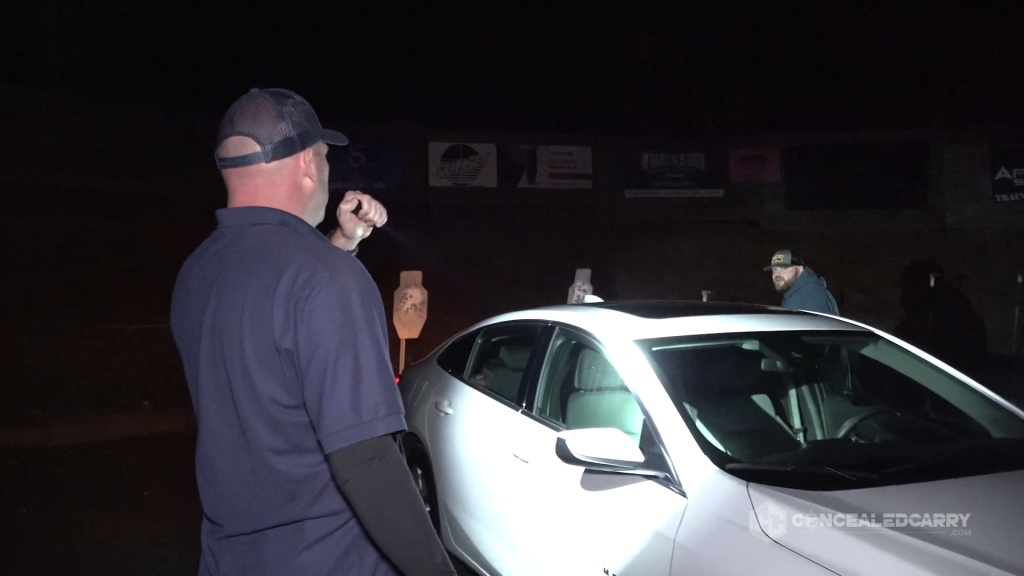
That’s not the environment where a lot of defensive encounters happen. Robberies, carjackings, and assaults skew heavily toward after dark, the Bureau of Justice Statistics found that 68% of carjackings occurred at night (Carjacking, 1993–2002, published 2004). Darkness isn’t incidental to violent crime.
So there’s a gap. And after spending several days filming in it, we’ve built a course to close it.
Introducing Defense After Dark
Defense After Dark is a five-module, 23-lesson online course built entirely around defending yourself when you can’t see well. It features guest instructor Dan Brady alongside our Director of Training, Riley Bowman, and it covers handheld lights, weapon-mounted lights, photonic barriers, decision-making, and structured drills you can run on your own.
It’s available now in Guardian University, with lifetime access and our 60-day guarantee. Like all our courses, this one is included in Guardian Nation membership. All active members have all access to everything in Guardian University.
Why we made this one
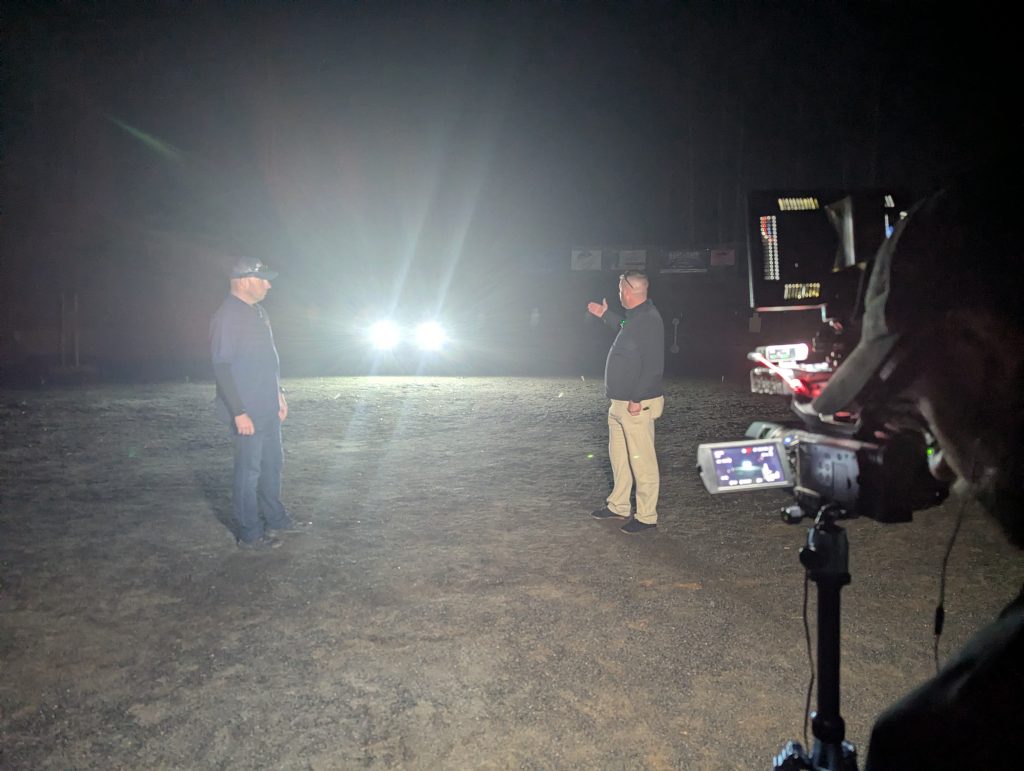
Nearly all the low-light instruction circulating in the concealed carry world traces back to law enforcement doctrine from twenty-plus years ago. The Harries technique. The FBI technique. The Surefire method. These were developed around the lights that existed at the time, for officers working in teams, clearing structures, operating under department policy.
Those techniques weren’t wrong. They were built for a specific job.
But you’re probably not working that job. You’re one person, alone, walking to your car in a lot you don’t know, or standing in your own hallway at two in the morning. You have a handgun and one light source, and your problem isn’t clearing a building, it’s figuring out what’s in front of you and deciding, in about a second, whether it’s a threat.
That’s a fundamentally different problem, and it deserves a better answer than a technique inherited from a patrol shift in 1998.
Additionally, we hear from our students and customers all the time how difficult it is to find low light training. It makes sense, given that most gun ranges don’t allow it.
Who’s teaching it
Dan Brady is a career law enforcement officer with more than 25 years of service and over 20 years as a firearms instructor. He’s trained local, state, and federal officers as well as military law enforcement personnel.
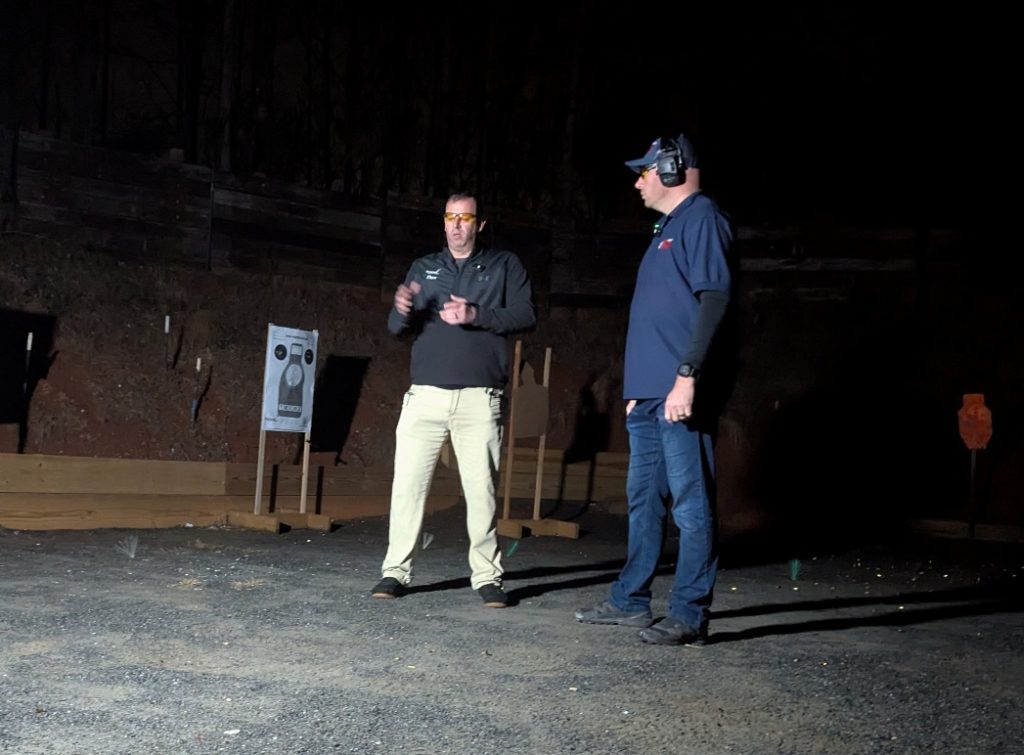
For the past six years he’s been part of the instructor cadre at Apache Solutions Firearms Training in North Carolina, where his focus has been developing curriculum specifically for the armed citizen, concealed carry applications including low-light defense and vehicle tactics. Within the civilian training community, Dan is widely regarded as a subject-matter expert on the use of defensive white light.
Dan’s view is that training should be mission-driven and audience-specific, which is exactly why this course exists in the form it does. He isn’t teaching armed citizens what he teaches police officers. He’s teaching what the mission actually requires.
Riley Bowman, our Director of Training and host of the Concealed Carry Podcast, works through the material alongside Dan — running the demonstrations, pressure-testing the techniques, and asking the questions most of us would ask.
What the course actually covers
The short version is that this is a course about judgment and technique, not a course about which flashlight to buy.
It’s about the mindset and skill of discerning when to use a light at all, and how to use it once you’ve decided to. It’s about the tactics of gaining information while denying it to an adversary — seeing what you need to see without handing him anything and without adding risk to yourself in the process.
It’s about knowing whether a given situation calls for a handheld or a weapon-mounted light, why that answer changes, and how to transition between the two without fumbling. And it’s about understanding what photonic barriers do to your vision and to his, and how to leverage them, defeat them, and punch through them.
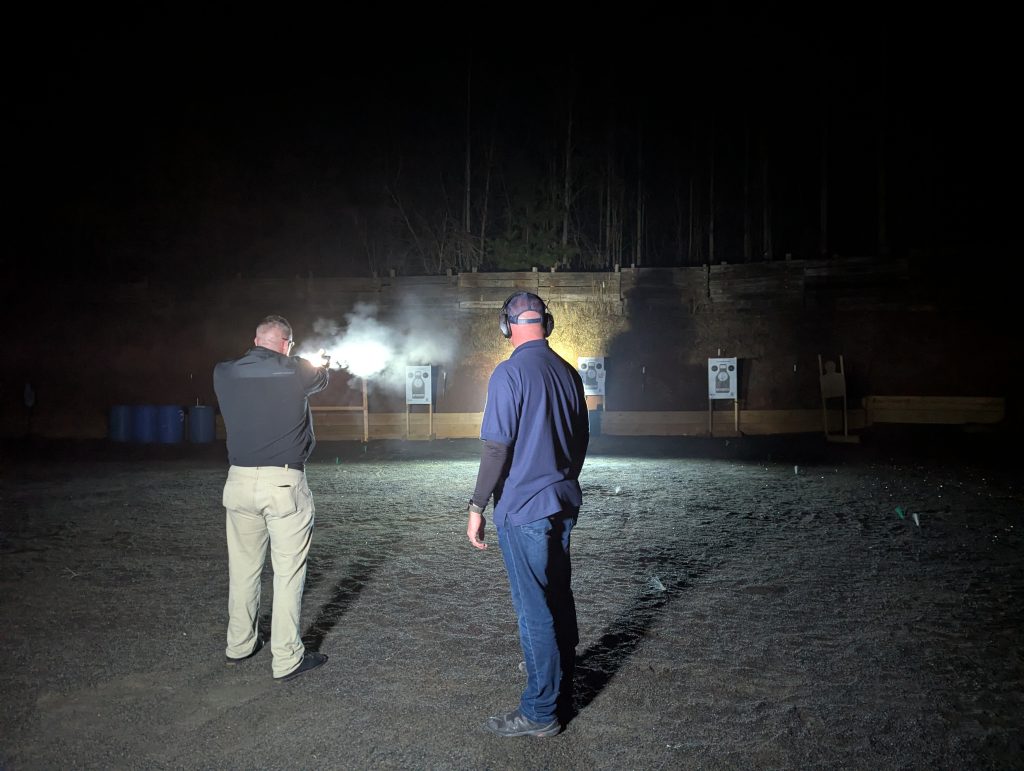
Here’s how it’s structured:
Module 1 · Why this course is important
- Course introduction and big-picture goals
- Meet guest instructor Dan Brady
- Course overview, context, and how to get the most from it
- Theory of use: when, where, and why low-light skills matter
- Why dry fire is critical for building low-light competence
Module 2 · Understanding the equipment
- Real-world applications of a light in defense
- Handheld light performance attributes that actually matter
- Handheld light operational features and setup
- Weapon-mounted light attributes, features, and selection
- Light care, maintenance, and troubleshooting
- Rifle-mounted light tips and best practices
Module 3 · The power of light
- What photonic barriers are and why they’re a big deal
- Why high candela matters: side-by-side comparisons and demos
- Using light to control information and deny your adversary vision
Module 4 · Low-light use & techniques
- Practical handheld light use and techniques
- Effective weapon-mounted light use and techniques
- How to comingle handheld and weapon-mounted lights
- When handheld-only makes sense vs. going weapon-mounted
Module 5 · Scenarios & drills
- Dark parking lot encounter walk-through
- Identifying threats through photonic barriers
- Leaving the store carrying a bag: real-world scenario breakdown
- Apache Solutions low-light challenge drill
- Course wrap-up and how to continue training on your own
Candela, lumens, and the number nobody shops on
One theme runs through the whole course is the importance of Candela over lumens on a flashlight.
Flashlight marketing has trained all of us to shop on lumens. Lumens measure total light output, how much light a device produces in every direction.
Candela measures intensity: how much of that light is concentrated into a usable beam and how far it will actually reach. Two lights with identical lumen ratings can perform completely differently at distance, because one of them throws a wide soft flood and the other puts the light where you need it.
If you’re trying to identify a person at fifty or a hundred feet, candela is the number that decides whether you can. Dan spends real time on this, with side-by-side demonstrations rather than assertions.

Looking for a quality WML holster? Check out the Revere from KSG Armory Holsters.
A story that illustrates the point
Riley had an encounter outside his own home last summer that ended up shaping how he thinks about this material.
Two men in dark clothing and face masks were loitering in his driveway late one evening. They approached him. He took his flashlight out with his support hand, moved laterally off the line they were walking, and lit the ground near the closest man first — enough to see, not enough to commit. When he moved the beam to their faces, they squinted and shielded their eyes, and the encounter turned. They left.
An hour later, standing in a dark corner of his property, he spotted the same two men on the cross street carrying items that turned out to be stolen. From close to a hundred feet away, his light was still effective enough to identify them and to make clear he’d seen them. They dropped what they were carrying and ran. A neighbor’s skis were also recovered from a bush.
Riley never drew his firearm. What ended that encounter, twice, was a flashlight and a series of decisions made in about three seconds each time.
Who this is for
If you carry every day and have never had formal low-light instruction, this is a clear and safe starting point. You’ll come away understanding what your light can and can’t do, how to work with it, and how to practice on your own.
If you’re experienced, and especially if you’ve had low-light training before, you may get more out of this than the beginners will. The entire premise is that a great deal of what’s still being taught was built for different gear, different environments, and a different set of use-of-force realities. This course respects what you’ve already learned and then shows you where the thinking has moved.

What you’ll be able to do
- Confidently select, set up, and maintain handheld, weapon-mounted, and rifle-mounted lights
- Understand how darkness, shadows, and photonic barriers affect what you and a potential attacker can see
- Apply proven low-light techniques with both handheld and weapon-mounted lights, and know when to prioritize one over the other
- Control your light to gather information while denying it to an adversary, rather than accidentally spotlighting yourself
- Run structured dry-fire and live-fire low-light drills that translate to real environments
- Make faster, better decisions from first detection through identification and engagement or disengagement
How to get it
Defense After Dark is available now. It includes lifetime access on any internet connected device, closed captioning, a certificate of completion, and our 60-day money-back guarantee.
It’s also included at no additional cost for Guardian Nation members, along with the rest of our training library.
If you want the handheld light Dan and Riley run throughout the demonstrations, the Noxon Anark is available separately. Watching the course with the same light in your hand means you can trust you have a quality product and see its application.
This isn’t a substitute for getting on a range in the dark with an instructor watching you work. In-person training is better, and if you have access to a quality low-light class we’d encourage you to take it, and especially I can endorse the one taught by Dan and the team at Apache Solutions. However, if that isn’t in reach for you in the near future, the realistic choice isn’t between this course and a weekend class. It’s between this course and nothing.
If you carry a light every day and have never once trained with it in the dark, that’s the gap worth closing.
Thank you to our partners
A course like this takes more than cameras and instructors. We want to specifically thank Apache Solutions, whose work developing practical firearms training for armed citizens shaped the perspective Dan brings to this material, and Noxon/Modlite, who supported the equipment side of the project and gave us the opportunity to put modern defensive lighting to work throughout the course without spending a few thousand bucks on the latest and greatest gear.

Defense After Dark is life changing, highly recommend this course to everyone!