

S1217: Competent and Dangerous with Justin Carroll
About This Episode:
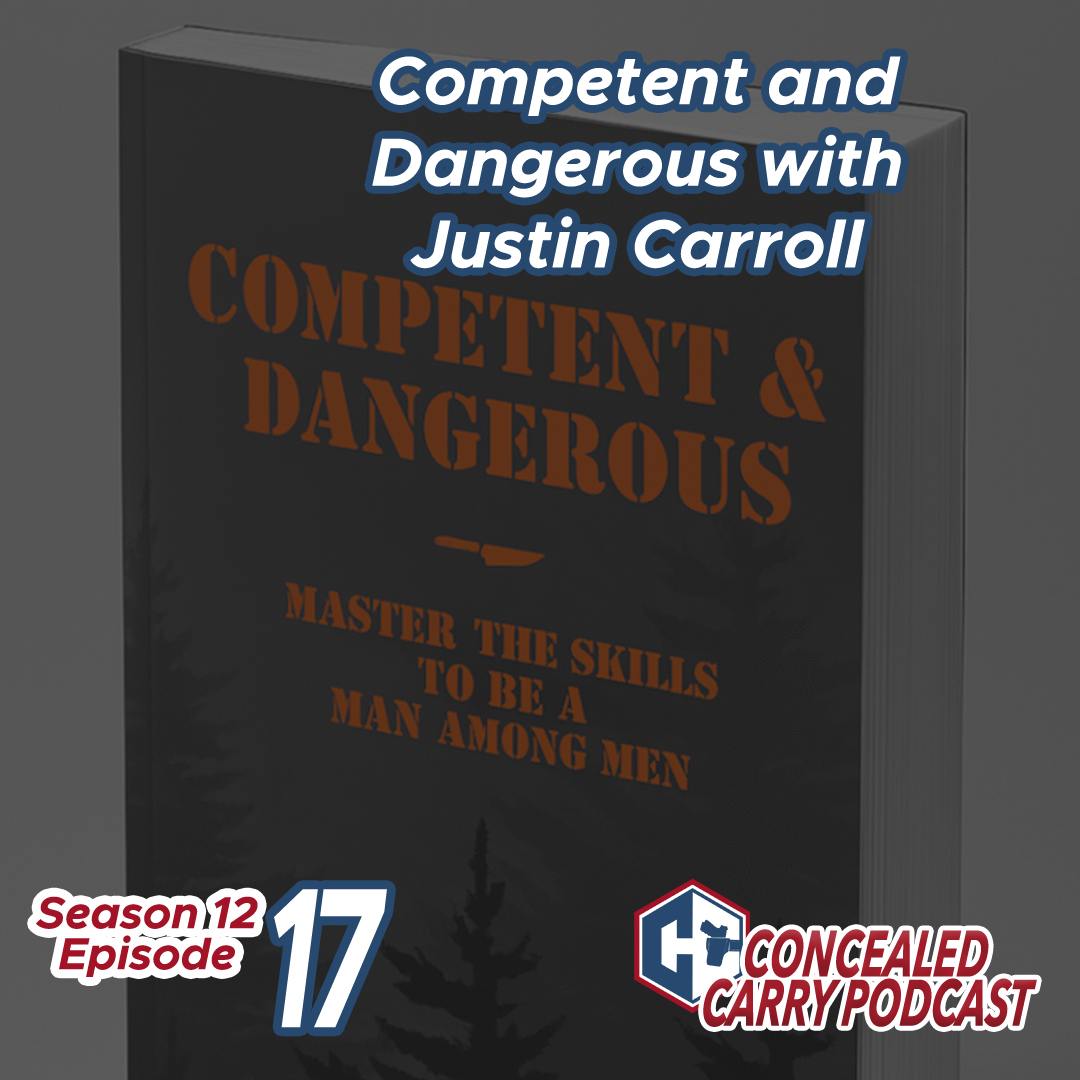
In this episode, I speak with Justin Carroll, an influential voice in the firearms community and author of "Competent and Dangerous." Justin shares insights from his diverse background in the Marine Corps and law enforcement, focusing on concealed carry practices and personal preparedness.
We explore critical life skills beyond firearms, including physical fitness, social skills, and emotional intelligence, emphasizing the importance of a well-rounded approach to personal development. Additionally, we discuss practical home security measures and how to effectively integrate technology in emergencies.
Justin advocates for face-to-face interaction amid a digital age, highlighting the value of conversational skills. Join us for valuable insights on personal security and living a competent, fulfilling life.
Watch this episode
Read the transcript
My name is Jacob Paulson. I am the host of today's show. We are sans Riley today, who is often the host or co-host on today's show because, well, I gave him the boot. That's the short answer. I was like, I'm going to talk to this guy, Justin, and I don't want you around. So we gave Riley the boot, and here we are today. The day of recording of this episode is December 11th, 2025, and we're really grateful to be here.
We're going to quickly just mention this episode. The podcast title sponsor right now continues to be HK, Heckler & Koch. I've been loving my HKs. I just got a new one. In fact, I'm pretty stoked about it. So thank you to HK for being a sponsor. I am joined today with our guest who, Justin, I don't even know if you like people knowing your last name.
So I'm just going to say you're Justin. Okay, that's fine. I never see your last name anywhere written down. It's on the book. You can say it. Okay, Justin Carroll. Okay. I could have checked the cover, I guess. It does say it on there. So Justin Carroll is here, and you guys are going to learn a lot about Justin. Justin is one of those people who has a lot of influence.
Okay, I'm now introducing you. That's what happens. You'll have to fix everything I say in a minute. But my perspective is Justin has a lot of influence on people who are in the know, but you're kind of like this silent, hidden dude in a lot of respects. You have an amazing blog, swiftsilentedly.com, that I've been following since, well, I don't know, years now.
And I see it quoted or referred to by a lot of people I trust and I respect. And that's very indicative for me. And now you've published a book, which we're going to be talking about today. So I'm just really thrilled you're here. Thank you for giving us some time. Yeah. Thank you so much for having me on. I really appreciate that.
And I'm really gratified to learn that someone's reading my blog because, uh, I feel like we were talking before the, before we started, but video, everything is video now. And sometimes I'm like, man, am I just casting this into the void? Well, there's some of us that still know how to read, um, though off. I'm being honest. I do have an app on my phone that reads people's blog posts to me so that I don't have to read it. Like I can listen to it. So that's how lazy I am.
I've thought at times of just making everything, you know, just reading all my blog posts, making it a podcast and putting some B-roll behind it. And, but yeah, obviously. Time. I'm a little busy. Yeah. Well, and I think that, you know, this is, this is not the direction I intended to go. But, you know, I think if we're being honest too, we have to say, you know, what is the primary objective?
What is the, what is the mission in me writing this blog? Like I operate a personal website, JacobSPaulson.com. And like I publish things there. I don't even have analytics on the site. I don't even care how many people see it. Like my purpose in writing things on JacobSPaulson.com is twofold. One, it's almost like a journal.
Like I just, I want to have a record of this that's out there. And second, like when someone asked me, like two or three people have asked me the same question. I'm like, it's time for me to make this a blog post. So the next person who asked me, I can just send them a link. But as far as I know, like 20 people have ever been to that website and that's perfectly fine with me.
So anyway, for whatever it's worth, I think, you know, what's my objective? What's my mission? Sometimes it's not exposure. It's not like I don't do this for the business and the views and the eyeballs. Yeah. And now that I have a book out, I'm kind of regretting that. But yeah, I started this with, so I started a blog called Revolver Guy that got really popular.
I mean, it's still fairly small for a firearms blog, but it's very popular within its niche, probably the dominant blog in the revolver space. And then I have written a couple other blogs. I worked in IT security for a few years, had a very popular blog in that space and just got bored with it. And this was a personal project. I said, I want to start a blog where I can write about my compost pile or my recipe I'm interested in or whatever.
And it's kind of gotten a little more industry focused as the years have gone by, but occasionally I still write some off the wall posts. And it is still a very much personal blog. And like you said, a record. I think that's important for, uh, to be able to look back and be like, what did I think about this back then? Cause I, sometimes I think I don't have a very high opinion of my younger self and I'm like, what did, uh, you know, what did I think about this when I was, you know, 35 years old and, you know, to be able to go back and read some of that and be like, oh yeah, I still had a pretty informed opinion or wow, I've really changed on that.
I think that's important, um, to, to lifelong learners like you and I. Yeah, no, I go back and read things I wrote 10 years ago, and I'm embarrassed often. I'm like, oh my gosh, I was really naive. My understanding of this topic was very narrow at that time, and here I was trying to share my wisdom with others, and I had very little.
Oh, God. Yeah, there are a few blog posts I've considered just taking down, pretending never existed, but I've yet to do that. Yeah, that's all good. Before we get going too far, I did want to quickly mention, And in addition to Justin, who's our honorary, his book and his website are our honorary sponsor, which you're going to learn about throughout the episode today.
Also, today's episode is brought to you by a promotion we're doing right now, which is a free gift card promotion. And the way this works is it runs until December 24th, Christmas Eve at midnight mountain time. And if you go to concealedcarry.com forward slash free gift card, you can get the code you'll need. There's a code.
And basically the way it works is if you spend a certain dollar amount, then we'll give you a free gift card as a gift. I think the minimum tier is like $75. If you spend $75 between now and Christmas Eve, then you get a $15 gift card. So maybe you buy something for yourself for $75, then you get a $15 gift card and give it to somebody else. Or maybe you're a better person than that.
And it goes up from there. You can get bigger. I think the biggest tier is like a $55 gift card for free. So anyway, learn more about that at concealedcare.com forward slash free gift card. All right, cool. So this is being recorded live. So for those who have comments on YouTube or Facebook, feel free to chime in. And if they're relevant and we think valuable, then we'll reference them during the show. But we do see them here as they're coming in.
So Justin, let's start by sharing a little bit of your background. I'm going to kick it off by telling people how you and I first got connected. And I had to dig this up a little bit. And then I'll let you kind of share your story. And you have a diverse story because you seem to be the kind of person who gets bored and decides to get off into life.
But here's how we got connected. I was working with Mike Seeklander and Rich Brown over at the American Warrior Society, American Warrior podcast, American Warrior, whatever, like all the things that they have going on. And we were collaborating on a med kit, a branded American Warrior Society med kit, trauma kit. And we were working through what would be included in that kit.
And we kind of started to sort that out. And then Rich and Mike basically said, hey, hold on. Like, we're not the experts in this topic. We're going to, you know, talk to somebody who we think, you know, really knows what's going on. And it was you. So they wrapped you into the email thread and said, hey, Justin, like, what do you think about this, you know, these supplies?
And you had some feedback, some valuable thing. Like, hey, I think we should add this and that kind of thing. And so you were instrumental in kind of nailing down the components in that med case. So that was our first time crossing paths. That's where I learned about Justin. So for everybody who's listening and watching, give us the quick bio, like where you've been, what you've been doing.
Well, I'm glad you brought up Mike Seaclander because I'm going to steal Mike Seaclander quote. And it's basically, if I give you my whole bio, it just sounds like I can't hold down a job. Sometimes I think my diverse interest is kind of a maladaptive trait. But no, overall, I do have a very diverse background. I've done a lot of different things.
And that's kind of been with a little bit of purpose and intentionality. There's a podcaster who's no longer on the air, Aaron Frankel. He did the in the rabbit hole podcast. He called it the human Swiss army knife syndrome. Like you want to be want to be very good and very skilled at everything. And I've I refer to it as the competent man trope from Hollywood.
The guy who's just any situation. He's like, oh, I was, you know, I did this for 10 years as a job. So I know how to overcome this obstacle or whatever. That's kind of what I wanted to do. And I'm still just chasing little boy, Justin dreams of, uh, being a cop. I recently went to the police Academy. I've been a sworn law enforcement officer for like six months now.
Uh, it's my full-time job now. So, uh, initially I, you know, I went to high school. I did not go to college. I got out, I got a super dead end job at a factory as an assembler. And I was like, man, this really sucks. Uh, so I joined the Marine Corps. I did eight years in the Marine Corps. I was very fortunate to be in force recon.
I was actually in a force recon platoon. I was at third platoon, second force recon company when MARSOC stood up. I was very fortunate to be a member of the first deploying MARSOC unit. I got out and I just, man, I just lucked into everything. I became a contractor going overseas with the State Department and then with another agency.
I was kind of getting burned out on that when my buddy was like, Hey bro, we're looking for instructors down at the special operations schoolhouse, the Marine special operations schoolhouse. So I went down there, uh, taught for just right at five years as a full-time equivalent instructor. I left there and spent a couple of years living in a van down by the river.
I've heard that joke one million times. I did. I bought a van. I spent some time just kind of on personal sabbatical exploring the United States. We live in a vast country, and it kind of makes me a little bit sad when you look at the statistics of how few states most Americans visit. I think it's like five or six. And that's, man, we live in a vast country with a diverse array of landscapes and, Anyway, anyhow, I digress, but just me and my German shepherd, mostly out West because I'm from the East Coast, camping in national parks, climbing, hanging out with interesting people, visiting friends from the military that I've been separated from for years.
During that time, I wrote a book and was doing a podcast on digital privacy and security, which got me headhunted by a startup up in Northern Virginia. So i went to work for them for a couple of years and then uh for a lifestyle change decided to move out of the beltway area um covet happened and i like i'd still been contracting for that company i could work a few a few weeks a year and pay the bills uh and then covet happened it shut down all i was i was primarily teaching for them and that got shut down so i decided now would be a great time to go into health care so i went to emt school and then paramedic school um i'm still a paramedic.
I actually just picked up a, I'm still part-time. I picked up a shift tonight. So I'll go in at 7 PM tonight, work till seven in the morning. Uh, and just about a year ago, um, well, just before hurricane Helene, I decided to go into law enforcement. It's always been kind of a dream, always been something I've wanted to do.
So I, uh, went to the academy at night while still working full-time at ems and uh my plan was to stay full-time at ems and just be a part-time cop but that kind of got for whatever reason got turned on its head and now now here we are so. A little bit of everything uh there's a lot of a lot of you know personal interest between the cracks there but that's the the general outline of my background um since i've been you know for the last 25 years i've been pursuing interesting and novel hobbies and vocations and jobs and training, and here we are.
Yeah. Okay. So what I love about these kinds of podcast episodes, a lot of times, you know, frequent listeners and watchers of Conciled Carry Podcasts know that we tend to go into these conversations. For every hundred episodes of this podcast, we only have a guest on about 20 of them. So most of the time it's just Riley and or I or someone else from our team talking about a specific topic.
What I love about these episodes is that we figure out what we're going to talk about as we talk about it. And so First question, have you been to all 50 states? No, man. No, I'm pretty sure my blog lists some number. I'm pretty sure it's, I'm equally sure it's wrong. There's like, besides Alaska and Hawaii, there are, I think, two in the United States, and there are really no reason to go to either one.
I don't say that to be mean. We better not say out loud which ones they are. Yeah, yeah. I don't say that to be mean. I just like, I'm like, hey, what is the thing to do in this state? Like, if I'm going to go say I've been to the state, where do I go? And everybody's kind of like, oh, well, I'm not really sure. Well, yeah, there's a couple.
We don't have to insult North Dakota or whatever it is you might be talking about. The only state I've not been to is Minnesota. So I've been to 49 states. Though some of those, you know, kind of passing through. But before we move off this topic, I do have to ask a couple specific questions. Who has the best food? Like if you're like, man, I just want to eat well.
Like where would you go in the this in this country Uh honestly i know this is gonna be unpopular on a gun podcast i would go to new england i love seafood i absolutely yeah. Boston all the way up that coastline yeah yeah Uh which i actually lived in massachusetts i i was a concealed carry holder there aside from the assault weapons thing like i didn't find like i i actually loved living there i know i like we're so siloed now that like i feel like you can't even mention massachusetts without making people mad but it was an amazing place to live beautiful four amazing seasons the best summers anywhere in my opinion yeah um and the amazing history amazing yeah yeah i mean history i.
Don't know anywhere in this country you have like a stronger like attachment to America, to American history, I should say a stronger attachment to American history than you do in Boston. Yeah. And probably to the, to my, to, to the betterment of me, I didn't know this until I moved away, but I lived like five blocks from the Sam Adams, the original Sam Adams distiller or brewery, which I toured when I went back to vacation. But I'm, I'm glad I didn't know that when I lived there.
It's an amazing city. All right so we talked about food all right so one one more thing about your your travels and i read by the way on your blog post maybe three four years ago you wrote a beautiful article about kind of the van life you know kind of some do's and don'ts and and things and uh i thought it was a very uh valuable blog post and i and i think it was timely because it's you know it was kind of covid time and people were kind of embracing the overlanding you know trend and and that kind of deal uh so it's it's it's kind of uh interesting you know that that aspect of that that period of your life but we asked about food um i was going to ask about weather but you already made it very clear that you know that's that that's the best you know seasons of the year so my last thought will be this like where are the nicest people like if it's just like man where did you find like the most amazing humans i would be honestly Honestly everywhere like if you like uh i say this all the time i've been all over the world and people are essentially the same everywhere people want basically the same things they want security food security housing security financial security they want to be loved and accepted by their groups and that's essentially universal the the things that are different about us are really kind of surface things the foods we eat that's i mean yeah it's different and it's weird to go somewhere you you know to some country that doesn't eat like us at all it's it's weird to kind of figure out what you like and don't like and how to well sometimes just how to feed yourself but uh people are nice everywhere once you just broach that initial, that initial wall that initial social guard that we all have up at all times people everywhere in the world will take you in and be friendly with you and you know show you the you know the good secret spot to eat or whatever uh people are amazing everywhere if you will just you know just give them the opportunity to be yeah.
Thank you i was i was I was hoping you might say something like that. Okay, we're going to get into the meat of this. Like we're going hardcore meat and potatoes now. You have a captive audience right now of people listening and watching this podcast. Probably, you know, between 10 and 30,000 people are going to hear and listen to what you're about to say. So here's the question.
No pressure. Yeah, no pressure. Yeah, just, you know, whatever comes out of your head is fine. Our podcast is Concealed Carry. That's the Concealed Carry podcast. Our brand is concealedcarry.com. You've interacted with a lot of people that make up my demographics. And now you're doing it with a badge. You did it as a paramedic EMT.
I would like to hear your thoughts on what are the biggest incorrect things or things that concealed carriers are ignoring or neglecting that you think we need to address as a community, as a group. Yeah i think number one thing is uh failing the concealer gun um open carry i'm i'm not a fan at all and this is the concealed carry i'm you know just still a quote from spencer keepers i'm a fan of the right not a fan of the practice um because universally everyone i see open carrying and i'm sure there's one guy out there who's going to comment that not me i carry in a safari land level three at all times is carrying in kind of a crappy holster that is not well attached to the body that won't retain that gun.
And we, we, we know we have the information. We, we have the video, we have the news articles. Greg Elfords has written a huge, beautiful article about this very thing. The people are not intimidated by your gun or, or the people who we want to be intimidated are not intimidated by the gun. They've probably had guns pointed at them before. They may have been shot before they've likely been shot at before.
If they decide they want your gun, just the virtue of you having it is not going to be a huge deterrent to them taking it away from you and in many cases using it against you on the spot i i um uh. You know, hike in the woods. I don't care, but, um, being in public with open carry, I that's, and not even as a law enforcement officer.
Um, it's just, it's just kind of a, I don't think it's a best practice. Um, the other thing is, um, you know, carry conditions. I see this quite a bit as a paramedic. If someone's in a car wreck and I pulled them into my ambulance and they have a gun, I'm going to, I'm going to make that weapon safe. Um, I, uh, I wouldn't recommend all my paramedic sisters and brothers do that not all of them have the skill set to do to do so safely and safety of patient first and crew second is you know our highest priority but uh carrying without a round in the chamber i see that quite a bit um carrying just in a pocket or a purse without a holster i see that kind of that's kind of scary frequent um and i i don't think that's a good practice at all that uh when we're talking concealed needs to be in a holster holster does several things for you and importantly it protects the trigger and prevents stuff from getting inside the trigger and potentially pulling that trigger when you don't want it to be pulled or just you know a guy like me who's just really all i'm looking for is is your wallet so i can see if you have a medication list because you're unconscious and i grab a gun i don't or your child or grandchild or whomever may be in your purse or backpack or whatever uh that trigger should be protected by you know kind of a rigid a rigid mechanical protection there to keep fingers or other objects from getting in there and pulling the trigger uh when it's when it's not intended i think those would be my two biggest things they're kind of i guess a little bit related yeah.
So i want to talk about both of these well i think i think the open care thing doesn't require a whole lot more discussion because I think, you know, I just It seems so straightforward to me. It's like, yeah, guys, like, it's like what there's applications for open carry. So I don't think that you or I are suggesting that like never, ever, I think what we're saying is that as a, as a general daily practice, it tends to, um, the potential benefits are greatly outweighed by the downsides.
That's, that's kind of how I, I see it or perceive it. I agree about with Spencer, uh, about the right. Like I, I, I want us to have the right of open carry all day, everywhere in this country. I live in what has become a relatively restrictive state in Colorado, where open carry is banned in certain municipalities. But I'm a fan of the right. It just doesn't make sense. But I want to talk about carry conditions.
So that was interesting because when you said carry conditions, I wasn't sure where you were going to go with that. And you went in two different directions. One, you talked about sort of this idea of are we using a proper holster, whether that's in the pocket, whether that's in a bag, like whether that's on the waistband, whatever the thing is, I'm going to come back to that.
But the other thing you started with when you mentioned carry conditions was, are we running it with a round in the chamber? Now, this still is a little bit of a hot-button issue in the community. Is it? I mean, it must be because I see. Based on the comments I see. And it's funny because I perceive the gun culture differently today than I did a year ago.
I've had this huge mental shift because as a company, we've seen a significant amount of success taking small clips, video clips from this podcast, and publishing them on Facebook and Instagram and stuff. And we're reaching millions of gun owners a week doing that. And the comments on those videos have completely changed the way I perceive gun culture.
Because, you know, if you look at the last decade, I spend most of my time with people who go to gun classes, who go to gun trade shows, who are kind of part of, you know, what is really like the top 1% of consumers or instructors or professionals. And so over time, you start to kind of get the sense of like, well, those are the people, like everyone's like this group.
And then you see comments on Facebook posts that just make you go, oh my gosh, like, no, not at all. Like that really is the 1% and 99% perceives things differently than I would have expected. And this carrying around in the chamber is an example of that where I think it's divisive. I think you have some people on one extreme that are sort of like, hey, if you don't have a round in the chamber, like you might as well not carry it all.
I've seen that exact phrase many times. If you're not carrying around the chamber, you might as well leave the gun home. You know, almost like this, like shameful, like make you feel guilty about yourself. Like you're a horrible person for daring to carry with that. And then on the opposite extreme, you have these people are sort of like, hey, what's the big deal? It's safer to not have a round in the chamber.
I'm going to have, you know, I train this way as part of my draw sequence. It'll be fine. I think that those people tend to be kind of in this like tunnel vision thing where the only thing they see is the time factor. And they think that that's something they can mitigate. So I'd like to hear your thoughts more about why you so fully support caring with around the chamber, which I do as well, I might add.
Well, like you said, a lot of people fall into like very strong camps of like, if you're carrying a 380, might as well just shoot yourself with it because it's not going to be effective. And I've carried without a round in the chamber for a couple different, very specific reasons, but not as a general practice. That's a very one-off thing.
I support carrying a round. I believe you should carry with a round in the chamber if a few conditions are met. if you're carrying in a holster that adequately protects the trigger. Otherwise, I don't think you should be carrying a, you know, the covering ground I've already covered, but you shouldn't be carrying a gun on your body that the trigger is not protected in some way.
The risk is just too high. Okay. I like, I carry with around in a chamber and recommend it as a general practice because we, whatever picture of a gunfight you have in your head is probably not what's actually going to happen to you if you are forced to use your firearm in self-defense. So we all have this idea of the guy, like, you know, whatever your scenario may be, the guy at seven yards away, it's like, Hey, give me your money.
And he's got a gun and I'm gonna have time to draw one out and rack the slide or whatever. But it may not be that way. It, you may not even be on your feet. You may have a child in your hand or a grandchild, or you may be holding onto something for support. You may be catching or have just caught yourself from falling. You may be entangled and fighting that person and not have use of two free hands.
And when you get the gun out with no round in the chamber, have no real viable means by which to rack that slide. Um whatever your whatever you envision as being the gunfight that you are in is almost certainly not what you will actually be in uh so i prefer to prepare for the you know worst case scenario and then if it's better than that great i'm sorry it probably will be better than that and i'll go a step further and say odds are i'll probably never need even as a law enforcement a uniformed law enforcement officer i'll probably never fire my gun in anger it's just the statistical probability.
But if I do, I don't want to prepare for only one or two circumstances. I want to be prepared for as many as I possibly can. Yeah. Yeah. Yeah. I think I guess the way I kind of perceive it is this idea that I'm going to carry without a round in the chamber because it's safer and then I'll just train to chamber a round is sort of an acknowledgement that you're taking a shortcut because you're not willing to invest the time and energy to build a level of competence to be able to carry the gun the way it should be carried.
That's kind of rude of me, but that's how I feel about it. Yeah. So two, two things can be true. It is objectively safer from the standpoint of shooting yourself upon holstering, shooting yourself on the draw. But yeah, it also is also an acknowledgement of skill gaps and lack of confidence due to those skill gaps. I don't see any very high level military law enforcement, firearms trainers carrying without around in the chamber.
I mean, you may know of some, but I have yet to run across that group or individual who has a very high level skill and training who carries without around in the chamber. And, uh, I would contend that it takes, you know, if you would invest the skill that you invest in practicing drawing the gun and racking the slide or otherwise putting around it in the chamber into understanding the, you know, manipulation of the gun and safe holstering practices, you'd probably end up in the same place, but be more prepared. Yeah.
Well said. Let's depart a little bit. Now we're going to take another little right-hand turn here. Uh, your book that you recently published, competent and dangerous, uh, It's interesting because for this, for the sake of our audience, for Conciled Carry, there's a chapter about guns, but there's a whole bunch of chapters that have nothing to do with guns.
So, hey, there it is. There's the visual. So tell me, what's the approach? What was the intent? What's the objective? What's the mission of this book? So I subtitled it Master the Skills to Be a Man Among Men. And I talked about this in the introduction. I've talked about it on Rich and Mike's podcast. Um my intent with this was to write the book that 16 year old me would have absolutely loved to get i don't think i even you know knew that i wanted this when i was that age but i i would have loved it i loved reading survival manuals and first day you know boy scout handbooks and that sort of thing, uh and it's also the book that i kind of toyed with the idea of writing when i was like 26 27 like had this idea in my mid-20s like man i want to write a book of manly skills but really i didn't have any of those skills yet.
I had been in the military, but that's all I had done. I had not worked in all these other things that I've done since. And it would have been a pretty, honestly, pretty empty book. It would have been nearly as long as this. So that was kind of impetus to, I want to, I want to write a book that's, you know, what I wish I had known at 16, 18, 20, to help me prepare for just being a life of being a manly, adventurous man.
And there's only one chapter about guns. I don't know. I think that chapter is like 30,000 words. It's still a pretty hefty chapter. But I wanted to cover all this basic stuff first, like just being healthy. If you're going to be a prepared individual, it's not just about the beans and bullets and Band-Aids that you can stack in your closet or your basement.
Your body is your first line of preparedness. If you begin a disaster or an emergency in a poor state of health, even if it's a gunfight, right? If your resting heart rate is 100 beats a minute, you don't have very much to work with before you're in a state of being completely unproductive because your body can't perfuse tissue.
If you're healthy and your resting heart rate is 50 beats a minute, it can pretty much triple before you start to see serious degradation in skill. So your body is your ultimate preparedness item. I think being healthy is your first and most important and most ongoing step toward being prepared for any sort of emergency or disaster, short-term, long-term, acute, chronic, whatever.
So we start with that and then build up from there. Most of it is skill. There's some equipment chapters, firearms. I really struggled with how to teach skill through the book, so I didn't really try. So it's mostly an equipment chapter. It's the last chapter. it's like you're okay here's your fun brain candy uh to read after you've read all this heavy you know homework stuff.
Yeah yeah i'm going to pick out a couple of specific things i want you to talk about uh that are in the book and to be clear just to be transparent and uh Genuine, I guess, with the audience. I've not read the book yet. I'm planning to read the book. My copy is inbound, but I've been through, you sent me a digital copy in advance of this show, and I read a chapter front to back, and then I spot read a couple other things.
I've seen the table of contents. People can go see what's in the book on your website, and it's all over the place. I mean, there's a chapter. If you want to know how to change oil in your car, you can get out from this book. If you want to start a fire in the woods with, you know, a magnifying glass or steel wool or something like that's, that's in here.
So I love kind of the way you described it, almost like a, like a boy scout manual for manhood. I appreciate that, but I want to talk about a couple of specific things and you're not going to be able to dive into much depth in the time we have. But with that said, you just mentioned kind of this physical preparedness thing uh which which i think is important i want you you have a you have a chapter in here kind of a section i should say but you know edc gear basically and i'm curious to hear your thoughts on some of these things because there's some of these things like you talk about wallets knives flashlights like we talk about flashlights a lot in our community knives come up all the time a medical pepper spray but you know you talk about something as much as like as simple as like a wallet keys and a watch so i'd like to hear you kind of expand like this kind of this holistic idea of EDC like why is my wallet matter why what do you mean when you talk about keys what does that look like why a watch though I am pretty obsessed with my watch but you know tell us what you're talking about Yeah. So I've kind of, I don't know how well it came, it comes through the reader, but there's kind of this underlying thread throughout the book of everything kind of building upon itself.
So, um, EDC, like knife, I talk about, you know, you should have your, you know, your same stuff in the same place every single day. You always know where it's at. You always know if something's missing, that sort of thing. Get into the knife. I'm like, uh, you know, these are, these are kind of some things you should look at in regards to knife, how it locks the blade length, all these, all these you know different factors and you know you probably want a spare knife in case you lose your knife and it might be a good idea to get like a you know if you live in a state where you can carry a reasonable length knife you might want to get a smaller version that you can carry when you travel to those restrictive states and throw that smaller version in your bug out bag so that serves multiple purposes right now if i travel to you know what x state i don't know knife laws but travel to a state i'm going to do my research ahead of time they only allow you know two and a half inch blades.
I'm going to pull that mini out of my bug out bag. I'm going to put this one in my bug out bag and that's how I'm going to travel. And then when I get home, I'm going to replace them. That also is a backup, right? If I lose my knife, I just take the one out of my bug out bag. Probably not going to need my bug out bag in the time it takes to order a new knife.
So it's, it's serving a purpose there. And if I have to, you know, if my house catches on fire and I have to run out in the middle of the night with nothing and all I have time to grab is my bug out bag, I've got my knife, right? So it's this, um, this holistic kind of approach of everything you do should have multiple purposes and should support your should support your main effort right i talk about this in firearms kind of carries over your first firearm should be your everyday carry handgun your next firearm your next handgun should support that right invest in a family of firearms like again mike seeklander talks about you know same magazine same holster same manual of arms that sort of thing maybe up or downgrade your capability a little bit depending on what your needs are so i start with the basic stuff uh because i you know i i, I had an idea of EDC when I was a kid, but back then there weren't EDC forums and EDC YouTube channels and EDC podcasts and all this EDC information.
So I just kind of started piecing this stuff together. And again, this is the kind of thing I wish someone had handed me some guidance on back then. And kind of the haphazard way I see, I got behind a kid yesterday and he was driving so badly. I'm like, this person is trying to goad me into pulling them over. This person just wants me to pull them over so they can shoot me or something because no one would drive this bad with a marked police car behind them.
But sure enough, it was some high school kid texting. I get up there like, hey, you got your driver's license on? He's like, yeah, sure. He's fishing around. He's like, I guess it looks like I don't have my wallet on me. And I'm like, what? how do you not have your wallet on you man like this like this is your your most basic preparedness item outside of your body right your wallet's going to do the most things for you of anything you can carry on your body it's identification it's cash which can get you out of a bad situation it can repair your car it can get you lodging it can get you food it can solve all these problems and you don't have your freaking wallet on you how is this even possible so um i i just wanted to start at the very very basic stuff be healthy carry basic things on you and keep them on you keys uh nothing takes me out of the moment more in a horror movie but somebody's running from the you know the maniac killer and can't find their keys and i'm like man my keys are never out of my pocket i always know where my keys are uh because they're always in my pocket uh when i take my pants off at night all my stuff stays in there i set it in the same place so um you know and i'm i'm probably on a you know one end of the spectrum of this stuff i'm a little nerdy about it but i wanted to start with those basic things rather than just jump to you know guns guns guns guns guns guns you need this gun with this optic you know you need to be carrying a glock 47 with an optic and extended magazine and a you know surefire x300 to be prepared really all this other stuff is going to do a lot more for you uh in my opinion in the long run than than the gun will.
The gun is for a very small narrow band of situation. I don't know if that answered your question. I probably digress. I think you went the direction that is reflective of what's in the book. I mean, I guess in my head, I was, you know, I was thinking about keys. I was like, am I supposed to be carrying a certain type of key?
But I think that really what you were, what you were trying to communicate in the book based on your comments is like, no, like you should just have your keys on you. Yeah. And maybe there are some other, you know, tips in there. I imagine there are, but you'll say, you know, why is your, where, where is your wallet? Like, why is it not on you? So I think those things make a lot of sense.
And I see people, you know, I see, I used to work in an office environment. People come in, lay their keys on their desk, and that's where their keys would sit all day. And it's like, man, that's a terrible practice. That's a terrible idea. Your car is probably the second biggest investment most Americans will ever make is in their vehicle.
It's one of your biggest preparedness, survival, whatever assets you have. And it's useless without the key. Why would you not keep this key on you? What, so I'm curious about a watch, you know, cause the watches on your list of, uh, of kind of critical EDC things in your book. So talk about watches. Like, I mean, obviously, you know, being knowing what the time is, is valuable, but a lot of people today be like, yeah, my phone tells me what time it is.
Sure. Yeah. Uh, so I relate an embarrassing little anecdote. I was in paramedic school and I had to do a clinical at an infusion clinic, which is where people come to get, you know, drugs infused over a period of time. So it's you're basically just there to start a million ib's that's part of your you know your it's really real early ones so my preceptor is a nurse and she's like hey give this person this over uh just you don't have to hang it in a bag just push it through a syringe but give it to them over like three minutes and i was like i was like how do i do you know how do i she's like just look at your watch just it's not precise i was like um i don't actually have a watch and she's like here you can borrow my watch.
And I was like, dude, never again will someone have to loan me a watch to do my job. And then I got to thinking about it and all the other things, uh, medically specifically, cause that's, you know, that's where I was at that time. Use a watch to take someone's pulse. How do I know what their pulse is? If I don't know how much time has lapsed.
And I, you know, I could pull my phone out for that. Now I'm opening the timer, trying to your stopwatch, trying to find different settings with gloves on that may be dirty. It's much easier just to look down at my watch. Uh, if you have the skill and know-how you can use your watch to find directions, uh, in an emergency, your phone battery may die.
Uh, I lived and worked through Helene. Um, people were out of power for weeks after Helene. Um, I was, you know, I was very fortunate that wasn't the case, but your watch battery will last for years. Uh, or if you have, you know, my watch recharges on light, it will last pretty much indefinitely until the mechanical, uh, works inside the watch fail.
But hopefully that's years and years and years from now. It's just a much longer live device. And I, you know, just as a gun guy, I need one more thing to nerd out on and spend money on, I guess. But I do like wearing, I don't wear a very expensive watch, but I do like wearing a watch. Also being punctual, being on time, super important.
Yeah, you can pull out your phone, but it's, there's also a chapter in there on people ops about being a good communicator. That's a big theme of that is being a good communicator, an effective listener, able to elicit information from people. One of my biggest tips in that is put your cell phone away. It's a huge barrier to communication. Even if it's laying on the table, they're pretty good studies.
Even if it's out and face down laying on the table, it is still a massive distraction. It takes away from your ability to listen to another person. And you can check the time without pulling a cell phone out and looking like, oh, I'm disregarding what you have to say. You're just checking the time rather than pulling out this computer in our pockets.
Yeah, yeah, I like that. I'm going to take another kind of hard right turn here. Sure. Yesterday, almost exactly a day ago, about 2 o'clock in the afternoon for me, I was driving from my house to a store that I needed to visit and got stuck. The road was blocked due to a car crash. And I probably was 45 seconds behind this crash.
I mean, the interior of one of the cars was filled with the smoke that came out of the airbags. That's how fresh I was on the scene. And you have a handful of people who are just, you know, life's too busy. So, you know, they're pulling U-turns and getting out of there. So they don't have to be in the way. And, but there's no cops. There's no sirens, you know, like that's, I'm pretty fresh on this incident.
So I grabbed my med bag and I, and I go in there and I check and, you know, I, I, there wasn't much I could do. And these people were, were doing okay. Like, you know, basically their, their, their damages came from airbags. They had airbag and seatbelt injuries and an 80 year old dude and like a 17 year old girl um and and you know ems was on site in probably about five six minutes but here's what it got me thinking a little bit about and i'd love to hear your your insights on this um And today, there's a lot of opportunities to leverage technology to help first responders help you.
So, for example, like on your lock screen on your average phone, you can put medications you're on and emergency contacts and your blood type and all this kind of stuff. Some people are wearing bracelets to talk about specific conditions they have. I'm wondering as a paramedic, still part-time, and now as a law enforcement officer, how valuable or useful are those kinds of things?
You come up on something, you've got an unconscious injured party, casualty, whatever. What are tips or suggestions you might have for adults and humans at large that would be useful for first responders? That's a great question. I will say crash notification saved the life of a paramedic. He's actually the supervisor for whom I'm going to work tonight.
He was in a motorcycle wreck, crash notification alerted. And most of the, we get a ton of those. And usually it's because somebody's, you know, phone fell out of the car or, you know, some, it's usually not an actual crash, but that did actually save his life. He was in a horrible motorcycle wreck about maybe three years ago and probably wouldn't be alive today had it not been for crash notification.
So that's a, that's a good thing. These, these are important things. Um, being able to, if you are unconscious, unresponsive, being able to find a list of importantly allergies, uh, because I am going to be very hesitant to push any medications to you if I don't know your allergies and you may need those medications very badly, but if I don't know what they are, that's, uh, I am probably, depending on the situation, end up giving them, but I feel much more confident giving you what you need early on if I know you're not allergic to it or don't have a known allergy to it.
Your medications are super helpful. They really point to these are the problems this person has. If I just find somebody down behind a steering wheel, now I got to go through a whole set of differentials trying to figure out what's wrong with them. If I can look at a list on your phone and be like, this person has congestive heart failure and this, that, or the, what are diabetes?
That's a big one that I deal with in the Southeastern United States. Yeah. If I know what your underlying health conditions are, that is super helpful. I don't have to try to figure it out and trial and error on the way to the hospital. Blood type is completely irrelevant. They are going to type you before they give you blood.
If you got your blood type patch on the sleeves of your combat shirt, just realize that's just tactical LARPing. They will type you before you get blood because the consequences of getting blood that is not a type match are fatal. It's going to be 100% fatal. there's nothing you're going to do um it's going to be a disaster so they will type you it's very easy quick and inexpensive um so uh writing your blood type on your stuff is or your phone whatever is you can if you want doesn't hurt anything but it also doesn't help anything um yeah yeah super good information to have and a next to ken if somebody's unconscious unresponsive it's really nice to have some confidence and saying yeah like i we got in touch with next to ken and they know and they're on their way and they can you know tell the hospital staff about this person that sort of thing and.
Presumably you know first responders have the training and experience to know how to pick up a random phone they find in the in the wheel well or whatever and grab it and retrieve that info And you know a couple like a couple um sad anecdotes uh two christmases ago no this is like christmas eve of 2021 had a traffic fatality uh and had to just like had no idea of who this person how to get in touch with this person's next to ken she was t-boned pulling out of a parking lot by someone who's doing like 70 and a 35 um so like we're just start going through text messages and it's uh oh man it was awful it's like okay grandma see you soon like leaving the grocery store okay grandma we'll see you in a few minutes and like having to make that phone call, which I mean, making the phone call would have been bad either way, but having like, I would, I could have done without seeing that text message.
And recently, well... Fairly recently, we had a gentleman at a gas station who didn't have a way to pay. So they called law enforcement and the law enforcement called EMS. And I got there on the ambulance and this guy has no ID, has no idea where he are, where he, how he got there, nothing. And it turns out he had a metabolic derangement, his, you know, just all out of whack. And he was very uptended.
He had driven from like a state and a half away. um and the only the only card he had on him was his gym membership card so we called that gym and like read the number off his little barcode and they looked him up and they're like oh god this is so and so he has this condition that sometimes makes him forget who he is and you know good have altered mental status so yeah having that have that information is is very helpful and very important it's very helpful to your continued long-term health if you have some accident or medical condition.
If you have seizures, you're not going to be able to talk if you go down with a seizure. So that's a good thing to wear. Medical alert bracelet, have on your phone, whatever. Side tracking down the medical rabbit hole. And the longest chapter in the book, I think, is the first aid chapter. I think we've, in the tactical community, it's good that we've recognized that tourniquets don't cause cancer and we can use tourniquets safely, but also I'm, I'm kind of becoming known as the anti-tourniquet guy, uh, because I, it's far from the only intervention you need.
It's, uh, we're all carrying a tourniquet for the maybe 2% of injuries out there that actually require one. So 50 to 60% of your body is not limbs. Tourniquets only work on limbs. And 92% to 97% of injuries to your limbs can be treated without a tourniquet. So we're carrying a very small use case item and recommend that everyone carry a very small use case item to the exclusion of being able to treat the entire rest of the body for traumatic injuries.
I'm not sure why we've gone like, I can't say that on the air. I'm not sure why we've gone all in with tourniquets and saying this is the medical intervention that you should carry. When the fact is it's a very, very specific medical device and it's certainly not harmless. We should not use it for any bleeding on any extremity because it does do some harm.
We should do the least invasive, least harmful medical intervention that we can before we jump to something like a tourniquet. And we are starting to see, I think you're an early preacher of the, let's get off the tourniquet, high horse cult. Because I have seen more and more people kind of like, whoa, if we take this too far, you know, kind of thing.
And my big objection is that I'm leaving most of my body uncovered. If, if all I'm carrying is, is a tourniquet, I don't have anything for my head. For my neck, pretty important stuff in the neck. I don't have anything for my life box, which is my, uh, thorax and abdomen, a lot of important stuff in there too. I should probably, my junctional areas, uh, even parts of my extremities where I can't get a tourniquet up to, uh, I'm much more likely to be hit in one of those than I am in one of my extremities, just because of body mass.
There's more mass there to hit and it's more stable mass in a and in the in the self-defense community all we're thinking about is gunshot wounds but we could be uh injured by any number of mechanisms other than a gunshot wound that it would probably be a good idea if we are carrying medical items to be able to treat i'm going to make an awful noise on the radio pulling this out my pocket but uh i i never go on my shift without an ole's bandage in my pocket it's a pressure dressing the gauze comes out of the dressing portion to be able to pack a wound it has an occlusive dressing built in but also the package is two very large occlusive dressings and this will treat most of those extremity bleeds it's it's a little bigger and bulkier i will grant you that but it is a far more capable and versatile medical tool than a tourniquet and i'm not anti-tourniquet i carry a tourniquet on duty too for what it does nothing is better yeah like the.
I'm sorry. Go ahead, Justin. No, go ahead. Go ahead. Like the metaphor, I was trying to think of a metaphor that might put this in context for people who are a little bit on the fringes of the medical knowledge. But like the thing that came to my mind is it's sort of like having a weapon-mounted light and no handheld light.
Yeah. It's like are weapon-mounted lights useful, practical, applicable, especially, and I'm thinking outside of a law enforcement context. And the answer is sort of like, yeah, sure. I mean, there's very little downside to having a weapon-mounted light, but is it the end all for low-light scenarios? And the answer is no, a handheld light's probably, you know, a much more versatile, uh, tool, you know, for, for all the potential low light applications.
Well, I think I've described it as you could carry a multi-tool, which has pliers and scissors and a knife and a file and a screw, you know, a flathead screwdriver and a Phillips screwdriver, or you could carry, uh, you know, a ratchet with a 14 millimeter socket on it. It does one thing better than a multi-tool, but a multi-tool does a lot of stuff.
Yeah. Yeah, I love that. I'm a big fan of that bandage from TechMed is the one you're holding up. We stock a lot of those in the warehouse and they now have a version of it that is a hemostatic version that comes in a white package. And basically just that the gauze that's inside of there is a treated interwoven gauze with chytocent.
It's chytogauze. So anyway, good stuff. Awesome. We're coming up on, you know, toward, we're kind of, you know, on the tail end of the podcast here, we're going to call it 10, 15 minutes just to kind of give you a, just check in on the time a little bit, but I wanted to swing around to physical security. You have a section of the book that talks about physical security, you know, things like putting a lock on your door, you know, some of that's very basic.
And this is a place where I do think a lot of gun owners drop the ball. You know, we read a lot of DGU stories where, you know, we have home defense scenarios and things take place in backyards, front yards. In fact, I think two episodes ago in this podcast, we talked about four incidents in the previous 30 days where someone basically breached a home through the front door.
So talk a little bit about like, you know, what are some of like the key points that you think that our community or my audience should like, you know, like a little inventory of, hey, go check these boxes for your home. Yeah. Before you invest in like a $3,000 Novesque AR and a $1,000 flow through can and a night vision and all these cool things, you should probably have more than a $15 quick set deadbolt on your front door.
And there are very good locks out there. You can spend $1,000. You can spend $500 on a deadbolt for your door that is like nobody from the FBI down is going to surreptitiously open that lock. It's also going to be much more heavy duty, but you don't have to spend a fortune. If you spent a hundred bucks on a really high quality deadbolt for your door installed it correctly and then reinforce that door jam a little bit uh now you what we build in is time right we're only a pane of glass away from the rest of the outside world someone really wants into any house they will they will get in um and and breaking glass is probably how but i want to force someone into breaking something to get into my house because it uh is noise that i may hear it as noise that my German Shepherd dog will hear and alert me.
It will set, you know, glass break sensors will go off my, on my alarm system, letting me know someone's there or kick in my door. Like you're not going to easily kick in my door with one kick, unlike most doors. So most, uh, deadbolt strike plates are held in place with three quarter inch screws. Those are not very long. And they're just in a simple piece of pine that comes in that pre hung door jam.
That's all that is keeping you from the outside world is a thin little piece, a thin little strip of pine that's very soft. And it, you know, one or two kicks and that thing's going to be open. And now you're exposed to the outside world. The outside world is coming into your home. Um, I, I talk quite a bit about how to, what to look for in a better deadbolt.
Um, you know, from, I nerd out a little bit on the surreptitious entry methodologies like bump keys and, and lock picking, how to get a deadbolt that offers you more protection against those things. Because I know too much. I taught that stuff for several years as a full-time job. I can't say where, but my job was teaching how to get in, how to get through locked obstacles.
So I can't not think about those things. but forced entry in in a civilian context really probably what we need to worry about and that essentially boils down to a high quality deadbolt that is correctly installed and some reinforcement around around the door jam to prevent that door just from being kicked up and i think that's really really important it you know it buys you time you're laying in bed you you know you shouldn't be down to like no i don't want to lock my gun in this i i heard i believe i heard you guys talk about this recently the bedside safes like it takes me three seconds to get in there you should buy yourself probably like three or four minutes by upgrading your door and the locks that are on it so you actually hear someone coming you have all the time in the world to prepare for that yeah yeah.
So I love everything you said, so I'm not going to dirty the waters by trying to just repeat all the awesome things you said. But you have some interesting sections and chapters in the book. I'm trying to decide how I would best kind of group these together with an adjective. They're kind of a throwback, not even a throwback. They are a nod to being like a gentleman.
Okay, yeah. So things like how to dress professionally, how to cook a quality meal, how to give a good handshake, how to be a good conversationalist, how to be a good house guest, things like this. I'm curious. I think that in the theme and the mission of what you're trying to achieve, they make sense in here. As a father who has a son who's entering adulthood, as I was reading the outline of the book, it had me thinking, have we lost touch with some of these things generationally?
And have I done a good job setting my son up for success in an adult world? Talk about some of those elements and why you include it in the book or if there's anything specific about those things you want to speak to. I'd love to hear more. Yeah, I guess we could group this all under kind of being likable, right? If you're clean, if you present well, if you're well-spoken, if you're capable of preparing a meal for someone or a group of people, actually feeding a dinner party, if you can have people over and pull that off and have them be like, man, wow, Justin had everything ready to go.
It was such a great trip. um i i think you're um i i think you will live a higher quality life than if you're not capable of doing certain things and i was i relate this in in the people ops chapter i was painfully shy as a child as a teenager and even into my early 20s and this was not something that i was like this this kind of sucks this is not the life i want to live i want to have awesome experiences and have all these stories and i want to go live life to its fullest so i really need to get out of this and be able to talk to people and be able to be charming i want to you know like i want to have um my ability to to to date and uh you know to the extent that i want to and not be limited by um by you know being afraid to talk to people or not being very comfortable talking to people or being the weird dude just standing in the corner at parties because i'm you know i don't have the skill to get out there and mingle so that's kind of you know again this this very much is the book that's for 16-year-old me.
I wish I'd had the book that's like, this is how you are interesting, how you build a mystique, how you get people... To talk to you, how you keep them talking is it's a spoiler alert. That's really how you make yourself appear. Interesting is just by listening to people. You don't have to say anything. You just have to give them some minimal encouragers, ask some, you know, some kind of intelligent questions.
They will talk about you about themselves all night long, not know a thing about you, but to them, you are the most interesting person they've ever met. That's just the way conversation works. And, you know, I also, you know, as much as I wanted this in the eighties, uh, we were nineties at, you know, 16 or maybe as much as I didn't want it, but needed it.
I feel like people need it as much or more now as we increasingly descend into walking around, staring at the, you know, the four by three screen in front of our, uh, in front of our face and living lives through Facebook and Instagram and Tik TOK and, you know, become increasingly, uh, less socially agile, less socially fluent.
Uh, and this is a thing I, You know, I hear from law enforcement FTOs and instructors of kids now don't know how to talk to people. I'm sure everybody's complained about the generation that precedes them. But I think this is a thing we need more and more, just the ability to be charming, to be someone who is socially fluent, for lack of a better term.
Yeah, yeah, I think. And sometimes I think that we have a detachment from the concealed carry lifestyle and the objective that drives that lifestyle. Yeah. Can I just say one thing? Go ahead. Yeah. So, and that is part of it too, right? The, the firearm, I carry firearm. Well, for a couple of reasons. One, I'm exceptionally well-trained and that's not a brag. It's just the choices I've made. I was in a special operations unit.
I pay for three to five classes every year. And I, and I feel like I'm kind of an asset to my community in that way. Like I would hate to be in a situation where I could intervene and not be able to. Uh, but the, the, the real root reason is to prolong my own life in the event that violence seeks me out. And I want to make my life as vibrant and amazing as I possibly can.
Uh, it's not, my life is not hiding behind the gun. I, it's not about, uh, it's not about the gun. The gun is a compliment to it. And I know, you know, a lot of people are like, I would never travel anywhere. I can't take my gun, bro. You're, you're missing out on the majority of the world. I, you know, I'm sure Greg Eliferts and Rich Brown and some other people would, would echo this, but, uh, man, you, you should, you should go to Europe.
Europe is pretty amazing. Um, like there are a lot of things in the world out there to see that you can't take a gun to, but I like, that's not going to be a limiting factor to me. It's a compliment to my life, not a limiting limiting factor within it. Yeah, ditto. That's kind of exactly where I was going with my comment is that if the objective of carrying the gun is to prolong my life, protect my life or that of my loved ones, then what value is that to me if I'm not comfortable in society or I don't know how to be healthy and be able to go up and down stairs without breathing hard or interact with new people and meet new people and see new things and have new experiences?
So I think that we sometimes fail to maintain the perspective of what this is really all about. And it's about living a longer, fuller, healthier, happier life. And so the gun is- Your odds of a defensive gun use are minuscule, but your odds of cigarettes strangling you to death in your sleep, if you smoke, are almost 100%.
Like they are very, very high. So like there's a, there's some risk assessment you need to do. Yeah. Yeah. Yeah. Well said. Well, folks, we've kind of hit our time here. We're, we're just a little over an hour. We've been talking, talking to Justin Carroll, the author of competent and dangerous. So Justin, where, if someone's like, oh my gosh, like I freaking love everything that Jacob and this guy have been saying, like, I want to go buy this book.
Where do you recommend, or where would you direct people to learn more or purchase the book? So uh you can you can check out my blog swift silent deadly.com i'm not very active on it anymore but i still post something every now and then uh the book is available on amazon.com it is competent and dangerous master the skills to be a man among men it is uh it weighs three pounds it is a huge book 326 000 words uh five right at 500 600 pages it's it's a long right at 600 pages uh three years uh to to actually write and a lifetime to accumulate the skill and wisdom to to actually do that so again amazon.com competent and dangerous by justin carroll.
I think this is a book that the way it's written, a person could jump around. A person could say, I want to read this chapter. Sure. Like you would, I mean, you've written it in a way that it's meant to build on itself and being like the order is not random. So there's going to be value to just picking it up and reading it cover to cover.
But a person could bounce around to the topics that interest them and still gain a lot. Oh, absolutely. Yeah. Every chapter could be a standalone, could be read standalone and you never know anything was missing. Yeah, absolutely. Cool. Well, thank you, Justin, for your time. We really appreciate you being with us today.
Yeah. Thank you so much for having me on. I really appreciate it. Yeah. So, guys, that's kind of a wrap for our convo here today with Justin. A quick couple of reminders. One, don't forget about the promotion we're running, concealedcarry.com forward slash free gift card. You can go get yourself a free gift card with purchase on concealedcarry.com up until Christmas, basically a mountain time.
Also, don't forget to subscribe to the podcast. This is your first exposure to the Concealed Carry podcast. Sign up wherever you listen to the shows. You can find us on Spotify and Audible and iTunes and all the places. And so make sure you subscribe and get connected there. And don't forget to go to concealedcarry.com and follow us on all the socials and video places and sign up for the newsletter and all that stuff.
We can put out a lot of free resources. One that we don't talk about as much as we should is our free mobile app. So you should probably go to the Google Play Store or the Apple App Store and download Concealed Carry Gun Tools so you can stay up to touch with all the things we're doing and take advantage of our legal reference library and other materials.
So I think that's a wrap from the Concealed Carry Podcast. This is Jake Paulson signing off. Remember, train right, train often, train safe so you can fight hard, fight fast, and fight true. Take care, everyone. A reminder that laws vary from place to place, and we encourage listeners to seek local legal advice to understand applicable laws.
Concealed Carry, Inc., its brands and properties, and the Concealed Carry podcast is not a legal service, nor are we attorneys at law. We make our best faith effort to share Concealed Carry-related insights and information about firearm-related incidents and the laws pertaining, based on our own understanding and experience.
But things can be different where you live, or laws may have changed by the time you listen to this. We cannot be held liable for your actions based on the information shared in this podcast. Please exercise care with all things pertaining to firearm use, Concealed Carry, and always practice following basic firearm safety rules.
More information about safety can be found at concealedcarry.com forward slash safety. Thank you.
More episodes
-
 S14E8
S14E8
-
 S14E7
S14E7
-
 S14E6
S14E6
-
 S14E5
S14E5

Great episode. Really liked Justin’s insight from a medical and law enforcement background. Will check out his book