
The New Mexico waiting period lost in federal court more than a year ago. Then the state kept enforcing it anyway.
That’s about to change. On November 18, 2026, New Mexico Attorney General Raúl Torrez and a coalition of gun rights organizations filed a joint motion asking a federal judge to enter a stipulated preliminary injunction against the state’s seven-day waiting period. “Stipulated” means both sides agreed to it. Once the judge signs it, the waiting period stops applying to every law-abiding buyer in the state, not just the two people who won the original case.
Let’s be clear about where we stand. Waiting periods are unconstitutional. All of them. A right you have to wait a week to exercise, after you’ve already passed a background check, isn’t being treated like a right. It’s being treated like a privilege the state hands out on its own schedule.
Here’s how New Mexico got here, and what this agreement actually does.
The Law: HB 129
Governor Michelle Lujan Grisham signed House Bill 129 in March 2024, and it took effect on May 15, 2024. It’s codified at N.M. Stat. § 30-7-7.3.

The law requires seven calendar days between the sale of a firearm and the transfer to the buyer. That seven days includes the federal background check, which usually clears in minutes. If the check still isn’t done after seven days, the dealer has to hold the gun until it is, or until 20 days pass. Transferring early is a crime for both the buyer and the seller.
There are exemptions. Holders of a valid New Mexico concealed handgun license, law enforcement agencies, licensed dealers, and transfers between immediate family members are among them. For everyone else, buying a gun in New Mexico meant passing the check and then going home empty-handed for a week.
Ortega v. Grisham: The Tenth Circuit Gets It Right
Samuel Ortega and Rebecca Scott sued the governor and attorney general on the day the law took effect. Both had passed their background checks and were still forced to wait.
The district court refused to block the law. On August 19, 2025, the U.S. Court of Appeals for the Tenth Circuit reversed. In an opinion by Judge Timothy Tymkovich, the court held that the waiting period was likely an unconstitutional burden on the Second Amendment rights of New Mexicans.

The court’s reasoning is worth understanding. It said the right to keep and bear arms necessarily includes the right to acquire them. It found that waiting periods are neither longstanding nor widespread enough to fit within America’s historical tradition of firearms regulation. And it drew a sharp line between a delay that exists to screen a buyer (a background check) and a delay imposed on someone who has already been screened.
We covered that ruling when it came down: Victory in the Tenth Circuit: New Mexico’s 7-Day Waiting Period Struck Down.
New Mexico asked the full Tenth Circuit to rehear the case. The court said no in December 2025.
So thank you to the Tenth Circuit. You looked at a law that tells a person who has already cleared a federal background check to come back next week, and you called it what it is.
The “Only Two People” Problem
The case went back to U.S. District Judge James O. Browning. He granted Ortega and Scott a preliminary injunction in February 2026, then granted them summary judgment in late August 2026. In his ruling, Judge Browning was candid that he still personally believed the law was constitutional, but said he was bound by the Tenth Circuit’s decision.
Here’s the catch. That judgment protected Samuel Ortega and Rebecca Scott. By name. Nobody else.
When lawyers asked whether the state would stop enforcing the law now that it had been struck down, the state’s answer, according to court filings, was that it could and would keep enforcing it against everyone except those two plaintiffs. State officials also warned buyers and sellers who didn’t comply that they could face criminal charges. And the state appealed the Ortega judgment back to the Tenth Circuit.

Think about that for a second. A federal appeals court says the law is unconstitutional. The state’s response is, in effect, “Fine. Those two can buy guns. The rest of you can wait.”
NSSF v. Torrez: Finishing the Job
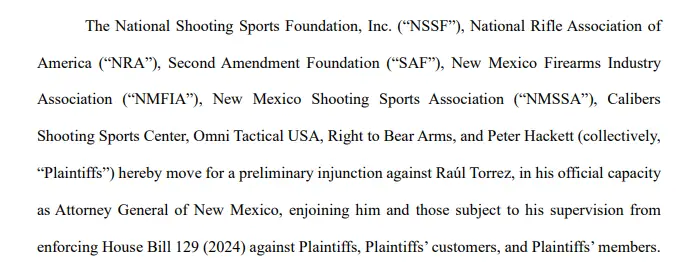
In October 2026, a coalition filed National Shooting Sports Foundation v. Torrez, Case No. 1:26-cv-03514, in the U.S. District Court for the District of New Mexico. The plaintiffs:
- National Shooting Sports Foundation (NSSF)
- National Rifle Association (NRA)
- Second Amendment Foundation (SAF)
- New Mexico Firearms Industry Association
- New Mexico Shooting Sports Association
- Three New Mexico dealers: Calibers Shooting Sports Center, Omni Tactical USA, and Right to Bear Arms
- Peter Hackett, a retired Albuquerque police sergeant
Hackett’s situation says a lot about this law. He served more than 20 years with the Albuquerque Police Department. He carries federal credentials as a qualified retired officer. But he doesn’t hold a New Mexico concealed handgun license, so the state made him wait a week like everyone else.
The groups filed a motion for a preliminary injunction in late October. Less than a month later, the attorney general agreed to stop enforcing the law. It is that stipulation that we are enjoying right now. The lawsuit isn’t over, but when the defendant basically waives the white flag on the injunction that is basically writing on the wall.
Thank you to NSSF, NRA, SAF, the New Mexico Firearms Industry Association, the New Mexico Shooting Sports Association, the three retailers who put their names on this, and Peter Hackett. Winning a case is one thing. Making sure the win actually reaches the rest of the state is apparently something else.
What the Stipulated Injunction Does
Based on what the parties filed and what the plaintiffs have published, here’s what the agreement covers:
- It’s statewide. This is the big one. It isn’t limited to the plaintiffs, their members, or their customers. It covers every buyer in New Mexico.
- It binds the attorney general and those under his supervision. They would be barred from enforcing or implementing the seven-day waiting period.
- It lasts until the Torrez case is resolved. The only way it ends early is if the Tenth Circuit reverses course in the Ortega appeal and issues a final mandate holding the law constitutional.
- It takes effect when the judge signs it. Not before.
When the plaintiffs filed their motion, they only asked for protection for themselves, their members, and their customers. The state agreed to more than that which is another sign that the state knew, and knows, they are doing something unconstitutional and the party is over.
What It Doesn’t Do (Yet)
As of this writing, the court hasn’t signed the order. Stipulated injunctions are usually a formality once both sides agree, but until the judge enters it, the seven-day wait is still the law for anyone who isn’t covered by Ortega or one of the statutory exemptions. If you’re a New Mexico dealer, don’t start same-day transfers based on a headline. Wait for the order.
Why This Matters Outside New Mexico
The Tenth Circuit covers Colorado, Kansas, New Mexico, Oklahoma, Utah, and Wyoming. Ortega is a published opinion, which means courts across the circuit have to reckon with it.
Colorado is the obvious next domino. Its three-day waiting period, passed in 2023, is already being challenged in federal court in Denver, and the challengers are leaning heavily on Ortega. Colorado’s defense is that three days lines up with the federal background check window, so it’s different. We’ll see how far that gets.
And the pressure isn’t limited to the Tenth Circuit. Back in June, Florida’s own attorney general conceded that the state’s three-day waiting period was unconstitutional and settled the case rather than defend it. Maine’s waiting period has been blocked in federal court. The states still clinging to these laws, all the way up to California’s thirty days, now have a federal appellate opinion pointed squarely at their core justification.
