

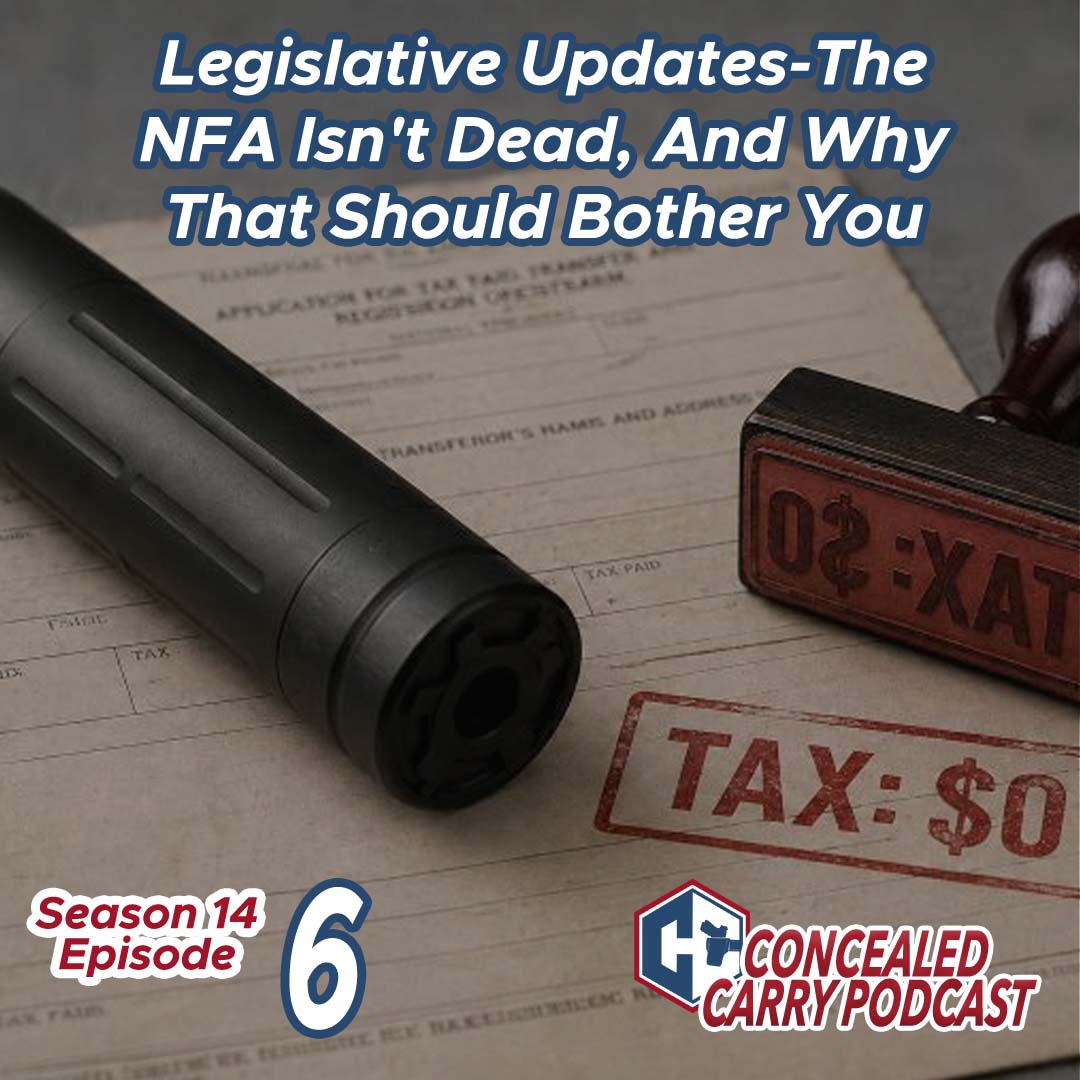
S14E6: Legislative Updates-The NFA Isn’t Dead, And Why That Should Bother You
About This Episode:
Today, Riley Bowman and Jacob Paulsen are bringing you our Legislative and Legal Updates episode — and August may have been the single biggest month for gun law in decades. Two federal courts struck down long-standing rules, the DOJ reversed a decades-old position on carrying in post offices, New Mexico's waiting period finally died, and the FBI quietly released a crime report that nobody on the other side seems eager to talk about. California, meanwhile, just sent three more bills to the Governor's desk.
But the big one is the NFA. You've seen the headlines saying it's dead. Riley read the actual court order, and it isn't — not for most of you. He also thinks the Justice Department made a serious mistake in how it handled the win, and that's the part almost nobody is talking about. Jacob pushes back. Tune in so you don't miss!
News Stories Referenced In This Episode
- Silencer Shop Ruling: The NFA Is Not Dead
- Federal Judge Strikes Down NFA Registration for Suppressors and SBRs
- DOJ Says Lawful Gun Owners Can Carry in Post Offices
- Federal Judge Rules Biden-Era Ghost Gun Restrictions Unconstitutional
- District Court Enters Final Judgment Striking Down New Mexico's Waiting Period Law in NRA Victory
- California Anti-Gun Bills Pass the Legislature, Now Heading to the Governor's Desk
- SCOTUS Statutory Ruling Not the Final Word on Biden-Era Frame or Receiver Rule
- FBI Releases Final Crime Report for 2025 to the Dismay of Firearm Prohibitionists
- DOJ's Post Office Directive Marks Another Second Amendment Milestone
- Federal Firearms Rights Restoration
- FBI Releases 2025 Reported Crimes in the Nation Statistics
- FBI's Latest Report Leaves 'More Guns, More Crime' Hypothesis in Tatters
- Texas News Report — The Center Square
- Grassroots Judicial Report — August 26, 2026
Watch this episode
Read the transcript
This is the Concealed Carry Podcast, Season 14, Episode 6. And welcome to the Concealed Carry Podcast, part of the ConcealedCarry.com network brought to you by HK. Today is Friday, August 28th, 2026, as of the recording of this live episode. I'm your host, Riley Bowman, joined today by co-host, Jacob Paulson. That's me.
That's him. That guy over there. Glad to have you with me and doing an episode with you. We're doing a legislative updates episode today. We've got a lot to cover, actually. It's been a busy month, actually, on the legislative slash judicial side of things. And we normally would do this once a month anyway, roughly. And it's been basically a month since we did the last one. But yeah, I was, you know, like in hindsight, like, holy crap, it's been a busy month.
Yeah, there's been like thing after thing after thing in just the last few weeks even. So pretty exciting to see some of what's going on, particularly on the judicial side of things. In fact, most of our news today is, well, it's judicial. There's some that's executive branch, governmental, you know, change of priorities and whatnot.
And there's a little bit of legislative news as well, as far as mainly some things out of California we'll tackle here later in the episode. But first, today's episode, we've got to talk about some quick sponsors today. Brought to you by our Concealed Carry Gun Tools app, which can be found at concealedcarry.com forward slash app.
That's free. Yeah, totally free. Yep. We'll talk some more in depth about it here after a couple of stories that we get out of our way. Also, today's other episode sponsor is Barrel Block. Not free. Yeah. Yeah, I wish it could be free. As far as like, that would feel good, but we wouldn't make any money. That'd be a problem.
That would be a problem. We'd lose money, yeah. So BarrelBlock.com is a good link that will get you there. So hopefully you'll check that out. We'll talk some more about that also later in the episode. So we're going to move right along. We're going to jump right into some stories here. This first one is our first legislative story that we're going to cover today.
Talking specifically about some stuff going on in California. Three anti-gun bills that have been passed by the state legislature. They are sitting on Governor Newsom's desk waiting to be signed, and I suspect they will be signed. I don't – it would shock me, I guess, in other words, if a governor with his track record was like, no, I'm not signing these.
Yeah, true. Though I think there's some recall efforts going on against the governor right now. So, yeah, he better hurry. He's got aspirations to be the big head honcho of our nation Train wreck, It'll never happen But yeah. It's going to make it more difficult too For passing some of these things perhaps California is still the most populous state in the nation By pretty good margin Yes, But it has had negative growth for like many years now Yeah.
Rather fascinating Let's talk about these three bills out of California. Senate Bill 948. So apparently there's a purchase... Permit to purchase. There you go. That exists in California, but that up to now was pretty straightforward, not too complicated. Go online, some California DOJ website, answer some questions, and bam, here you go. Yeah.
And we're using the term permit to purchase kind of generically because that's how we describe this kind of a scheme. Yeah. But in California specifically, it's a firearm safety certificate, an FSC. Yeah. It's not the only state or jurisdiction that has something like this, but they are now, the Senate Bill 948 is going to create a training component to that. Mandatory.
In-person. In-person classroom time, live fire shooting time. Basically, you got to go through, sit through a class, probably pass a test in that class. And part of that sounds like is a shooting test as well. Like you've got to shoot some rounds and presumably, I don't know if they're going to have a state mandated qual or if it's just whatever the instructor designs, but something that shows competency, knowledge based as well as shooting based that then allows you to get a permit to go purchase a firearm.
I think we're going to see more states roll out systems like this because the forecast of gun rights, if you're checking the forecast, is such that in the not-too-distant future, states are going to realize they can't ban anything. We're going to talk about that today too. And so I think what you're going to see is anti-gunners are going to say, well, if the Supreme Court won't let us ban stuff, then we can just make it harder to get the stuff.
We can require a process that is both painful, time-consuming, and expensive and inconvenient. And that is the closest we can get to basically banning the thing. And states like Illinois have been doing this for a long time but it's getting more arduous is what we're seeing. The new permit to purchase system that's now in effect as of the first of this month in Colorado, it does not apply to all guns but to those guns that it does apply to that permit to purchase program is very arduous.
And so now you see California basically taking their existing system and saying let's make this more arduous. Yep. Yeah, I think it's only a matter of time before here in Colorado because, you know, as you pointed out, right now applies to essentially AR style, AK style semi-automatic detachable magazine firearms. Yeah.
Mosselmanos. It's probably up this next legislative session. It would not surprise me if they're like, let's just do that across the board for everything. Yeah. There's going to be, there's going to be, there's already lawsuits against it too. Where do you think this type of approach that some of these states are taking fits in the current judicial framework with, you know, Bruin.
Too far. Okay. So I think there's maybe two different questions you're asking, or at least I interpret it as two questions. The first question is sort of, is this constitutional? Like, will this flush out in a court system to survive or to die? And I think the answer is to die. There's no historical tradition of forcing people to get any sort of training or undergo any sort of anything.
Period. So that's problematic. And then you also, I mean, we're going to talk today about what happened in New Mexico, which I think is also indicative of the kind of thing that you're looking at here. You know, like the question that's being asked is, is there a demonstrative public safety benefit to the delaying of or the barrier that's in place to exercise these rights?
That's what Bruin would establish as the framework, right? Is there a demonstrable public safety benefit and is there a historical analog? Well, there's definitely no historical analog. That's just outright silly. And we've seen several attempts to try and find something like that for other reasons in recent times. So we know that that's going to be a fail.
So then the question has to be asked, is there a demonstrable public safety benefit? And I think the answer to that is no. But, the other side, I guess, the other question I think you're asking is sort of like, well, how long will it take for the judicial branch of the government, for the lawsuits and the whatevers, to get to a point that it all culminates and the Supreme Court demolishes these permit-to-purchase programs?
I think the answer to that question is several years away. I mean, probably, probably not in this decade, but if so, toward the end of this decade. I guess a part of me that finds this kind of fascinating is, you know, states like Illinois has had something like this for a long time. And the fact that that hasn't yet been successfully challenged and or taken up, you know, to the higher courts of the land in light of Bruin is kind of surprising to me, I think.
Well, yeah, I mean, the Illinois version, the Foyt card, is not very arduous. Right. And so I think it seems probably hard to challenge, right? And this California thing, the firearm safety certificate, was much more, I should say currently now, is much more analogous to what Illinois does, assuming this bill doesn't get signed.
Once this bill gets signed, now it becomes a very arduous thing that I think is easy to challenge in court. So, yeah, I wouldn't want to be the attorney who's got to go fight the FOID card in Illinois. That would be a tough battle. Let's also talk about Senate Bill 1220 this one takes an already existing misdemeanor it says in the reporting on this into a rights stripping it takes it to a rights stripping level so like typically a misdemeanor charge there can be some exceptions particularly where maybe a DUI or domestic violence misdemeanor could qualify.
But in California, basically, Senate Bill 1220, the intent is to make what is already a misdemeanor crime in California, which is tampering with, removing, stripping away. It's specifically someone who's possessing, selling, transferring, or otherwise dealing with a firearm that has had its identifying marks or serial number altered.
Okay. So you're – I'm just saying if somebody – Possessing It would be. Enough. Gotcha. Okay. Fair enough. But I'm just trying to keep this simple that I was thinking more simplistically. You can expand on it. That's fine. I'm just saying that somebody does something with a serial number or some other identifying marker on a firearm, you know, hey, we already know that's illegal.
It's illegal on the federal level too, right? Yes. But this, the bill, the intent is anybody that, as you said, sells, transfers, whatever, possesses a firearm that does not have its serial number or has had it stripped or removed, that is a misdemeanor that will then automatically make them eligible from possessing or buying firearms for 10 years minimum. them.
And it still remains a misdemeanor. It's not like they made it a felony. They're saying, hey, no, we're going to leave the... It's still a misdemeanor for all other reasons or purposes, but it will have this added effect of removing this right from you for 10 years. I think this is another interesting one. There's a part of me that's like, well, why? Okay.
Why is that... Because I don't know... What's the problem we're trying to solve here? Because because typically someone that's Intent on committing a crime is just going to, you know, like it's what criminals do. They commit crimes, right? So if it's already illegal, then like people will probably just still, you know, like whatever, right?
And if you take away their rights for 10 years, their firearm rights, they'll probably just find a way to still own a firearm anyway, right? Yeah, it seems silly to me. So that's my point. It's like, what is the point to this legislation? Yeah. But the other thing here that's rather fascinating is I think this is one that definitely could be challenged, you know, at the court level as far as like does a relatively simple misdemeanor crime such as this become something that they can strip your Second Amendment rights away for 10 years?
Yeah, probably not. And I think there's some other factors here that will play into this. In fact, today we're going to talk about ghost guns. I think it's on our agenda. But I think that there's obviously a distinction here, and this is important to distinguish between a gun that never had a serial number or identifying marking, because I built it myself versus a gun that had one and it's been removed.
It's been stripped, demolished, filed down, obliterated. And this law is addressing that. It's addressing the removal of or the stripping of identifying marks. So I think that's –, probably in this law's benefit relative to its constitutionality. Because we definitely have an established legal system around the idea that, manufactured guns have to be identified, have to be serialized.
And so to suggest then that after they've gone into the marketplace, people can just remove those. Yeah, I don't know. But to your point, it's a misdemeanor. It would have made more sense to me if they just made this a felony. Because at least then there's some added incentive to not break this law. Like, well, crap, another felony charge. That's not ideal for me.
You know, it's more prison time, but it's like, okay, so now I can't have guns for 10 years? Like, I'm a criminal, bro. Yeah. Yeah. So that's an interesting one. And then finally, Assembly Bill 1743. This one you did a little bit of digging into, and it's kind of interesting. I mean, all of these are interesting and dumb and frustrating.
But this has to do with expanding the state's firearm owner's data sharing framework. This I'm quoting directly from NRAILA. By increasing access to information maintained in California's automated firearm system and related databases. And NRAILA makes a good point here. And this is, I think, very valid and should be something that's on everyone's minds in light of recent...
Database-based challenges or issues that California has had as far as protecting gun owners' private information and data, right? Because they had that whole snafu where they released, like, everybody's concealed carry records to people that should have had it. I personally think that is irrelevant to this question at hand.
Because the database existed. It still exists. So the state's ability to keep the data in that database secure is unimpacted, is irrelevant to this new legislation. That's fair. But I love that the NRA is ready to bring that up. And it is valid for us to remember that California does not have a track record of doing a good job of protecting this data.
But I don't know what it has to do with this. This law is not creating a database that didn't exist before. It's simply saying, we're going to expand who can request info from that database. Well, I think that's still part of the discussion, because it's like... You're giving information to a broader array of people or institutions. Sure.
And then so it's like, how do I know that my information is going to be protected? And now we're putting it, you know, we're making it possible where it's in the hands of more and more people. What are they doing with that data? What is the actual data they're getting their hands on? That's the point. I disagree completely. And I'm not saying I'm in favor of this legislation, not at all.
I'm saying that the two things are unrelated because the data we're talking about in this legislation is specifically the database of guns gathered from crime scenes. Okay. So this is not like, hey, we're going to give access to who has concealed carry permits to more people. This legislation is specifically about data gathered from crime scene gathered – assuming I'm reading it properly and I'm happy to be corrected.
But based on the research I did, we're talking about crime scene guns, data collected from that that gets distributed to the DOJ and is also held by, the California Department of Justice. And that database, which has analysis done on those guns, we're saying, hey, we want to make it so that more people, some specific people, can access that data.
So I don't think it really expands a privacy concern unless you're like, man, crap, I don't want everybody to know about the guns I left at the crime scene based on how I'm reading it. Now we're getting to the meat of it, and that's why I'm asking the questions, because these are relevant questions to ask. And to help understand better, what is this actually doing as a new statute on the books or soon to be probably on the books, right? Right.
So, yep, reading right from it here has to do with firearms that have been reported, stolen, lost, found, recovered, held for safekeeping, surrendered, relinquished, or under observation. I don't know what that means, But... I would think of it this way. The California Department of Justice has databases in sync with the ATF databases.
So the idea of firearm registration at a national level is not a thing, right? But the ATF does, with authority, currently maintain certain databases of guns. But it's not like all guns. It's certain databases. Like here's the database of guns that have been reported stolen. Here's the database of guns that have been recovered from crime scenes.
Here's the database of whatever. They kind of have these unique lists as part of their tracing department. So California Department of Justice has kind of a mirrored image list of databases that they maintain for their state. And that's the data we're talking about so yeah to your point it's these different you know list of what guns have been stolen list of what guns have been recovered those kinds of things.
As you dig down further into the bill, there are some data points that is referencing, you know, basically firearms dealer inspections as well as ammunition vendor inspections and some of the information specific to those dealers and or vendors. And maybe some of those people might have concerns about, you know, that. That would be valid. I think this legislation is bad. And to kind of finish the half of this too, because we're talking about, well, this bill would expand who has access. Well, who is it expanding it to?
Right. And I think that's the valid big question. And the answer is mostly higher levels, higher institutes of education. So universities, like University of California and California State University are specifically named. And it talks about other publicly funded higher, whatever, education, something, something. So that's the target here. It's like how I see it as this, I see it as previously there would have been a legal challenge to us sharing this data to universities so they could conduct research.
And we're trying to pass a bill to remove that barrier so we can provide this data to these organizations that want to conduct research on the data. Is that a good thing? No, it's not a good thing. Right. But that's, I just don't want us to see it for more than what it is. Good points. All right. Well, those are three bills we mentioned that are on Governor Newsom's desk.
And if you'd like to do your part and contact the governor's office to let them know that you are either for or against these, I imagine most people probably are against. You know, that's always what you should do. We should always be active participants in our governmental processes. Let's move on to a story from, a story article.
It's actually basically an amalgamation of a bunch of different updates, judicial updates in different cases that are pending and whatnot, on thegunmag.com. And specifically, we're going to highlight a couple of things here that we thought you'd want to know about. Something out of New York and something for the Supreme Court.
So let's talk about the New York thing we've got the Second Amendment Foundation the NRA and Firearms Policy Coalition they're involved as part of a lawsuit they're firing it's called Firing Pin LLC versus James of course James is their attorney general there Leticia James so they got an ongoing lawsuit with the it's a challenge to the New York state ban on convertible Pistols yeah so I think there's some foundational info yeah so, New York's not the first state to basically attempt to ban Glocks.
And California and Maryland come to mind as well. So these states have laws that they don't say Glock, but they describe Glocks, or they describe the attributes about a Glock that they think make it scary and concerning, specifically that they can be converted into. Readily converted or some language like that, into fully automatic machine guns.
They're talking about the Glock switch, right? For some long period of time, gun grabbers are losing their mind about the Glock switch, something that is a felony to possess or have because it just makes it too easy to convert these guns into machine guns. So these states have gone out of their way to write legislation that effectively bans them.
And that's the foundational element. That builds on where we're going. So now someone steps in and files suit against New York. There's also pending lawsuits against California, Maryland. So you kind of have – this is happening in three different places. I know the NRA is involved in I think all three of these lawsuits.
I think other organizations are tacked on to each one. So yeah, I think the question to kind of bring it back, there's two issues with this lawsuit. One is this idea of readily convertible. Like all guns can be converted into full auto. Right? Like, it's just a question of like, well, how hard is it? And this idea of readily convertible is too arbitrary.
It's like, well, that's not clear or specific. So I think we could see a ruling come back that just says, this is too vague. Like, be more specific. And so injunction until legislature makes it more specific. So that's one possibility. That's one possible outcome. But I think the other legal challenge to this is this idea of our previous Supreme Court decisions and made it clear that you can't ban something that is in wide common use among the citizenry.
And so to suggest that the guns they're describing, namely Glocks, are not in wide common use would be utterly, you might as well hit your head against a wall. I mean, it's just silly stupid. Can you imagine a gun that isn't, or that is more in common use than a Glock, right? It's like that. It is the most common gun. Well, it's probably the most common, certainly the most common handgun platform in America.
So those are like the big questions here that would seem to play in favor of gun rights when this comes into a court. But again, we're going to see this come into three different district courts, and that will lead to potentially a district split if we see different decisions from those over time. So that's one we're keeping an eye on. All right. That'll be interesting to see how that plays out.
The other main thing that we want to make you aware of is some Supreme Court cases, Supreme Court of the U.S. They're currently in recess right now but they have a couple of big ones that they're taking up in their next term and specifically Veramontes vs. Cook County which has been combined that's out of the 7th Circuit and that's been combined with the Grant vs.
Higgins case out of the 2nd Circuit they're on the same, very similar issues which is dealing with AR-15s and similar semi-automatic firearms rifles and the Supreme Court has indicated they are going to hear those cases. They're going to hear them for argument in the next term. That could be as soon as October. We're almost at the end of August here, so that could be, you know, the reporting here is suggesting there has not been an argument date yet set, but that they will hear those cases argued.
It'll be a one-hour argument session or hearing, and that could be as soon as October, which is kind of exciting. Yeah, I have two comments on this one. One is just to clarify some timeline. Hearing arguments will be very important because we'll be able to kind of guess what the outcome of the case will be based on the arguments we hear from both sides.
Well, in this case, really from four sides because you have two different cases. So you have two sets of plaintiffs and two sets of defendants. Thank you. But anyway, so from those arguments, we'll kind of be like, oh, yeah, okay, these are the arguments that were made, and we can decide, you know, based on our own opinions, how much water we think they hold.
It's also the questions that the justices ask. Yes. Yeah, yeah. What are they interested in knowing? It really kind of gives you some insight as far as where their mind is at on the issues. But I think it is worth clarifying that we probably should not expect a decision from the Supreme Court until probably about a year from now would be like a decent guesstimate.
Typically, we see arguments in the fall or late fall, and there seems to be kind of like late May and through June sort of like the hot bed for output when you start seeing some of those come out. So we'll see. But just to temper expectations, this also comes – I think we're going to win this one. For me, this one's a slam dunk. There's certainly some of these you're like, I mean, I'm not sure because whatever.
But this is one of those where it's like I cannot imagine how we could lose this. Yeah. Like, you know, we're talking about the most common rifle in America. Yeah. Like, it is extremely widely in public use by the citizenry, so that's a non-question. There's no historical analogs, nothing even remotely approaching one. The district court decisions where we've lost this case, where AR-15 bans have been upheld, You go back and look at those decisions, and they're decisions that basically chose to ignore previous U.S. Supreme Court decisions.
That's the only way they arrived at the decision to uphold those bans. So now that the U.S. Supreme Court has to weigh against their own previous decisions, I just see no world where we can lose. So it's a matter of time, and it's going to clean it up. And this is one of the reasons I said earlier that I think we're going to see more and more permit-to-purchase schemes, like we were talking about in California, Colorado, and other states that are doing things like this, because when this disappears, when the U.S.
Supreme Court basically says, you can't ban this, I think you're going to see states go, oh. Well, okay, then we'll do this. We'll force people to go through an arduous process and get training and spend money and their time in order to be able to buy these things. Right. So I think it's the inevitability that will come out of this case.
I agree. I mean, we already know for a fact, like, I mean, Kavanaugh is easy for sure. He's the one that's, you know, for a couple of years now been basically saying, we're going to take up this case. Yeah, it's coming. He's been signaling where he stands on that for a while now. And, of course, he was involved in that case out of the 11th Circuit or whatever, whichever circuit he was in years ago. He was involved in a major one on a similar issue way back then.
Thomas, for sure. Alito, for sure. Kavanaugh, as I mentioned. Gorsuch, probably, almost certainly. Do you see either Barrett or Chief Justice Roberts maybe coming down on one side or the other on this? I don't know. This is a layer deeper than I generally choose to analyze. But I think it comes down to... We had dissenting opinions in Bruin in 2023, but now Bruin is the law.
Well, and even then, though, it was six to three. So all of the, quote-unquote, conservative justices were in favor of Bruin. So I think my point is that even if you dissented then, you now have to accept that that's the deal. I just, I'm bringing up the question because to me, I see this as like the first major test before the court.
Yeah, there's been a couple hours since Bruin testing some, you know, I call smaller issues. I think this AR-15 or similar rifle issue is a big, big, big issue. Because again, we just talked about how in common use Galaxar nationwide. AR-15s are the most common rifle. I mean, as far as, like, type, right? So I see this as, like, the first major test since Bruin.
I suspect it'll be a 6-3 split. But it'll be interesting to see if any of the justices rethink where they are at since Bruin. Yeah. I think the best way to think of this is in the United States, we have been taking the Second Amendment over the last 20 years, and we have been building an extraordinarily massive foundation underneath it.
And we're now in a position to go build the house on top of the foundation. And that's what you're seeing. Like, like Heller, McDonald, Heller, Bruin, like this established a foundation that is so solid, that is so uncrackable. And now we're building the house with all these other lawsuits. And it's like, on this foundation, we can't lose.
Cool. We'll be watching those cases, especially that Viramonte's case. All right. Concealed Carry Gun Tools. Jacob, let's talk a little bit more in depth about our first episode sponsor, our own mobile app, which, by the way, has existed in some form since 2016. Yeah. Ten plus years now. Wow. Yeah. And free since 2016. Ad-free, money-free, cost-free. I mean, it's not for us, but. No.
Yeah, no. I think people would vomit a little bit if they knew how much money we spent on it. Tell people why they should make sure they have the Concealed Carry Gun Tools app on their phones. Concealed Carry Gun Tools app. It's so full of cool stuff. For one, you could be listening to this podcast right now in there for all we know.
So maybe you download the app and you're listening to us talk. So you can access all podcast episodes and all articles. Just kind of everything in our Learn Hub is there. So all articles, all podcasts. You can see it all there. You can play, et cetera. Additionally, you have what we call the Maps Tools. There's three of them in there.
So the first map tool is Reciprocity Maps. You can generate Reciprocity Maps for any combination of permits you have. We're actually working on an enhancement to that right now. I don't want to blow it too much, but it's going to be cool. And the second map tool in there is our business directory. And it needs some tweaks. We have some big plans for that one that we're going to do to improve. But right now you can go in there. If you grant it location permissions, it'll see where you are, and it'll show you gun businesses near you.
Here's gun ranges, gun. And you can filter. You can say, I just want to see instructors. I just want to see gun ranges. Or I just want to see gun-free zones. We have, I think, something like 80,000 gun-free zones that are logged in there. And you can submit them yourself on concealedcarry.com if you want to add one to it.
I recently added one. That's just about a week ago. And then our third map tool that's in there is the state law library. And this is probably the most utilized thing inside our mobile app, is that you go in there, you can pick any state from the 50 states, and it'll pull up a summary of all the gun laws that we track for each state, for the state you chose, I suppose.
And we're pretty comprehensive about that. We're pretty crazy about making it accurate. In fact, this week we were contacted by a professor who has written some legislation in a state, one of the northern states. And he contacted us with a question about what we have in our app relative to a certain statute. And we had some back and forth. And basically we both agreed that the way it's written is as good as it can be.
So this app has been downloaded over like 250,000 times. It's currently active on I think something like 15,000 phones. So it's pretty tested. It's pretty proven. It's very effective. And I think that you get a lot out of it. We'd love to see it active on 100,000 phones. So download the Concealed Carry Gun Tools app today. Jacob just told you why you should have it.
Go to concealedcarry.com forward slash app. And if you already have it downloaded, go rate it. Go give us five stars. I think that's going to make a huge difference to make sure other people can also enjoy it and find it. Yeah, that's always appreciated for sure. Let's turn our attention now to some pretty significant news out of New Mexico, Jacob.
Yeah. So New Mexico, you know, had a seven-day waiting period, you know, this cool-off period for the purchase of a firearm in their state there in the land of enchantment. And that is now, at least within the 10th Circuit, dead. So this is an interesting one, Jacob. So this is what's known as the Ortega v. Grisham case.
NRA and the Mountain States Legal Foundation were involved in this, along with NSSF. The law was passed back in 2024. It was challenged almost immediately. And basically a year later, about a year ago now, the Tenth Circuit held that law unconstitutional. It was remanded back to the district court. And this is what's fascinating to me. So basically the 10th Circuit's like, yo, you got this wrong. There's not a historical precedent for a mandatory waiting period on a firearm purchase. Hello, Bruin.
And so remands it back to the district court. Hey, get this right. And New Mexico, so the state of New Mexico, arguing that, again, before the district court, basically asked the district to ignore what came down from the 10th Circuit. Like, that just is fascinating to me because, I mean, hello. It echoes like a 12-year-old in a courtroom.
Yeah. Can we just ignore what mom and dad said and just do this anyway? So the district court disagreed with that, saying, no, we've got to abide by what the Tenth Circuit has remanded to us. And so as of now, this is the law of the land for the Tenth Circuit, which includes states like Colorado, Kansas, New Mexico, Oklahoma, Utah, and Wyoming.
We have a waiting period in Colorado. Three days. So shouldn't that be rolled up into this? I need to go read the decision from the 10th Circuit again, or maybe I've never read it. I don't know for sure. Because that's the question is sometimes these decisions are very narrow. The decision might be written to the effect of a seven-day waiting period is unconstitutional. Right.
In which case, okay. Three days is okay. Six days will be fine. Right? Or it might just say waiting periods are unconstitutional. But it does create a foundation upon which additional lawsuits can be filed, like here in states of Colorado, if we might see. Again, I don't know. I wish I was more educated on this one. I didn't have time to go read it before we recorded. But I would think it would have implications.
At very least, I think the implication would be that if someone does go file a lawsuit in a state like Colorado, certainly in a state like Colorado, since we're part of the same district, that that has a high chance of success. Because they'd be like, yeah, we already talked about this. Yeah, exactly. But in a different district, I think it still gives you foundation because you can reference those arguments and the decision that was written by the 10th District.
Or 10th Circuit. Thank you, 10th Circuit. Yeah. So anyway, we'll try to keep posting on that. This actually was news to me. I hadn't heard. Well, I think it happened like today or something. Yeah, but I hadn't really heard much about this even leading up to today. So we'll probably come back to this with some further updates.
August 28th. Particularly as it relates to other states within the 10th Circuit. Because, again, that's going to be very – because I don't think – let's see, Kansas, Oklahoma, Utah. Yeah, none of the other states have a waiting period on purchases. It was just New Mexico and Colorado within the 10th Circuit. So we'll see where that goes and try to provide an update.
Now, let's talk about an article that you wrote, Jacob, updating folks on how the new approach, if you will, that DOJ is taking towards possession of or carrying of a firearm on post office property. Yeah. This is another one of those where we've yet to see the implications of this. But the short of it is, I don't know, I think we've got to back this up a minute.
So federal law, in fact, I'll see if I can tell you the exact, 18 U.S.C. Section 930, subsection A, okay, makes it a federal crime to possess a firearm in a federal facility. However, subsection D number three exempts, quote, the lawful carrying of firearms or other dangerous weapons in a federal facility incident to hunting or other lawful purposes.
So you have this law, this U.S. code that says you can't have a firearm in a federal facility unless it's a part of hunting or other lawful purposes. Other lawful purposes is a little bit open-ended. I mean, it isn't to me. To me, it's like super clear. But apparently it's confusing to some. And it was under that guise that the U.S. Postal Service had their own little whatever deal. What was it?
Rule 39 CFR Section 232 Subsection 1 Letter I that banned firearms on postal property except for official purposes. Yeah. Okay, and that rule was posted in 1988. And so basically, the Department of Justice has said, hey. This rule is illegal because, I mean, in 1988, maybe you could argue that just having a gun on you for self-defense was not a lawful purpose.
Maybe. Like that could pass some muster. It was a different world then. Completely different world. But now that we've had McDonald and Heller and Bruin, there's no world you could suggest that me stuffing a gun down my pants and walking into a post office is anything other than a lawful purpose. And so with that in mind, then if that's a lawful thing, like me just choosing to carry a gun for self-defense is lawful, then without question, the U.S.
Postal Service does not have the authority to keep me from taking it into a post office. And that's what the Department of Justice said. Now, so that's done. It's over. The post office has gone to the effort of removing the code from their site, all the things. It's take your gun into the post office. Proceed. Have a good time.
However, there's still a couple of things. One, the Department of Justice clarified that we're talking about post offices that are open to the public. So if there's some post office center where only employees can go and they sort mail and there's no front-end lobby where you can walk in with a package, you don't have a right to just walk in there with guns.
That's not what they're saying because that's not open to the public. We're talking similar to... You know, any old, any other business, right? You know, like that public can just walk in because they, because they have a lawful purpose to go there for. Uh, if it was a business, a store, you go somewhere to buy something, right? So you, you know, you walk in, even if it's private property.
Uh, I mean, yeah, they can do certain things. So, you know, restrict, you know, it's their property, but we're talking open to public. It's not like it's a restrictive, it's not ticketed. It's not like I can go cruise into Fort Knox. You're not having to pay to get in. You're It's not secure. Yeah, exactly. Now, this is why I say we've yet to see the implication because this DOJ decision would suggest to me that then, by extension, I should be able to carry my gun into a building in a national park, or any building open to the public at the federal center that we have or a VA hospital or...
Any federal facility that's open to the public, based on the argument that DOJ has made, should be open to me and my gun. If it's not a secure facility and it's open to the public, then I would say that this argument suggests I could carry there too. No, one of the things that comes to mind that I think is a big one is VA hospitals, that kind of stuff. There's one that's not too far from where I live.
Not a VA hospital, but it's a doctor's office. It's a VA facility. You know, guys go there for, and gals, for, you know, like, it's just a doctor's office, right? Sure, sure. And the parking lot, like, at the entrance of the parking lot has pretty large, obnoxious signage, making sure you know, on this property, we're not talking about in the building, we're talking you pull into that parking lot, guns are a no-no.
And, like, that's always been fascinating to me. There's a flock camera right there looking right at us. Like it's always been, I'm like, really? Like why, why do we got to be so, you know, hard, hard nosed about this kind of thing? You know, like Uncle Sam taught you to carry a gun, taught you to shoot the gun, authorized you to kill people with the gun.
And now you cannot bring guns on Uncle Sam's property to get treated for the injury you occurred when you were shooting the people with the guns we trained you to use. Right. It would be one thing. Maybe if they're like, don't bring it in the building, but hey, secure it in your car. Right. You know, like, but like to make such a point about like, don't even come in this parking lot.
So, yeah, I'm with you, Jacob. I think this should call into question. And DOJ hasn't said anything about those types of situations. But it should call into question those other situations. I think it sets a precedent that someone needs to go test. Yeah. I have found that I'm happier in life when I'm not a guinea pig for these kinds of things.
But I appreciate those who choose to be guinea pigs and go put these things to the test. So, you know, we support you. Yeah. Good stuff. By the way, if you guys want to read anything we're talking about, links for the stories, articles, whatnot that we're sharing in this podcast, they're included in the show notes. We do our best to include those links as much as possible. This was one that Jacob wrote. It's published on concealedcarry.com. You can go read the whole thing for yourself if you want to get more into the nuts and bolts yourself.
Let's go to yet another one that you wrote, Jacob. Federal judge rules Biden-era ghost gun restrictions unconstitutional. Yeah, so here's what happens. During the Biden administration, the ATF changes, without any piece of legislation, without any judicial interference, just presumably under the direction of the Biden administration.
Right. The ATF changes the definitions by which they determine what is and what is not a gun. To include, where previously it did not include, partially finished frames or receivers. The thinking being, you know, basically we're worried about 80% lowers. Like for those of you who need some definitions, right? Like, you know, the Palmer 80 guys that were buying partially finished guns and finishing them themselves.
That that was legal but oh my gosh like it was so scary to to the to the anti-gunners just terrifying so etf says okay we're gonna change the rule we're now going to define anything that can be readily you know finished or converted into, a receiver to or frame, to also be a gun and so these things are now regulated like guns so no act of congress no, court decision no supreme not just boom we just decided, so now previously then a lawsuit is filed and it goes all the way up to the US Supreme Court and the US Supreme Court does not rule that.
Unfinished receivers are not guns. The Supreme Court just rules that the ATF did not have the authority to change that rule. The ruling from the Supreme Court... The process was wrong. Correct. The Supreme Court said, hey, you can't do this. You can't make this decision unilaterally, on your own, willy-nilly. ATF lacks the authority to make that decision.
So that was the U.S. Supreme Court decision that was made. Now fast forward to this month, and that same case that the U.S. Supreme Court said, you don't have the authority, gets sent back down, and now in its current position in the court proceedings, the current court has made the ruling that that was, in fact, unconstitutional.
So before it was like ATF acted outside of its authority, and now this new ruling is not only did the ATF act outside of its authority, but the rule that they created was just flat out not constitutional, because there's no historical analog for not letting people manufacture their own guns, whether they came from kits or not.
That's crazy asinine. And there's no demonstrative risk to public safety by allowing it. So therefore, unconstitutional. Yep. Again, we're seeing the downstream effects of Bruin just continues to really shine for us. In almost all of these battles is just so, so amazing to see how impactful that is and will continue to be.
I thought it was interesting how Justice O'Connor, or judge, actually, I think it's a district court, so I believe he is referred to as a judge. He was picking at some of the words and definitions and things in the ATF's rule. And there's some pretty interesting stuff there if you want to go read what he wrote about that.
It's a good read. So I'm going to, just due to time, I'm going to keep us moving along here. Again, you can see this article for yourself, Jacob wrote on concealedcarry.com. All right, so here we go. This is the next story has to do with suppressors. And short barrel rifles and short barrel shotguns. Yep, yep. So NFA, all right. So big news, everyone knows, about two weeks ago now, actually, almost exactly two weeks, I think it was like two weeks ago yesterday, big rolling out of the North District of Texas about the NFA.
So we were expecting this. We were expecting once Congress removed the $200 tax associated with suppressors, short-barrel rifles, short-barrel shotguns, For that tax stamp, that it was only a matter of time. Obviously, it was going to be challenged and likely ruled unconstitutional. And so because Congress has the power to tax but now there's no longer a tax and there's no benefit the government's receiving because of that.
There's no reason for it to have to therefore monitor or ensure a tax is being collected. That's the whole premise of the NFA from the get-go which was challenged, I think it was like the Salisbury case or it started with an S. Way back in the 30s after the NFA was first passed, basically said, nope, Congress has the right to to tax, raise revenue to tax.
This was done through essentially commerce and tax taxing. Right. And so therefore, the NFA is allowed to stand because we got to have paperwork and fingerprinting and all that stuff to make sure people are actually paying the tax. So anyway, that tax is gone. Now, as soon as this ruling came out of the North District of Texas, people were like, woohoo, NFA is dead, NFA is dead.
And, you know, big news was you had, oh, what's his name, Brandon? Herrera. Herrera, right? and one other dude go right into a silencer shop store Just after midnight once the initial seven-day conjunction expired. Thank you. You're feeling all the words that are slipping my mind here. And they bought and walked out of the store that night with their suppressors just as a test and as a validation of this ruling, which applies to those who are members of, what is it, the...
Well, it applies to plaintiffs, members of plaintiffs, and customers of plaintiffs. Right. And so we got the, I think the NRA was part of it, the Second Amendment Foundation was part of it. So the NRA, yeah, so... No, not the NRA. It was not NRA. It was like a local state NRA association. There you go. I was actually meaning to say firearms policy coalition. It's just we've been talking about NRA a bunch.
GOA. GOA was part of it. Palmetto State Armory. Second Amendment Foundation I mentioned. Palmetto State Armory, that's right. Second Amendment Foundation was not part of it. Silencer Shop itself. I thought they were. No, they have a separate case that's similar that they're part of, but not this case. Thank you for getting me straight. In a different district.
It's hard for me to remember to keep all this stuff straight. They're all listed in the article. Yeah, that I wrote. But I can write something and forget about it. You and I both wrote articles about this one. It's kind of ironic. Yeah. Well, you were kind of just reporting about it and sort of the happenstance around it.
You added some thoughts. That's what I wanted to talk about here today. This is my whole thing. Well, before you get there, let me clarify. So I just want to establish some clear foundation here. So the big, beautiful bill that was passed last year removed the $200 tax. So lawsuits get filed to say without that tax, the law is now unconstitutional as it stands.
This particular case which the plaintiffs we just mentioned Silencer Shop, Palma State Armory GOA and FPC I think is the list and then some local organizations, those are the big ones, filed a lawsuit they win this lawsuit there's an injunction given, or there's basically a stay so what the court does is it says yep this is the ruling but it doesn't my ruling is not going to go into effect for seven days because I want to allow seven days for the DOJ to appeal the ruling.
Because if they appeal it, then we'll stay the injunction. So seven days goes, the DOJ does not contest, does not appeal. And so the injunction then goes into effect, saying the NFA is basically no longer, at least the parts of the NFA, the required registration in order for these three types of products is no longer constitutional.
But that's only for those plaintiffs and their members and customers. Okay yeah thank you I have more thoughts, but I assume you're going to go there, so we're good. Yeah, no. I was going to also clarify a couple other things, right? One is also that this is only going to be applicable to you if you're in a state where suppressors are legal to possess or SBRs, SBSs.
Specifically on the issue of suppressors, for instance, there's a number of states where they're just out. And folks who live in these states, you already know this, right? There's no mechanism for you to get a suppressor anyway in places like California, Illinois, New York, Massachusetts, I think Delaware, Hawaii. Well, there's been some confusion about states where the state law specifies that it's lawful as long as you go through the NFA registration process.
Oh, that's the next category. Yeah, right. And that's us, actually, here in Colorado. Yeah, we're in that category. Right, Colorado, some other examples, you know, common examples, Nevada, Oregon, Washington, Montana. That's a few. A large number of states like that. There are quite a few. Yeah. So a number of states basically say, it's legal, but only if you have paperwork from the government that says it is.
Right? From the federal government. Right. And so, yeah, if I can't apply for a tax stamp. Or if I don't have to. For that process. Right. Then that's a problem for me here in Colorado as far as being able to obtain a suppressor. Yeah. This is a hurdle that's currently being sorted. Yeah. So it's important for people to understand that as well. Now, if you're in what's, you know, like Silencer Shop is calling these free states, and I would agree, and there's a little map, and you can see it in the article that I published, and it kind of calls out these different categories.
So any of these red states that are shown here, then you can presume, as long as you meet one of those plaintiff categories, that you can probably purchase a suppressor without having to go through the tax stamp process, the Form 4 and all that, right? or even have to file a form one. And so if you want to make your own, that is.
Now, there's still a lot of questions, and people are asking specifics, and there's dealers that are like, what do we do with this? How do we handle this? What's the process? Is this actually legal? Are we getting our hands slapped by the ATF? And so on and so forth. And that's starting to get sorted out a little bit, but I think it still has a ways to go to really get it sorted out.
It's definitely pending. Yeah. And I've seen two major efforts to get clarity. The first one is from the NSSF, the National Shooting Sports Foundation. Yeah. Which is the big trade association for gun dealers, they've sent a request to the ATF saying, hey, ATF, figure it out. Give us direction. Now, please. And the other one is the attorneys on the case that just won their case.
Dave solicited the court to say, hey, court, you awarded us the injunction. And it still is an injunction, technically. There's like another 60 days or something that the DOJ could still appeal. Right. But you've awarded us this injunction, but now we need you to tell us how the plaintiffs can take advantage of the injunction.
Exactly. Because if I live in one of these free states, Utah, and I walk into... I mean, crap, Silencer Co. is based there. If I walk into Silencer Co. And I'm like, I want one of those, please, from the new factory outlet store maybe, how is Silencer Co. to verify that I'm one of the plaintiffs, that I'm a member of the GOA or a customer of Palmetto State Armory or whatever the thing is?
I mean, I don't know. Like, how would I prove it to them? So you get the point where this is the lack of clarity. And no one wants to jeopardize their entire livelihood and the livelihood of their employees by making a mistake because the ATF is not terribly forgiving. Generally, let alone in recent history, they're not forgiving at all.
Right. If you break rules as an FFL, as a dealer, that can mean that your license is revoked. Done. You go to jail. And then you're out of business and or going to jail. Exactly. So these are high stakes games we're talking here. I think clarity is coming. I guess that's my two cents is like, no one wants to be patient. Everyone wants their rights now. Don't blame me too.
But I think clarity is coming. Right. It has to come. Clarity must come. Now, let's talk about that appeal question. Okay. So we know within the seven day stay, there was not an appeal filed immediately. And it does appear that the Trump administration has signaled that they will not pursue an appeal. And specifically, Representative Andrew Clyde of Georgia, he posted and seemed to have word from the Trump administration suggesting, no, we're not going to appeal.
So it seems right now, as far as we know, that the Trump administration is not going to appeal this ruling, even within the 60-day window that it has allowed to be able to do so. Well, you may be hearing that and thinking, well, that makes sense, right? Like, that's one of the reasons why I voted for Trump or whatever, right?
And so you're like, yeah, go Trump. Go, you know, whatever, right? Here's the problem. This is what I argue in my paper that I wrote in this article. Is I think that's actually... While I'm also cheering and I'm happy about this, I think it's a mistake, potentially. And the reason why I feel that way is because we don't have a true national level ruling on this matter.
So if you're outside of one of those plaintiff categories, now what? It doesn't really apply to you. So how do you get your rights? Okay, you could join one of those organizations, that's fair, but you shouldn't have to do that either, right? And the other thing is, is that if we had like a Supreme Court ruling on this, then that would be, bam, nationwide most likely, assuming it wasn't like super narrow or anything.
But most likely that would come out as, yeah, hey, this law can't be enforced, therefore suppressors, SBRs, SBSs, boom, all right, just buy them over the counter, right? Using a standard background check, 4470 or whatever. 73. I'm struggling today. So an interesting case back in the Obama administration having to do with the Defense of Marriage Act. It's known as this...
There it is. The United States versus Windsor case. And you might be thinking, what are we talking about here? Why this? And I just wanted to make this point. This is what you can read in the article. And you can read more and learn more about it. The Windsor case was one where you had the Defense of Marriage Act that was passed.
That was under the Bush administration. The Obama administration did not agree with that. They didn't want to enforce that law, but yet they still continued to do so. And they could also read the writing on the wall, so to speak, and knew that there's a good chance that that would be overturned at the Supreme Court level.
And so they, while continuing to enforce a law, and arguing For the law, because you had plaintiffs now suing the federal government in that case, saying the Defense of Marriage Act is unconstitutional. The Obama administration basically took a strategy where they acted as though they supported the law and therefore needed to uphold it and enforce it, and basically argued it all the way to the Supreme Court so that it would be overturned at the Supreme Court level.
And that therefore meant that that law was done and over with. And that's actually what I argue in this article is, like, while we are cheering this case, this ruling, and the Trump administration, thank you, Mr. Trump, for not appealing. I think it's actually a bit short-sighted because I think... But there's a place where they could have continued to push the case forward to potentially try to get it before the Supreme Court and then get a lot more permanent ruling on the question of suppressors, SBRs, SBSs as it relates to the NFA.
There you go. There's my argument. Yeah, I think, though, that the current state, the current decision, whatever, assuming it stands, does not preclude an eventual full solution. In fact, the DOJ could just decide, you know, laterally just make the decision to allow this court ruling to apply to all people, not just the plaintiffs.
That's within their authority. They might do that. We might see legislation proposed, right? We just got the big, beautiful bill through. Like, what's to say the next bill doesn't come through? So my point is that I don't know that I agree or disagree with you. I'm sort of on the fence with the idea. In fact, I'll give you an example.
I remember, I'm on record here on the podcast. You can go back and listen to the episodes. when the big, beautiful bill passed, I called it short-sighted. I said, hey, we were shooting for the moons, and then all of a sudden we were just, like we settled with very little. Like why did we do that? Like why didn't we hold our ground and go after the big win here?
And now fast forward, and I'm like, geez, like actually seems like that was a pretty good strategy. I'm no legal expert. I'm no attorney. I'm no whateverness. I'm just suggesting that I think sometimes when there's a cookie there for the mouse the mouse should take the cookie mm-hmm. I hear your points. And let's also be clear that there are at least two other cases in other circuits that are making their rounds.
Right, on the same argument. And so this may still end up before the Supreme Court. And I do recognize that. But I just want you to know that sometimes there's maybe a bigger picture that we can have in mind with things like this. And that's the answers are maybe not always quite so clear I myself would love to see a much more, a broader more universal, more permanent ruling on this matter rather than something like you just mentioned well the DOJ could choose to apply it this way well that's nice and all until you get a totally different administration in power right?
Yeah but it is sometimes hard to wind back clock too so yeah I hear you I think it could be argued either way is my point and I'm no expert. Those are our opinions and our stories, and we're sticking to them. That's right. Final thing. We're at the hour mark, but this is just kind of an interesting thing I saw across the feed.
Bearing Arms, Cam Edwards reports, FBI's latest report leaves more guns, more crime hypothesis in tatters. So basically, back a couple weeks ago, FBI released their crime statistics report for the year. I think it was for 2025. Yep. But I thought I saw somewhere, maybe it was combined 2024, 2025. But anyway, basically what it showed is that virtually every single violent category went down, and in some cases quite significantly.
Yeah. So the question is, what's going on here? And, you know, if you were listening to just the anti-gun side of things, they would have you believe that we really need stricter laws because we need to make our community safer. But, yeah, while we're seeing all these big judicial wins that is opening up, You know, access to goods.
Yeah, more. Getting rid of waiting periods, for instance, in New Mexico and in the Tenth Circuit. Like, yet crime seems to be going down. What's your take on this? I think I'm not qualified to have any opinion on why crime is dropping. So that's my first two cents. It's like, are we doing better policing? I don't know. Are we having good legislation?
I don't know. I don't know. I think that the argument that this article is making is that basically what's clear is that while Americans own more guns than ever, More guns per American, more guns in America. Despite that number continuing to grow, the crime numbers are dropping. And I'll add that the crime numbers dropping is an ongoing trend, not just like last year they dropped. It's like, no, they've been dropping for about 25 to 30 years.
We've seen hiccups. COVID would be a clear example of that where it's like crime was dropping, dropping, dropping. Then COVID was like, oh, no, maybe not. But I'm just saying, if you looked at it, it grows. If you looked at that 50-year graph, violent crime has been dropping pretty steadily since about 1990. Get this. The 2025 murder rate was 4.1 per 100,000 inhabitants.
This, of course, nationally. That is tied with 1955 and 1956 for the lowest murder rate in history. That's my point. Right? Yeah. And it's believed that it's continued to fall and that whenever it is we see actual numbers for 2026, that the homicide rate for 2026 will probably be the lowest ever in our recorded history.
Yeah, and if we went and found like the highest ever, I'm guessing it's probably about 1987. Yeah. Or 1985. Yeah, it's in the 80s for sure. And that's the point. So I guess I'm just trying to point out the like, yay, awesome, safe or good. But I think it'd be short-sighted to attribute this purely to something that's happened in the last year or two or three because it's an ongoing trend.
I think that the other notable thing is that the number of guns in America is only going up at the same time this is dropping. And that is, I mean, I'm not saying one is a result of the other. I'm saying that at the very least, it is true yeah. It is interesting to point out though I was trying to come up with the words causation versus correlation I'm not saying it's causation but I'm saying there's correlation yeah.
At the very least, you have two things that are true, and one is the U.S. Is about as safe as it's ever been, and while we have more proliferation of guns. It's also interesting to note that the Giffords, the Bradys, the Everytown organizations would have you believe that things like Bruin has made our country less safe.
And now New Jersey and Maryland and Hawaii is having to issue permits, shall issue. And that's terrible. And yet the crime rate has not gone up in those places that they are now issuing permits at a faster rate than they probably ever have. In fact, Maryland saw a fourfold increase in carry permits in the year following Bruin.
New Jersey has seen a huge increase in permit issuances since Bruin, and yet crime rates continue to drop. I do think that there's a relevant warning for our audience, people who would listen to this podcast. I think there's two warnings. I think one warning is sort of don't then assume that you're good now. Yeah. Right?
The decision to carry a gun on you, at least initially, is emotional. And for long-term listeners of this podcast, people have been carrying guns for years and years and years. It goes from emotional into some form of logic or lifestyle, and that's fine. In fact, it's awesome. It's admirable. Good job. The risk is that you hear something like this, like all the crime rates are going down. You say, oh, cool. Then I can be a little bit more conservative with my actions, with my personal preparedness.
And I think that would be very unwise. Just because crime rates go down don't mean they don't happen. It doesn't mean it won't happen to you tomorrow. So that's my first thought. And my second thought is that this, like you have to make decisions for you. Like you have to say, like the equation has not changed for me. I never thought that I was likely to be involved in a violent crime.
Like at no point in my self-defense journey did I say, man, I'm like the odds of me being in an active shooter event or getting, you know, robbed, you know, a car jacked with a gun in my face. Those are really high odds. So I'm going to start carrying it. That's never, ever been my justification. And most of the people listen to this, maybe at some point that was like there was some element that played into like you had some fear.
But at no point ever have the odds been high. Yeah. It's never been true. Like none of us have lived in maybe some of you live in neighborhoods where the odds were high. But certainly for most of you listening to this the odds were never high. So while the odds now might be a little bit lower like just marginally lower fractionally lower it really shouldn't change the equation because I don't carry a gun because of the odds.
Yep. Solid points, my man. Solid points. More and more people are carrying their guns. More and more people have permits to do so, or are carrying under constitutional carry laws and provisions. Therefore, more of you are probably using, touching, practicing, holding, handling your guns. We want to encourage you to do it safely. I actually forgot to mention this a little bit earlier, Jacob. It's our second sponsor break, but we're now at the end of the episode. and we'll take the opportunity just to promote barrel block real quick.
Do all that gun handling practice, dry fire, all of that more safely. Use a barrel block. That's what we recommend. That's what we use. We've got lots of people doing the same, following, you know, right along with us in that practice. Even more and more companies becoming more aware of things like that. I don't know if people know.
Is it something we're allowed to put out there that, you know, certain… Sure. Yeah, Shields, all Shields stores, you go in there. For at least all the calibers that barrel block is available in. If you see a gun in the store and they hand it to you, it'll have a barrel block in it. Yeah. And that's just good practice. I mean, it's always been something that's uncomfortable to me, Jacob, even when I was lesser knowledgeable or experienced than I am now, but you'd go into a gun shop.
I remember one of the first times I went into a gun store. Oh, can I check out such and such gun there in the case? Sure thing. And then pull it out and like basically muzzle you and everybody in the store. I'm like, here you go. And then, of course, you're looking at it and you're like, well, how do I look at this thing without muzzling you?
It's an inherently dangerous environment. So more and more people are starting to, you know, and dealers, shields, that's what I was pointing out, they're doing that with barrel blocks installed to make it more safe, inherently safe. It's not something that is difficult to install or that difficult to remove necessarily, but you know when it's installed, and it just makes everything that we do with a gun in a non-live fire environment so much easier and safer.
So check out Barrel Block, BarrelBlock.com. Anything you want to add? I think another niche use case that's important, I was talking to a guy about this yesterday, is that if you're a person who's involved in the firearm community and you produce any sort of video content with guns, then... Please barrel block the gun while you're producing the video content.
You don't have to check the chamber 40 times and show it to the camera, which is both a waste of time and at no point does the viewer feel an absolute 100% confidence because video can be paused, cut, all these things. The correct thing is just barrel block the gun. You don't even have to say anything. You don't even have to point it out.
But any viewer is going to be like, that gun's a nerd. Yep. In fact, every video you see of ours that's not live fire on a range or something, the guns are barrel blocked. That's been a practice we've adopted for years now. And I tell you, it takes a load off of us. We know once things are barrel blocked, our camera guy knows, everybody in the room where we're filming knows, everybody knows that that gun is inert, essentially inert. It's incapable of chambering around.
It's incapable of firing around. Until you remove that plastic rod from the chamber and the barrel, you know what you got. It's no more dangerous than a hammer. Yeah, exactly. So BarrelBlock.com. And a reminder of our first episode sponsor today was the Concealed Carry Gun Tools app. Go to concealedcarry.com forward slash app. Get that sucker downloaded.
You'll be able to see a lot of the same stories we just covered in the app right there. You'll be able to listen to the podcast. You can go to the recent podcast episode, hit play, all that. Check it out. Well, that's a wrap of today's episode, Jacob. Yeah, good job. We'll see you guys later. Bid you adieu. Have a great weekend and a great week. We'll be back next week.
So until next time, a reminder to train right, train often, and train safe. So you can fight hard, fight fast, and fight true. Take care. A reminder that laws vary from place to place, and we encourage listeners to seek local legal advice to understand applicable laws. Concealed Carry, Inc., its brands and properties, and the Concealed Carry podcast is not a legal service, nor are we attorneys at law.
We make our best faith effort to share Concealed Carry-related insights and information about firearm-related incidents and the laws pertaining, based on our own understanding and experience. But things can be different where you live, or laws may have changed by the time you listen to this. We cannot be held liable for your actions based on the information shared in this podcast.
Please exercise care with all things pertaining to firearm use, concealed carry, and always practice following basic firearm safety rules. More information about safety can be found at concealedcarry.com forward slash safety.
More episodes
-
 S14E9
-
 S14E8
-
 S14E4
-
 S14E3
